
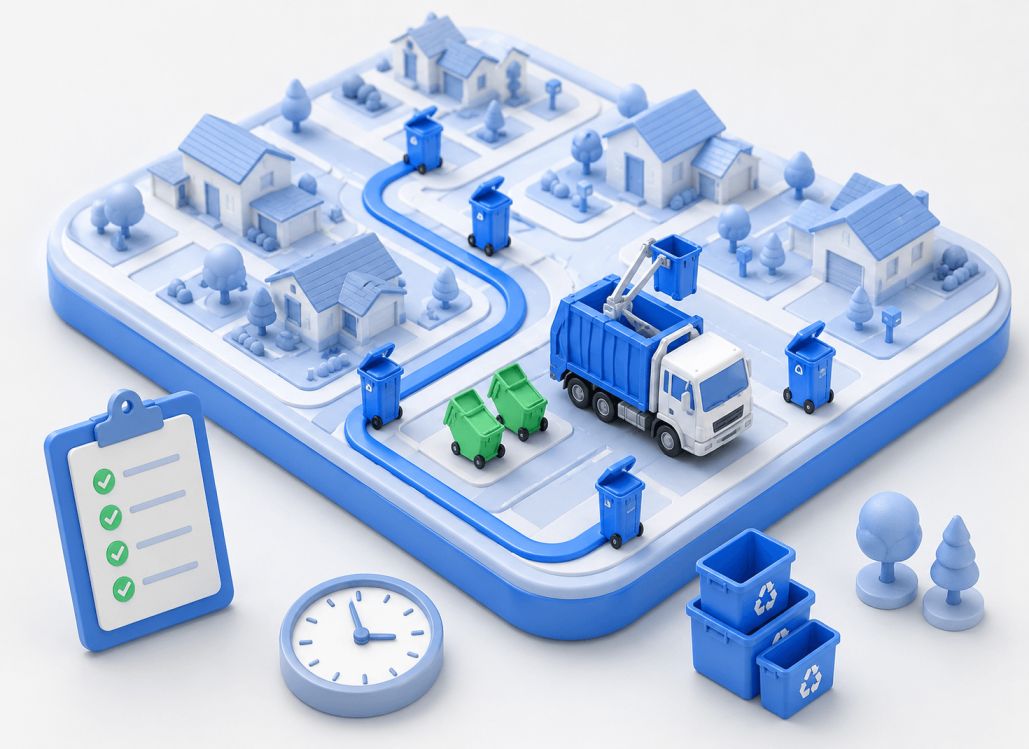
- Waste route optimization must model collection work, disposal or transfer trips, and vehicle capacity together.
- Clean service-point data and explicit frequency rules are prerequisites for a reliable route.
- Balance routes by total work time and operational difficulty, not stop count alone.
- Test proposed routes with drivers and reconcile every accepted stop after dispatch.
- Measure service reliability, route time, capacity use, changes, proof, and missed work as one scorecard.
Waste collection routes repeat, but the work is rarely identical. New accounts appear, bins move, access hours change, containers overflow, vehicles reach capacity, and a disposal trip can interrupt an otherwise compact route. When planners rely on inherited sequences and driver memory, one small change can create missed pickups, uneven workloads, and unnecessary travel.
The scale makes disciplined routing important. The U.S. Environmental Protection Agency’s 2018 materials-management fact sheet reports that the United States generated 292.4 million short tons of municipal solid waste, or 4.9 pounds per person per day. The figure is national context, not a route-level forecast, but it shows why collection capacity and reliable service matter.
Waste collection route optimization turns customer locations, service schedules, material streams, vehicle limits, driver shifts, disposal facilities, and field evidence into practical routes. This guide explains how the process works, which data and constraints it needs, how to design and test routes, how to manage recurring and exception work, and which metrics reveal whether the new plan performs better than the old one.
What Is Waste Collection Route Optimization?
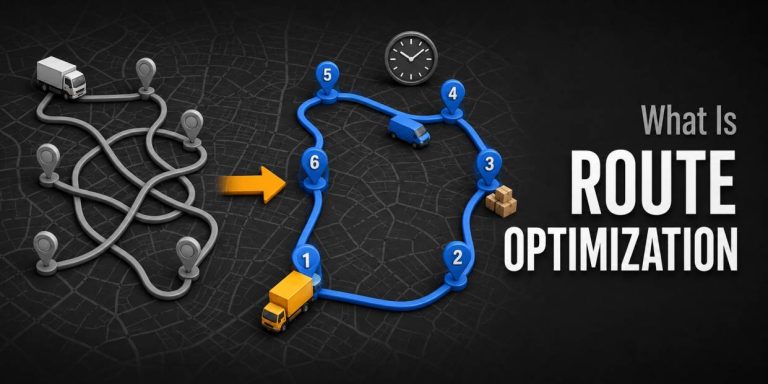
Waste collection route optimization is the process of assigning and sequencing collection stops across vehicles and crews while respecting service, capacity, shift, access, and disposal constraints.
The objective is not simply to draw the shortest line between addresses. A usable route must tell the correct crew which eligible stops to service, in what order, with which vehicle, within what time and capacity limits, and where the load should go next.
Optimization can support residential carts, commercial dumpsters, roll-off containers, recycling, organics, bulky items, cart repair or replacement, and other multi-stop waste services. Each model needs different operational fields, but the planning loop remains similar.
How Is Optimization Different From Route Planning?
Route planning defines the stops, rules, resources, and operating plan. Optimization evaluates many feasible assignments and sequences against an objective such as lower travel time or distance. You need both: accurate planning inputs and a controlled method for finding a better route.
How Is It Different From Navigation?
Navigation guides one driver between stops after the route is chosen. It does not decide how work should be divided across the fleet, whether a stop fits before disposal, or whether all service commitments remain feasible.
The distinction matters because waste routes contain constraints that a general map does not understand.
Why Are Waste Collection Routes Difficult to Optimize?
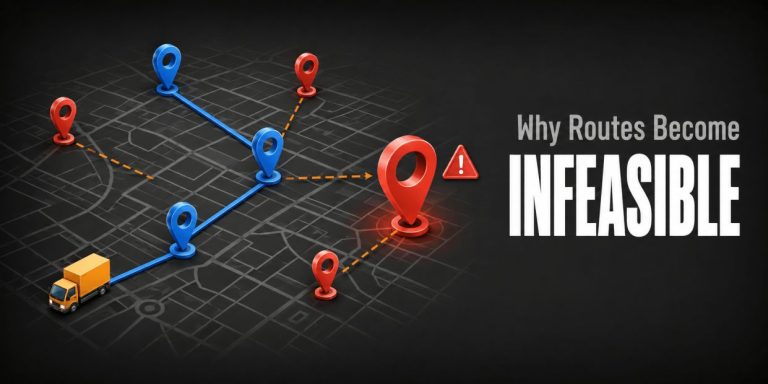
Waste routes are difficult because recurring service, uneven stop effort, material separation, vehicle capacity, access rules, disposal trips, and field exceptions interact in the same shift.
Two nearby stops may belong on different routes because they require different vehicles or material streams. Two routes with 80 stops each may have very different workloads because container sizes, set-out patterns, traffic exposure, and service methods change the time per stop.
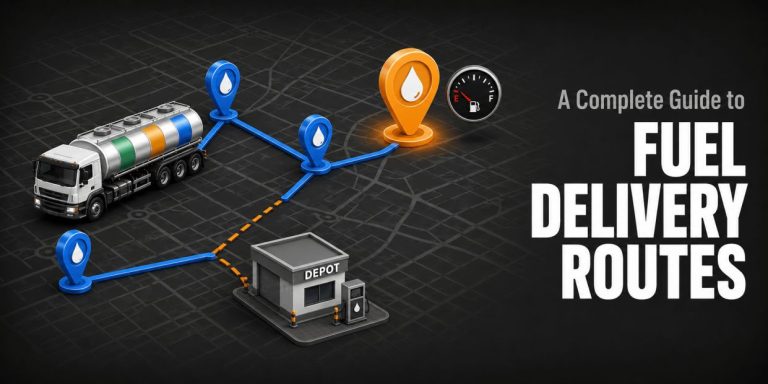
The route also has a load cycle. Once a vehicle reaches its operating capacity, it may need to visit a transfer station, material recovery facility, compost site, landfill, or yard before continuing. That interruption affects the feasible sequence and total shift time.
| Waste-routing variable | Example | Planning consequence |
| Service cadence | Weekly trash, biweekly recycling, on-call roll-off | Determines which stops enter each service date |
| Material stream | MSW, recycling, organics, bulky waste | Restricts compatible vehicles and destinations |
| Container and method | Cart, dumpster, compactor, roll-off | Changes equipment eligibility and service time |
| Access | Gate hours, alley, one-way street, school zone | Creates time or approach constraints |
| Capacity | Weight, volume, container slots, legal limit | Triggers disposal or reload trips |
| Closeout | Photo, note, exception code, signature | Defines proof and reconciliation requirements |
A useful optimization model starts by turning these operating facts into consistent service-point data.
Which Data Does Waste Route Optimization Need?
Waste route optimization needs accurate service locations, schedules, service requirements, time estimates, vehicle eligibility, capacity demand, facility rules, driver shifts, and proof requirements.
Begin with a stable service-point ID. The billing account, mailing address, and physical collection point may not be the same. Store the service entrance or collection coordinates separately so navigation reaches the place where work happens.
Use structured fields for facts that affect eligibility or sequence. Keep notes for unusual details, but do not bury service frequency, access hours, or container type inside free text that the routing process cannot filter.
What Should the Service-Point Record Include?
Include location, latitude and longitude when needed, service days or frequency, time window, expected duration, material stream, container type and quantity, estimated demand, required vehicle or skill, access instructions, contact information, priority, and completion evidence. Record whether a field is measured, contracted, estimated, or unknown.
How Should You Estimate Service Time?
Use historical timestamps for comparable stops where available. If data is missing, time a representative sample and classify locations by service pattern. Review outliers separately rather than allowing a blocked container or one-off cleanup to distort every future estimate.
How Should You Handle Bad or Missing Data?
Put invalid addresses, conflicting schedules, missing coordinates, and unassigned service types into an exception queue. Do not silently omit them from the optimized output. Assign an owner and deadline, then reconcile the queue before dispatch.
Once the records are trustworthy, define which rules the optimizer may never break and which outcomes it should improve.
Which Constraints and Objectives Should You Configure?
Configure hard constraints for service commitments and resource limits, then choose measurable objectives such as lower total time, distance, overtime, or fleet usage.
A hard constraint makes a route infeasible when broken. A preference or objective helps compare feasible routes. Separating them prevents the system from trading a contractual or safety rule for a small mileage saving.
Document each rule in plain language before configuring software. Dispatchers and drivers should understand why a stop is locked, why a vehicle is ineligible, or why a route includes a disposal visit.
| Rule type | Examples | Treatment |
| Service requirement | Correct day, time window, priority, material stream | Hard when contract or operation requires it |
| Vehicle requirement | Lift type, clearance, capacity, compactor or roll-off fit | Hard eligibility rule |
| Workforce requirement | Shift, break, license, territory, facility access | Hard or policy-controlled rule |
| Facility requirement | Opening hours, accepted material, turnaround time | Hard destination and time rule |
| Efficiency objective | Total drive time, distance, overtime, vehicles used | Optimize only after hard rules pass |
| Stability preference | Keep route ownership or familiar territories | Use as a preference with explicit exceptions |
These settings create the rules of the problem. The next job is to turn them into routes through a controlled workflow.
How Do You Optimize Waste Collection Routes?
Optimize waste routes by baselining current performance, cleaning service data, modeling resources and facilities, generating routes, validating them with field knowledge, piloting, and measuring results.
The UK’s Waste and Resources Action Programme describes route optimization as a key part of designing efficient waste and recycling collection services. Treat the process as service design, not a one-time button click. Each step should preserve accepted work and make assumptions visible.
Start with a representative zone, service type, or collection day. A bounded pilot makes errors easier to find and gives you a fair comparison with the current route.
1. Freeze a Baseline Period
For 2 to 4 comparable cycles, record planned stops, completed stops, route time, travel distance, disposal visits, overtime, missed pickups, customer contacts, proof completion, and manual route changes.
2. Clean and Classify Service Points
Resolve duplicate accounts, bad locations, unclear frequencies, missing container fields, and inactive services. Keep every unresolved accepted stop in a visible queue.
3. Model Vehicles, Drivers, and Facilities
Add shift limits, eligible vehicles, usable capacity, material compatibility, start and end locations, breaks, disposal locations, operating hours, and expected turnaround time.
4. Choose the Objective and Guardrails
Decide whether the pilot prioritizes total time, distance, overtime, route balance, or vehicles used. Lock commitments that must not move and document the threshold for accepting a change.
5. Generate and Review Candidate Routes
Use route planning to assign and sequence stops. Review the map, route timeline, unassigned work, capacity assumptions, facility visits, and the workload placed on each driver.
6. Conduct a Driver Review and Dry Run
Ask experienced drivers to flag wrong entrances, restricted turns, recurring blockage, unsafe service positions, school or traffic timing, and unrealistic service estimates. Verify critical segments in the field.
7. Pilot With Controlled Dispatch
Run the proposed routes in one area or collection cycle. Give dispatchers an override process and drivers a clear way to report blocked, contaminated, missing, or inaccessible containers.
8. Reconcile and Improve
Match every accepted stop to completed, failed, canceled, held, or reassigned status. Compare the same metrics with the baseline and update route inputs only through version-controlled changes.
The workflow produces a sound route for a defined service day. Recurring collection requires an additional scheduling layer.
How Should You Build Recurring Waste Collection Routes?
Build recurring routes from service calendars and reusable templates, then generate each operating day from the active accounts, exceptions, resources, and facility conditions.
A master route is useful, but it should not become an unchangeable list. Separate stable service definitions from each day’s operational route. This lets you add a vacation hold, missed pickup, new account, holiday shift, or vehicle absence without corrupting the underlying schedule.
Use clear cycle labels such as Week A and Week B only when every stakeholder understands the dates they represent. A dated route should remain the authoritative dispatch object for the field team.
How Should You Handle Holidays and Seasonal Volume?
Create exceptions at the schedule level and test their capacity impact before publishing routes. If a holiday compresses service into fewer days, measure whether existing shifts and disposal windows can absorb the moved stops. Seasonal yard waste or bulk pickup may need separate routes and vehicles.
When Should You Rebuild a Recurring Route?
Rebuild when growth, stop migration, service-time drift, facility changes, vehicle changes, or repeated overtime makes the current territory structurally weak. Use targeted daily changes for isolated exceptions and a formal redesign for persistent patterns.
Recurring schedules define which stops are due. Capacity and workload rules determine how those stops should be distributed.
How Do You Balance Vehicle Capacity and Driver Workload?
Balance waste routes using total route time, service effort, capacity cycles, facility visits, and shift limits rather than equal stop counts.
Eawag’s municipal solid waste collection guidance notes that fair collection areas should be compared by required time, which may not mean equal waste weight because travel time, access, and loading methods differ. The same principle applies to private and municipal fleets: balance the work the route requires, not one easy proxy.
Track both planned and actual capacity. Volume estimates may work for some material streams, while weight, container slots, or equipment-specific rules may control others. Use the limiting measure that reflects your vehicle and compliance requirements.
What Should Trigger a Disposal Trip?
Use the fleet’s approved operational threshold, not theoretical maximum capacity. Add travel to the correct facility, queue or turnaround assumptions, unload time, and the return path to remaining work. If actual loads vary widely, capture route-level load evidence and update the estimate.
How Can You Prevent Overloaded Route Tails?
Review the final third of each route for clustered complex stops, late facility visits, and hard service windows. Move compatible stops before dispatch or create an overflow rule with a named backup route. Do not rely on drivers to negotiate the entire rebalance through calls.
Balanced routes reduce predictable failure, but dispatch still needs a controlled way to manage exceptions during execution.
How Should Dispatchers Manage Waste Collection Exceptions?
Dispatchers should classify each exception, preserve its service status, choose a permitted response, communicate the change, and retain proof of the final outcome.
Common exceptions include blocked access, contamination, missing or damaged containers, excess material, vehicle failure, driver absence, facility delay, road closure, and a new urgent request. Each type should have an approved status and escalation path.
Avoid treating every exception as a route-wide reoptimization. A local skip with evidence may be the correct response, while a breakdown or disposal closure can justify reassignment across several routes.
| Exception | Immediate record | Possible controlled response |
| Blocked access | Time, location, reason, photo when permitted | Retry window, customer notice, or documented failure |
| Contamination | Material type, photo or note, policy code | Reject, partial service, or supervisor review |
| Vehicle failure | Location, remaining capacity, open stops | Reassign route or stops to eligible vehicles |
| Facility delay or closure | Facility, estimated delay, material on board | Use approved alternative or resequence work |
| Missed pickup report | Account, promised service, prior status | Verify evidence, insert stop, or resolve service record |
A controlled response ends with reconciliation. Every stop remains visible until the business can explain its final status and evidence.
Which Metrics Show Whether Waste Route Optimization Works?
Measure service reliability, route efficiency, capacity use, workload stability, exception handling, and proof completion together.
Compare a pilot with the baseline using the same service area, material stream, and operating conditions where possible. Keep system timestamps separate from driver estimates and document exclusions.
No single metric proves success. Fewer miles can hide missed pickups, and more stops per hour can hide incomplete evidence or unsafe assumptions.
| Metric | Calculation | What it reveals |
| Collection completion | Completed eligible stops / eligible stops | Whether the route covers accepted work |
| On-time service | Stops completed within rule / eligible completed stops | Whether service promises are protected |
| Plan accuracy | Actual route time minus planned route time | Where time or facility assumptions drift |
| Capacity utilization | Actual load / approved usable capacity | Whether routes use vehicles effectively |
| Route churn | Stops moved after dispatch / dispatched stops | Whether plans remain stable |
| Missed-work rate | Accepted stops without final service / accepted stops | Whether work disappears during changes |
| Proof completion | Stops with required proof / completed stops | Whether service remains auditable |
Use the scorecard to decide whether to keep, revise, or roll back the new route. Public proof can illustrate possible workflow changes, but your baseline controls the decision.
What Did WinWaste Change With Upper?
WinWaste replaced manual route building and scattered photo records with faster planning, assigned mobile routes, live visibility, and stop-linked proof.
Upper’s public WinWaste case study describes a Charlotte, North Carolina waste-services company using 5 field crew members for municipal cart replacement work. The team handled 200 to 300 stops per day and needed photos and detailed records available for up to 2 years.
The figures below are vendor-published results for this named customer. They are useful for defining a pilot scorecard, but they are not guaranteed outcomes for another waste fleet.
| WinWaste measure | Before Upper | Reported after Upper |
| Daily route-planning time | 45 to 60 minutes | Under 10 minutes |
| Photo retrieval | Hours of searching | Seconds |
| Record storage | Scattered across devices | Centralized with 2+ years accessible |
| Stops per crew member per day | 40 to 50 | 55 to 65 |
| Driver visibility | Phone-call dependent | Live GPS visibility |
| New contracts in first 2 months | Baseline | 8 additional contracts |
| Reported productivity headline | Baseline | 52% increase |
| Reported stop-output headline | Baseline | 30% more stops per crew member |
The key lesson is that route optimization and proof belong in the same operating flow. A shorter plan has limited value if the office cannot confirm what happened at each stop.
Which Waste Route Optimization Mistakes Should You Avoid?
Avoid optimizing dirty data, balancing by stop count alone, ignoring facility trips, hiding unassigned work, changing routes without version control, and measuring mileage without service quality.
Most failed pilots are not caused by a weak map. They come from incomplete service records, undocumented assumptions, or field workflows that do not preserve changes and completion evidence.
Use a pre-dispatch checklist and an end-of-day reconciliation so the same controls apply even when the dispatcher or driver changes.
Treating the Historical Route as Ground Truth
Driver knowledge is valuable, but inherited routes may include old accounts, territorial habits, and inefficient crossings. Capture the useful site knowledge, then test the sequence against current data.
Optimizing Around One Average Service Time
Different container, access, and set-out patterns require different estimates. Use service classes and review outliers instead of assigning one duration to every stop.
Dropping Infeasible Stops
An optimizer should surface unassigned work and the reason. Never publish only the attractive routes while accepted stops remain hidden outside the plan.
Skipping Driver Validation
Drivers often know access restrictions and recurring obstacles that the database lacks. Review the candidate route and correct the data before using a manual workaround as permanent policy.
Avoiding these mistakes creates a fair test of both the routing model and the software workflow that supports it.
Conclusion: How Can Upper Support Waste Collection Route Optimization?
Upper connects stop import, multi-driver route optimization, dispatch, field visibility, route updates, and proof of delivery in one workflow.
Use Upper’s waste management routing solution to organize multi-stop collection work. The documented route-creation workflow lets you import stops, assign drivers, optimize for time or distance, review routes, and share them to the driver app.
For fleet plans, Upper’s multi-driver planning documentation explains how work can be distributed and sequenced across selected drivers with different workload modes. Connect the route with GPS tracking and proof of delivery so the office can monitor progress and retain stop-level evidence.
Test Upper with one representative collection day, including a disposal trip, one capacity constraint, one blocked stop, and the proof required by a customer or municipality. Compare the output and closeout record with your current baseline.

See it in action
See how your waste routes perform as one workflow
Bring your stops, schedules, vehicles, facility rules, and one difficult exception. Verify the plan from optimization through proof.

To evaluate the workflow with your own waste collection data, book an Upper demo.
What Are the Frequently Asked Questions About Waste Collection Route Optimization?
These answers cover route frequency, optimization goals, capacity, recurring routes, driver knowledge, and implementation.
Use them to align fleet managers, dispatchers, drivers, customer-service teams, and technical owners before a pilot.
Your configuration should reflect your contracts, local requirements, material streams, facilities, vehicles, and workforce rules.
What Are the Frequently Asked Questions About Waste Collection Route Optimization?
Review routes whenever service demand, locations, schedules, vehicles, facilities, or performance change materially. Generate each dispatch day from current work, but reserve full territory redesign for persistent structural changes.
There is no universal objective. Choose the measure that fits the pilot, such as total route time, distance, overtime, fleet use, or balanced workload, while protecting hard service and capacity rules.
Yes, when the workflow models capacity thresholds, eligible facilities, opening hours, expected turnaround, and the vehicle’s path back to remaining work. Validate the assumptions with actual event data.
Driver familiarity can be a useful preference, especially where access is complex. Keep it flexible enough to cover absences and rebalance workload, and make site knowledge available to any trained replacement.
No. Software can evaluate assignments and sequences using recorded rules. Drivers and supervisors must help identify access restrictions, site hazards, realistic service time, and field exceptions so those facts enter the model.
Allow enough time to capture a stable baseline, clean data, run representative collection cycles, and compare results. A small bounded pilot may take several cycles, while a territory redesign across multiple service streams will take longer.