

- In the worked example below, the cheapest option ($120 second trip) misses the 4:00 p.m. deadline. The cheapest option that makes it is a $62 reassignment.
- That $62 plan fails if depot collection runs 20 minutes long. The $152.80 extra vehicle is then the only option that still arrives on time.
- With the example rates, an extra vehicle beats a second trip only once the second trip adds about 66 more minutes.
- Count every cost once, in the same units, and count only costs the decision actually changes.
Second trip vs extra vehicle: which handles delivery overflow better? A second trip sends the same driver and vehicle back out after returning and reloading. An extra vehicle adds another run, usually with another driver. Pick the option that can still meet every delivery commitment, then compare what each one adds in cost.
Before adding either run, check whether an existing route can take the overflow. Route optimization software can compare the route changes, but spare space alone is not enough. The goods must be reachable, the vehicle suitable, and the revised route finishable.
When a second trip works
A second trip fits when the original driver can return, reload, and finish the overflow before the last commitment. It avoids finding another driver and keeps a familiar route. It works best when the depot is close, loading is quick, and the deadline leaves slack.
Count the whole added journey: the drive back to the depot, the reload, the overflow deliveries with their service time, and the final return. Loading queues can push the plan past a deadline even when the miles look small.
Check the driver’s shift too. A second trip adds paid time at the end of the day, so confirm the driver has the hours left under your shift rules and any local driving-hours limits before you count on it.
A second trip also doesn’t double the day’s distance. Measure the added journey against the route the driver would have finished anyway.
When an extra vehicle works
An extra vehicle can start the overflow before the first driver is back. Check the driver, vehicle, loading slot, and required equipment together. A spare vehicle with no available driver is not an option.
For today’s decision, include only the costs the extra vehicle creates: a rental or day charge, added paid hours, fuel, and tolls. Insurance or registration you pay either way is not a new cost just because the vehicle runs today.
An extra vehicle is easiest to justify when the overflow is large. Its fixed day charge is spread over more stops, and it can run alongside the first driver instead of after them.
When a larger vehicle works
A larger vehicle is a separate option. Swapped in before departure, it can carry the full load in one run with one driver. Check access restrictions, equipment, loading, and route timing. A bigger load doesn’t remove service time, and swapping vehicles after departure adds its own transfer work.
Price it with the same formula as the other options, using its own running cost and any rental charge.
When you can reassign the overflow
Before departure, you may be able to load the overflow onto another route that has room. After departure, the receiving driver needs the goods in hand, through a depot visit or an approved transfer. Reassigning a stop on a screen does not move the parcels.
Added stops also use up time, capacity, or equipment on the receiving route, even if there is nothing to collect. Check them against that route’s existing work. A route can fit its vehicle and still miss a customer window. Google’s capacity-constrained routing example and time-window routing example show why load and timing are separate checks.
Other ways to clear the overflow
Two more options can beat all of the above on a given day:
- Third-party or on-demand courier. Hand the overflow to an outside carrier. Check that it can take the goods in time, that your service standards still apply, and what it charges per stop. Add your own handoff time (staging, labeling, tracking) to the quote.
- Delay the non-urgent stops. If some customers have flexible windows, moving them to the next run can remove the overflow. Confirm each customer agrees and count any rebooking effort.
Both go through the same two checks as the rest: feasibility first, then incremental cost.
Compare costs on the same basis
For a short-term choice, compare only the future costs that differ between options. This follows the relevant-cost principle explained by OpenStax. Buying a vehicle needs a wider analysis than one day’s overflow.
Use this formula for each feasible option:
Additional cost = added miles × variable vehicle cost per mile + added paid hours × applicable hourly labor cost + other incremental charges
- Added miles: extra distance the option creates, not the full route.
- Variable vehicle cost per mile: fuel, wear, and similar per-mile costs. Exclude driver pay and fixed costs if you count them elsewhere.
- Added paid hours: extra hours that change payroll, converted from minutes (minutes ÷ 60).
- Other incremental charges: rental or day charges, tolls, courier fees, handling.
Use the actual extra cash labor cost when judging immediate spending. If a driver is already paid and payroll won’t change, show that time separately as resource use, not as a saving. If covering the overflow displaces other work, record that lost contribution separately too.
If you would knowingly accept a late delivery, add its expected cost (refund, penalty, redelivery, or a lost customer) as another incremental charge. The example below treats the deadline as fixed, so lateness is not priced.
| Option | Miles and time to include | Other charges to check |
| Second trip | Depot return, reload, overflow driving, service, waiting, final return | Overtime, hours-limit impact, special handling |
| Extra vehicle | Its full run, plus the driver’s preparation and service time | Rental, day charge, minimum paid shift, tolls |
| Larger vehicle | The single combined run, plus loading and access time | Rental or upgrade charge, tolls |
| Reassignment | Collection or transfer, detour, service, and the receiving route’s return impact | Transfer handling, displaced work |
| Courier | Your handoff time and any collection wait | Per-stop fee, minimums, surcharges |
| Delay stops | Rebooking effort and customer contact | Goodwill or service-level cost |
If a per-mile rate already includes driver pay or allocated fixed costs, remove those parts or stop adding them separately.
A worked overflow comparison
This is an illustrative USD example, not a price quote, customer result, or benchmark. Assume 8 overflow stops, goods ready at the depot, and a 4:00 p.m. deadline for the final delivery. Vehicle suitability, load, route order, and individual customer windows are already checked for each option. Reassignment assumes the receiving driver collects the goods at the depot.
For this example only: labor is $30 per hour of added paid time, vehicle running cost is $0.60 per added mile (excluding labor and fixed costs), and an extra vehicle has a $70 incremental day charge.
| Option | Added miles | Added paid time | Other charge | Total |
| Second trip | 50 | 180 minutes | $0 | $120 |
| Extra vehicle | 38 | 120 minutes | $70 | $152.80 |
| Reassignment with depot collection | 20 | 100 minutes | $0 | $62 |
Second trip: 50 × $0.60 + 180 ÷ 60 × $30 = $120.
Extra vehicle: 38 × $0.60 + 120 ÷ 60 × $30 + $70 = $152.80.
Reassignment: 20 × $0.60 + 100 ÷ 60 × $30 = $62.
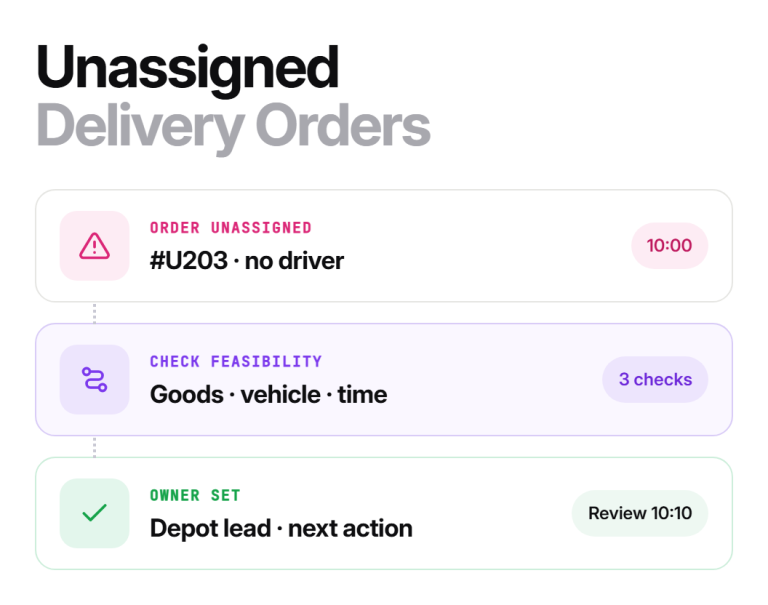
Now apply the timing check. Suppose the second trip’s last delivery finishes at 4:20 p.m., the extra vehicle’s at 3:20 p.m., and the reassignment’s at 3:45 p.m. The second trip misses the deadline even though it costs less than the extra vehicle. Reassignment is the lowest-cost option that makes it.
Sensitivity 1: collection runs long. If depot collection takes 20 minutes longer, the receiving route’s last delivery moves to 4:05 p.m. and reassignment fails too. The extra vehicle ($152.80) is now the only option that arrives on time. Pay for it, or agree a new commitment with the customer before release.
Sensitivity 2: the deadline moves to 4:30 p.m. The second trip now fits at $120, but reassignment is still cheaper at $62. A looser deadline changes which options are feasible, not their cost order.
Break-even rule. At these rates, each added minute of paid time costs $0.50. The extra vehicle costs $32.80 more than the second trip, so the second trip would need to add about 66 more minutes (65.6, from $32.80 ÷ $0.50), roughly 246 minutes in total, before the extra vehicle becomes the cheaper of the two. Run the same arithmetic with your own rates.
Scale matters. With only a few stops, an extra vehicle’s fixed day charge is hard to justify. With a large overflow, the single run and the early start tend to favor it. Always check feasibility first, then rerun the numbers.
Record the decision before dispatch
For each option, keep these inputs:
- The affected order IDs and where the goods are located.
- Vehicle and driver availability, suitability, and remaining hours.
- Added route miles and the full time breakdown.
- Each customer deadline and the estimated completion time of each stop.
- Cost rates, their units, and which components they include.
- The chosen option, who approved it, and which customer or driver updates are still needed.
Upper’s automatic driver assignment helps you see which eligible drivers and vehicles can take the work and how it affects their schedules. It does not choose between options on cost, and arrival windows are preferences, not guarantees. It also does not check whether a mixed load fits a vehicle by combined weight, volume, and compartments, so verify that yourself.
For overflow caused by a driver who can’t complete the route, use the driver recovery guide to plan the physical transfer of goods. A dispatcher should review any recovery suggestion before the plan changes in the field.
Check whether overflow is becoming a planning problem
If you needed overflow cover on three or more days in a week, treat it as a planning problem, not a daily scramble. Review demand, load measurement, route boundaries, service duration, and loading cutoffs. Keep logging the daily costs, and compare longer-term fixes such as rebalanced routes, another shift, or a different vehicle.
That longer-term decision includes ownership, maintenance, staffing, and idle capacity on quiet days. The lowest cost today doesn’t automatically make the best fleet plan. Use route management analytics and your own cost records to compare like-for-like work over time.
Choose a feasible run before the cheapest run
Build the full route and handling plan, check it against every commitment, then price the options that remain. You will then have a decision you can explain when the same overflow returns tomorrow.
Comparing six options by hand across eight stops is where planning software saves time. Bring one overflow day, with its real loads and deadlines, to see how it works in Upper. Book an Upper demo.
Frequently asked questions
No. It is cheaper only when its added miles and paid time cost less than the extra vehicle’s run plus day charge, and it still meets the deadline. In the example above, the second trip cost less but finished at 4:20 p.m., after the 4:00 p.m. deadline.
Use an extra vehicle when the second trip can’t finish in time, the driver has no hours left, or the overflow is large enough to spread the day charge. With the example rates, it also wins once the second trip adds about 66 more minutes.
Yes, if the goods can reach that driver through a feasible collection or transfer and the revised route still works. Include the transfer in both the time and the cost.
Reassign stops to a route with room, send the non-urgent stops on a later run, delay flexible customers, or pass some stops to a courier. Each must pass the same feasibility check before you compare costs.
Only if the decision changes it. An extra rental or coverage charge matters today. A premium you pay either way does not change the immediate cash comparison. Include ongoing ownership costs when you evaluate a longer-term fleet change.
It depends on your rates. For one day’s decision, count the rental or day charge, added paid hours, fuel, and tolls. Use the formula above with your own inputs.