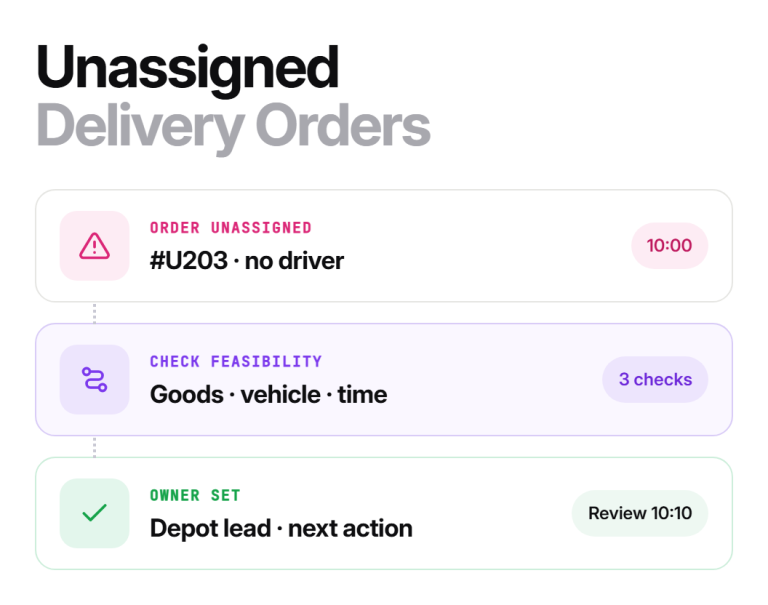


- Rules can use current data and respond automatically to events.
- Mathematical optimization can assign work across vehicles as well as sequence stops.
- Machine learning is one possible component, not a requirement for every dispatch calculation.
- Keep eligibility requirements, ranking preferences, and approval policy separate.
Rule-based dispatch applies explicit decision logic, such as assigning an eligible driver from the order’s territory. Products described as AI dispatch may combine those rules with optimization, prediction, or other models to compare assignments. The useful distinction is what each system checks, how it responds to change, and who approves the result.
If you are evaluating AI dispatch software, test it against your current process. The AI label alone does not establish machine learning, better assignments, or reliable automation.
What the approaches actually compare
| Approach | How it makes a decision | What to inspect |
| Explicit rules | Applies configured conditions and tie-breaking logic | Rule order, missing-data behavior, conflicts, fallback |
| Optimization | Searches possible assignments against constraints and an objective | Supported constraints, objective, feasible result, unassigned work |
| Predictive model | Estimates an input or outcome from data, such as travel duration | Training scope, validation, error, data freshness |
| Combined system | Connects rules, calculations, and approval steps | Each component’s role and the end-to-end decision record |
These approaches can coexist. Google’s vehicle-routing documentation describes solving multi-vehicle routing problems with restrictions such as capacity and time windows. That is broader than choosing the order of stops already assigned to one driver.
Do not assume all AI dispatch is probabilistic or all rules are static during the day. A deterministic rule can react to a newly recorded absence. An optimizer can use a fixed set of inputs without learning from historical outcomes. Results depend on the actual implementation, configuration, and inputs.
Where explicit rules work well
Rules are useful when your operating policy is clear and the exceptions are manageable. For example, you might first filter for a required qualification, then for availability, and then choose the eligible driver with the shortest estimated travel.
With fixed logic, complete identical inputs, and a defined tie-breaker, that decision is repeatable. To make it auditable, the system must also record the inputs and the rule that determined the assignment. Repeatability alone does not create a usable audit trail.
Rules can become difficult to maintain when many conditions interact. Adding a territory exception might affect workload elsewhere. Two rules may conflict, or the first eligible assignment may prevent a better combination later. Those are reasons to test a different method, not proof that all rule-based tools fail on changing work.
Where optimization or prediction can help
Optimization is useful when a local choice has consequences elsewhere in the schedule. The nearest eligible driver may be a poor choice if accepting one stop delays several existing commitments. Comparing whole-route effects can expose that tradeoff.
A predictive model may improve an input such as expected service time. That prediction still needs evaluation on relevant work. A prediction of duration is not the same as a decision that an assignment is feasible.
Ask the vendor to explain the objective it is trying to improve. Minimizing travel, balancing workload, and prioritizing urgent work can produce different plans. Also ask what happens when no valid plan exists. A system should expose that limit rather than disguise it with a confident recommendation.
A three layer decision policy
You can design a dispatch policy around 3 separate questions:
- Eligibility: Can this driver and vehicle perform the work under the requirements that must hold?
- Ranking: Among eligible options, which best fits the route and business priorities?
- Approval: May the system release this decision, or does a named person need to review it?
This is a practical design framework, not a claim that every production system uses the same architecture. It helps you diagnose a bad recommendation. The problem could be an incorrect driver record, an unsuitable ranking objective, or an approval policy that allowed too much.
Keep required customer commitments distinct from software preferences. If your business has promised a deadline, the fact that a product models a preferred arrival window does not authorize missing it.
A test that reveals the difference
The following is an illustrative evaluation case, not an Upper result. A new job requires a specified qualification and has a 30-minute service duration. You have already reserved the drivers’ existing commitments and included any required return travel in their remaining-time budgets.
| Candidate | Qualification | Added travel and service | Free time budget | Result |
| Driver A | Missing | 10 + 30 = 40 minutes | 80 minutes | Ineligible |
| Driver B | Present | 25 + 30 = 55 minutes | 50 minutes | Does not fit the budget |
| Driver C | Present | 40 + 30 = 70 minutes | 90 minutes | Candidate for full route and window check |
A nearest-driver rule that ignores qualifications selects A incorrectly. A better rule that filters eligibility first rejects A and checks B and C. Optimization may also identify C, but the correct result is not exclusive to a product called AI.
Now change C’s available time to 60 minutes. None of the candidates fits the simplified requirements. A useful tool keeps the work unassigned and explains the problem. Do not award a higher evaluation score to a system merely because it always produces a driver’s name.
Complete the test with actual locations, sequence, windows, load, and data freshness. The table screens candidates; it does not prove a complete route is feasible.
What Upper shows at the approval boundary
Upper’s automatic driver assignment page describes suggestions with reasons, proposed timing, estimated travel, and a confidence score. Routine suggestions above your configured threshold can be accepted by Autopilot. Critical conflicts stay out of automatic acceptance, and recovery changes require dispatcher review.
Treat the score as a review aid. It does not prove an assignment meets a requirement missing from the input or establish a calibrated probability of success. Upper considers preferred arrival windows and flags deviations; those windows are not guarantees.
Use the field service automation guide for implementation steps and the manual-versus-AI dispatch comparison when your starting point is a dispatcher using a spreadsheet. Neither comparison requires reducing route optimization to sequencing alone.
Decide with a matched pilot
Give each method the same orders, resource records, requirements, and updates at the same point in time. Include a routine day and the exceptions that cost your team time. Record input preparation, review, corrections, unassigned work, and driver confirmation as well as calculation time.
Use route management analytics and your incident records to compare outcomes where the necessary data is available. Keep an explicit list of manual checks the software cannot perform. Their time belongs in the evaluation.
Keep the current rules if they produce valid plans at an acceptable effort. Test optimization or assisted dispatch when interacting requirements create repeated comparison and rework. Expand automatic approval only after the bounded workflow performs acceptably under your own acceptance criteria.
Choose the decision process you can verify
The strongest comparison asks whether a system makes feasible assignments and exposes the cases it cannot resolve. A named product category cannot answer that for your operation.
Bring your rule list, a conflicting assignment, and an impossible case to the evaluation. Book an Upper demo.
Frequently asked questions
No. The label may cover optimization, prediction, explicit rules, or a combination. Ask which component learns, which data it uses, and how its outputs are validated.
Yes, if it receives the availability update and has appropriate reassignment and exception logic. Test its behavior when no eligible replacement exists and when the change affects other commitments.
Reject or hold it when input data is wrong, a required check is missing, the goods cannot reach the proposed driver, or the revised plan breaks a commitment. Record the reason so the underlying data or policy can be corrected.