


- Define the actual purchase before calculating a return: assignment software alone, a routing-and-dispatch setup, or a replacement for existing tools.
- Price a normal month and your busiest month using the same users, orders, messages and included features.
- Separate avoidable cash costs from staff time released for other work.
- Count each saving once and credit only the improvement over your current workflow.
- Calculate payback only after the full quote and one-time costs are known; include payment timing when estimating cash payback.
AI dispatch software cost depends on the billing unit, included assignment functions and the tools needed to carry out the plan. Compare the complete proposed setup with what you use today. A routing subscription is not automatically the full dispatch cost, and a separate AI engine does not always require replacing your existing software.
This guide helps you request a comparable quote, identify hidden costs and test whether the incremental purchase can pay back. For the broader measurement process, see Upper’s guide to calculating AI dispatcher ROI.
How is AI dispatch software priced?
AI dispatch quotes commonly include recurring charges. Check the contract for the billing period, minimum commitment and usage allowances. AI dispatch is software that decides which driver or crew takes each job. It checks rules like skills, vehicle fit and working hours, then re-decides when the day changes. Upper’s explainer on what AI dispatch is covers the category in more depth.
The billing unit is the thing a vendor counts to set your bill. Vendors use five common units:
| Billing unit | How the bill grows | Watch for |
| Per user or per driver | With headcount | Whether dispatchers and drivers both count as paid users |
| Per order | With order volume | The price per order once you pass the included volume |
| Per stop with overage | With stops above the plan allowance | The overage rate, which is the charge for each stop over your allowance |
| Flat platform fee | Stays flat until you change tier | Which features push you into the next tier |
| Quote only | Set in the contract | Renewal terms and the price of adding drivers |
The billing unit matters more than the headline rate. Two teams with the same fleet can get very different bills. One may run a few large orders, and the other many small stops. Compare the cost of your busiest month, not your average one.
What does Upper AI Dispatcher cost?
Upper AI Dispatcher is quoted for your workflow. Confirm which assignment and recovery functions are included, the setup or data-connection work, messaging charges and support.
Upper Crew has its own scope and pricing information. Do not assume the AI Dispatcher quote always sits on top of a Crew plan. Establish whether the proposal is standalone, works alongside your current tools, or includes a wider replacement. Get that scope in writing.
Use the same quote request for every vendor
| Quote field | What to specify | What the answer must clarify |
| Workload | Normal and peak orders, stops, drivers and dispatch users | Which units are billed and what triggers an overage |
| Assignment | Required skills, equipment, territories and availability | Included rules, exceptions and plan restrictions |
| Execution | How drivers receive routes and customers receive updates | Which product supplies each function |
| Data flow | Source system, import method and update frequency | Supported connection, setup work and ongoing owner |
| One-time work | Import, configuration, training and parallel running | Vendor charges and internal staff effort |
| Contract | Payment dates, renewal, cancellation and expansion | Upfront cash needed and future cost changes |
Compare like-for-like proposals. A lower subscription that excludes a required function is not a lower-cost equivalent.
What does the AI dispatch fee pay for?
The fee should pay for the assignment and review functions listed in the proposal. Routing tools can also assign stops, so identify which additional capability you are purchasing: eligibility checks, automatic routine decisions, explanations or reviewed recovery.
According to Upper’s product pages, AI Dispatcher:
- Checks skills, certifications, equipment, vehicle fit, working hours, time off, job limits and capacity before it assigns a stop. See skill-based driver assignment for the full rule set.
- Evaluates same-day orders and suggests recovery when drivers are absent or routes fall behind, subject to available eligible capacity. A dispatcher reviews each recovery change before it applies.
- Shows a confidence score with its reasoning. The score describes match quality. It is not a probability of on-time arrival.
- Accepts routine matches through Autopilot only above a confidence threshold you set. Upper explains how the confidence threshold works with an example.
- Never auto-accepts critical conflicts, such as overlapping jobs or impossible travel gaps.
- Shows the blocking reason when no eligible driver can take a stop, so the stop stays visible.
Preferred arrival windows are preferences, not promises, and Upper flags significant deviations for review. A customer’s firm deadline still needs your own check.
Which benefits count as cash savings?
Use your own baseline and expenses. A reduction in planning time is useful even when it does not reduce a bill, but it belongs on a separate capacity line.
| Benefit | Count as cash savings when | Otherwise record |
| Dispatcher time | Overtime, temporary labor or other actual spend falls | Hours available for other work |
| Driver time | Paid overtime or contracted hours can be avoided | Additional available working time |
| Vehicle miles | Fuel and other costs that vary with those miles are avoided | Operational mileage change, separate from fixed vehicle costs |
| Repeat visits | An identifiable expense or refund is avoided | Service-quality improvement |
| Replaced software | A current subscription can actually be canceled | No saving until the commitment ends |
Do not count repeat-visit labor and mileage again if they are already in the hours and miles buckets. An IRS mileage allowance is not a measurement of your fleet’s avoidable cash cost. Use records appropriate to the calculation; Upper’s cost-per-mile guide explains the wider cost categories.
If you already use route optimization, the baseline includes those gains. Credit only the additional improvement from the proposed setup. Revenue from extra jobs is separate from cost savings; use its incremental contribution after the cost of fulfilling that work.
How do you calculate incremental payback?
Define the following amounts for the complete proposed purchase:
- B: Monthly avoidable cash costs, including any retired subscriptions, supported by the baseline and pilot.
- C: All new recurring cash costs, including software, required add-ons and ongoing outside support.
- S: One-time incremental cash outlay, including setup invoices and any additional paid labor.
Net monthly cash benefit = B − C. If this is positive and steady, a simple payback estimate is S ÷ (B − C) months. If it is zero or negative, there is no payback from those cash savings at that cost.
Track internal setup hours separately when they use existing salaried capacity without changing payroll. Include them in an economic evaluation if useful, but label that result separately from cash payback.
Worked worksheet with explicit assumptions
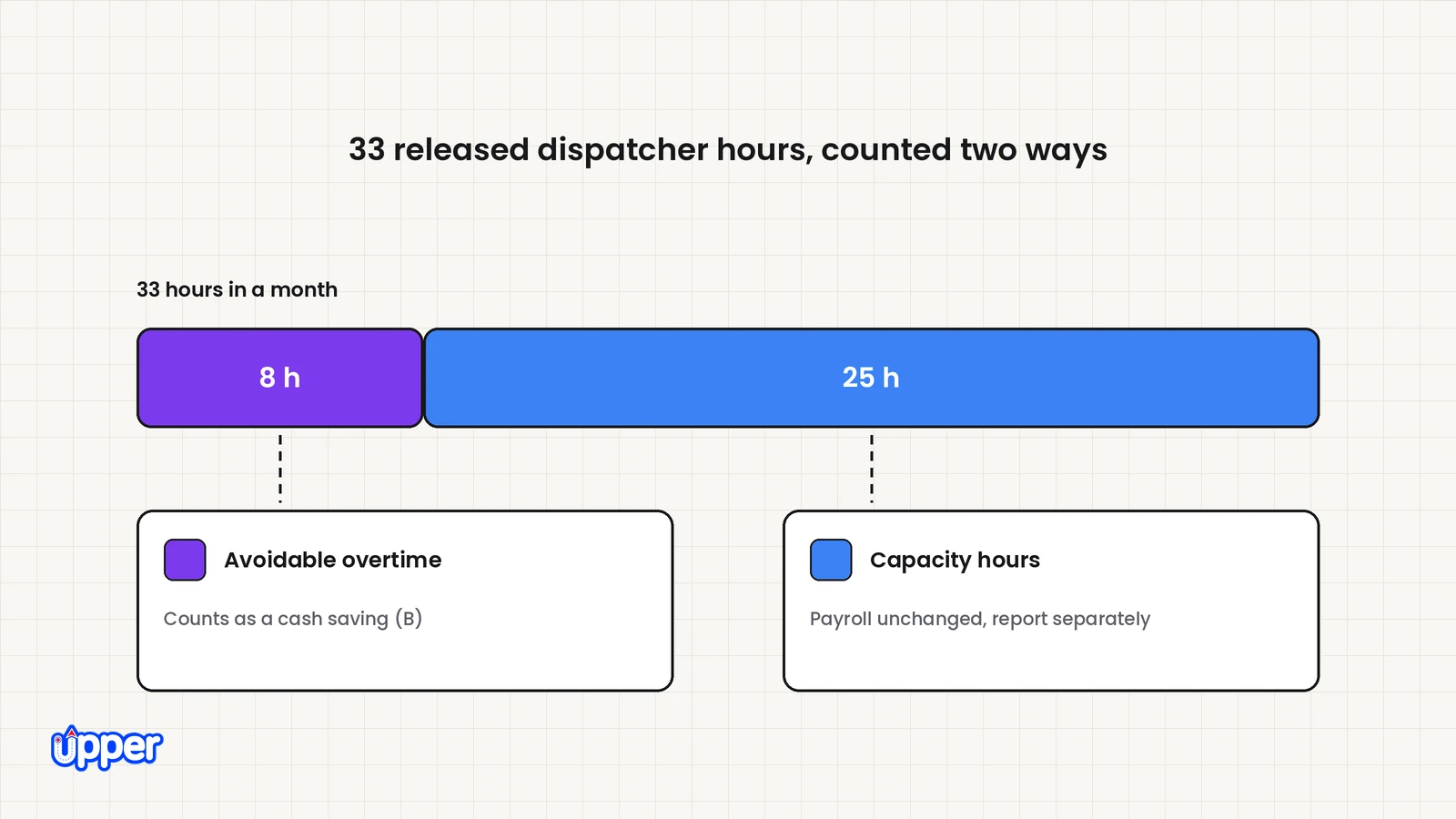
This is an illustrative scenario, not a customer result or a prediction of Upper savings. A pilot is assumed to show 33 dispatcher hours released in a month. Of those, 8 hours avoid paid overtime; the other 25 hours leave payroll unchanged. It also avoids 600 vehicle miles and 4 customer compensation payments. The compensation bucket excludes labor and mileage already counted.
Let L be the avoidable overtime cost per hour, V the avoidable vehicle cost per mile, and F the average compensation payment actually avoided. These come from your records, not a vendor price estimate.
| Scenario | Monthly avoidable cash costs B | Capacity benefit reported separately |
| Pilot assumptions hold | 8 × L + 600 × V + 4 × F | 25 dispatcher hours |
| Half the assumed improvement | 4 × L + 300 × V + 2 × F | 12.5 dispatcher hours |
| No measured improvement | 0 | 0 |
For each scenario, enter all new monthly recurring cash costs as C and one-time incremental cash outlay as S. Net monthly cash benefit is B − C; when that is positive and steady, simple cash payback is S ÷ (B − C) months. Until those amounts are known, the worksheet has no numeric payback result. The separate capacity benefit can still be valuable, but it must not be added to the cash total as though payroll had fallen.
What is the maximum quote that meets your target?
If the proposed AI fee is Q and all other new monthly costs are K, then C = K + Q. For a target of T months, the steady-state ceiling is Q = B − K − (S ÷ T). A zero or negative ceiling means the assumed cash savings cannot support a positive fee within that target.
Use the lower-benefit scenario as well as the expected one. This ceiling is a screening calculation, not an approved budget or evidence that the proposed product will produce B.
How do annual billing and ROI change the calculation?
For annual prepayment, use a month-by-month cash schedule: record the upfront invoice when paid and savings as they are expected to occur. Cash payback is the first point when cumulative incremental cash benefits cover cumulative incremental outlays. Dividing an annual invoice by 12 can help compare subscriptions, but it does not represent payment timing.
For a simple first-year cash ROI, divide first-year incremental cash benefits minus first-year incremental cash outlays by first-year incremental cash outlays. Include all required upfront and recurring payments. If the denominator is zero, that percentage is not meaningful. Label assumptions about ramp-up, seasonality and continuing savings.
Is software a substitute for hiring a dispatcher?
Evaluate the work that changes, not an entire salary by default. Upper AI Dispatcher handles routine assignment decisions and suggests recovery changes; people still resolve exceptions and communicate with drivers and customers.
If a pilot supports deferring a planned hire, document the workload, service level and timing that make that deferral realistic. Otherwise, report time released and how the team will use it. Do not describe unchanged payroll as cash saved.
Where do hidden costs show up in AI dispatch pricing?
Hidden costs sit in the terms around the headline rate. Check each one before you run the payback math:
- Annual billing. Check the required upfront payment, renewal date and whether a monthly equivalent conceals annual prepayment.
- Overage. Confirm included orders or stops, how excess usage is counted and when it appears on the invoice.
- Customer texts. SMS is often priced outside the base plan. Upper’s breakdown of delivery notification SMS costs explains why real per-text costs run higher than advertised rates.
- Feature tiers. Proof of delivery, recurring routes or skill-based assignment may need a higher tier or a paid add-on.
- Quote scope. Confirm whether the proposal is standalone or requires other subscriptions. Include only the combination you actually need.
- Your team’s time. Setup, data import and training cost real hours, even when no invoice covers them.
Ask every vendor for the cost of your busiest month. That is the month the ROI has to survive.
Do you need a new product or a better current workflow?
Check the recurring failure before requesting a larger setup. Your current routing product may already support driver assignment and live changes. If accurate records and a workflow adjustment solve the problem, use that as the baseline alternative.
For stable work with few interacting rules, a spreadsheet-based dispatch workflow may remain suitable. A new product needs to justify the additional capability, cost and review effort, not just replace a familiar tool.
What should each operation measure first?
Use these as starting hypotheses for your baseline. The table identifies work to measure, not promised savings for each industry.
| Operation type | Main savings driver | Measure first |
| Same-day delivery and courier | Re-sequencing live routes and placing late orders | Miles and stops per driver-day |
| Waste collection and snow removal | Rebalancing crews after a breakdown or storm | Missed stops and repeat trips |
| Route-based service (pool, pest, maintenance) | Fewer “what’s next” calls and better on-time service | Dispatcher hours and call volume |
| B2B distribution | Balancing workload across recurring routes | Stops per driver-day and overtime |
How can you evaluate Upper’s proposal?
Upper is route planning, route optimization and AI dispatch software for multi-stop delivery, collection and service teams. Ask Upper to demonstrate the quoted assignment and recovery functions using your stop list, driver schedules and one difficult case. Confirm how the proposed setup receives current data and sends an approved decision to the people carrying out the work.
Autopilot can accept routine matches above your chosen confidence threshold. Critical conflicts are not accepted automatically, and recovery suggestions require review. A confidence score is not an on-time probability. Preferred arrival windows are preferences, so validate any immovable commitment separately.
Use the demonstration to identify functions and data requirements. Use a controlled pilot and your own expense records to estimate the return.
What has an Upper customer reported?
PoolPros is a pool maintenance company with 14 technicians. It moved to Upper route planning, route scheduling, live GPS tracking and proof of delivery. The PoolPros customer story reports these results:
- Morning route planning fell from over 2 hours to 15 minutes.
- Technician calls to dispatch fell from 30 to 40 a day to 2 or 3.
- On-time service rose from 61% to 93%.
- Missed or skipped stops fell from 10 to 15 a week to 1 or 2.
These results were reported by the customer. They are not from a controlled study and are not a guarantee. The story covers route planning and does not name AI Dispatcher. It does show which savings to measure in route-based service: planning hours, call volume and missed stops.
What should you bring to an AI dispatch pricing call?
Bring a real day, not a feature list:
- A busy day’s stop list. It shows what your heaviest volume costs under each billing unit.
- Your hardest rule. For example, the certification only two technicians hold, or the van that cannot take a full load.
- One real disruption. For example, the 6 a.m. call-out, the 10 a.m. rush order or the van that breaks down at noon.
- Your cost worksheet. Bring current expenses, payment timing and a conservative savings scenario. Calculate a quote ceiling only with supported inputs.
A demonstration can clarify scope and workflow. It does not establish the savings your team will realize.

See it in action
See what AI dispatch would cost for your team
Bring a busy day's stop list and your hardest rule, and watch AI Dispatcher work through it.

Frequently asked questions about AI dispatch software cost
It depends on the billing unit, usage and included functions. Request a complete quote covering assignment, any required routing or execution tools, setup, data connections and messaging. Upper AI Dispatcher is quoted for the proposed workflow.
Confirm whether the vendor bills drivers, dispatch users, orders or stops. Supply normal and peak volumes and ask which features and add-ons are required. Driver count alone does not establish the total or whether a separate routing subscription is necessary.
For steady monthly cash flows, divide one-time incremental cash outlay by avoidable monthly cash costs minus all new monthly costs. The denominator must be positive. Use a cash schedule for annual prepayment or uneven benefits. No numeric result is valid until the complete quote and savings assumptions are supported.
Only if the saved time changes paid overtime, contractor spend, staffing or another avoidable expense. Otherwise it releases capacity for other work. Report that benefit separately from cash savings.
Ask for billing units, normal and peak usage, included functions, required subscriptions, setup, data-connection work, messaging, support and renewal terms. Confirm payment dates and cancellation commitments. Compare the complete proposal against your current workflow.
Yes. Upper Crew has a 7-day free trial with Professional plan features, excluding SMS customer notifications, and no credit card is required. Upper Solo, the single-driver app, has a 3-day free trial. AI Dispatcher is priced by quote, so the way to test it is a demo. Bring your own stop list, your hardest scheduling rule and a real disruption from a recent day.
Then the purchase rests on capacity or service benefits, not cash savings. Report released hours and service changes on their own line and decide whether they are worth the cost. You can also narrow the quote to the functions that address your recurring failure and recalculate.


