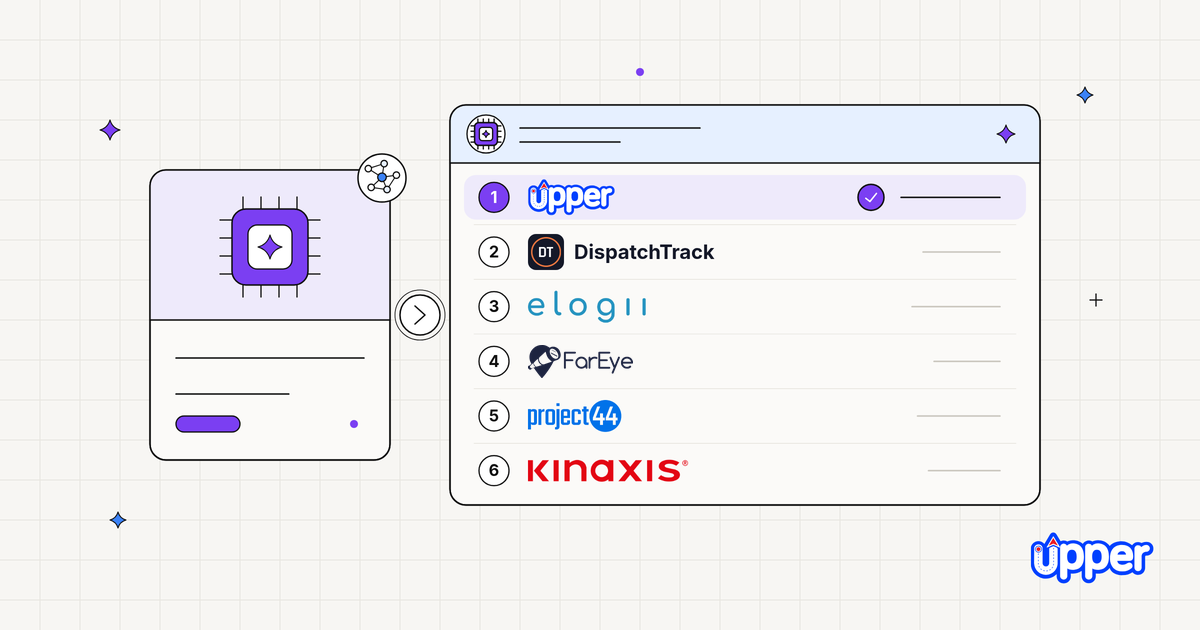
The best AI agents for logistics operations in 2026 act on the day’s work instead of only reporting it. For multi-stop delivery and route-dense operations, Upper AI Dispatcher is the pick. It recommends who takes each stop against your own rules, replans when the day breaks, explains each recommendation with a confidence score, and leaves the final call with your dispatcher. For multi-carrier freight visibility, look at project44. For company-wide planning, look at Kinaxis Maestro or o9 Solutions. For paperwork at forwarders and customs brokers, look at Raft. For a custom build, look at n8n or LangGraph.
Expectations are running ahead of adoption: in a Capgemini Research Institute survey of 1,000 supply chain executives (March–April 2025), 66% said agentic AI systems will take most supply chain decisions within three to five years, but fewer than 1 in 10 organizations already use AI agents or have implemented multi-agent systems (Capgemini Research Institute, 2025).
This is a ranked buyer’s shortlist of the best AI agents for logistics, grouped by the job each tool does. If you want the explainer on how AI agents work first, see our guide to how AI agents for logistics operations work.
- Pick the agent group that matches where your day breaks. Logistics agents fall into 4 groups: enterprise supply chain suites, route and delivery agents, document processing agents, and build-your-own frameworks. Each solves a different bottleneck.
- Within route and delivery operations, Upper AI Dispatcher is the pick for multi-stop teams. It weighs skills, equipment, capacity and travel together, replans routes after traffic, cancellations or callouts, and shows reasoning and a confidence score on every recommendation.
- Agents act, dashboards report. A logistics agent reassigns a stop or replans a route, while a dashboard only shows the problem. Ask every vendor "what will this do without me, and what will it hand back?"
- Exceptions are the best first job. The most expensive decisions are the late ones, such as a stop slipping past its window or a van that is full. Start where the agent saves a decision currently made by phone under pressure.
- Keep humans on the decisions that matter. Anything that commits money, breaks a hard rule or changes a customer promise should stay with a person. In Upper, critical conflicts are never automatically accepted.
Want to see an AI agent replan your real day? Book a demo.
What is a logistics AI agent, and what is it not?
A logistics AI agent is software that takes a step on the work, not just a report about it. In route-dense operations, the sources agree on 4 jobs:
- Track the work as it happens across drivers and stops.
- Flag and resolve exceptions, such as a stop slipping past its preferred time window, a stop that no longer fits on the van, or a route that needs help.
- Assign stops to the best-fit driver as new work arrives.
- Replan routes when traffic, a cancellation or a callout changes the day.
It works inside the TMS, WMS, ERP and route tools a team already runs, not instead of them. Our explainer on what AI agents do in logistics covers these jobs in more depth.
What it is not:
- Not a dashboard. A tool that only visualizes the late route still leaves the fix on someone’s phone.
- Not a fully autonomous replacement for your team. Good agents propose, explain and hand back. People decide on anything critical.
- Not one product for every bottleneck. A route agent won’t fix company-wide planning, and a document agent won’t fix a broken afternoon. Our overview of where AI already helps in logistics maps the other jobs.
- Not the right tool if your routes rarely change. It then adds review steps without saving decisions.
How did we rank the best AI agents for logistics?
Every option was compared on 5 criteria:
- Which bottleneck it acts on: planning, the route, paperwork, or a custom process.
- Replans the existing plan mid-day: yes, no, or only if you build it.
- Explains each decision: reasoning and a confidence score, or not.
- Human control: can a dispatcher accept, change or hold every proposal?
- Published price: a public price, by quote, or not covered in our sources.
Upper publishes this page, so read it as vendor content.
The best AI agents for logistics operations in 2026
Route and delivery operations agents
1. Upper AI Dispatcher: the AI agent that replans your delivery day
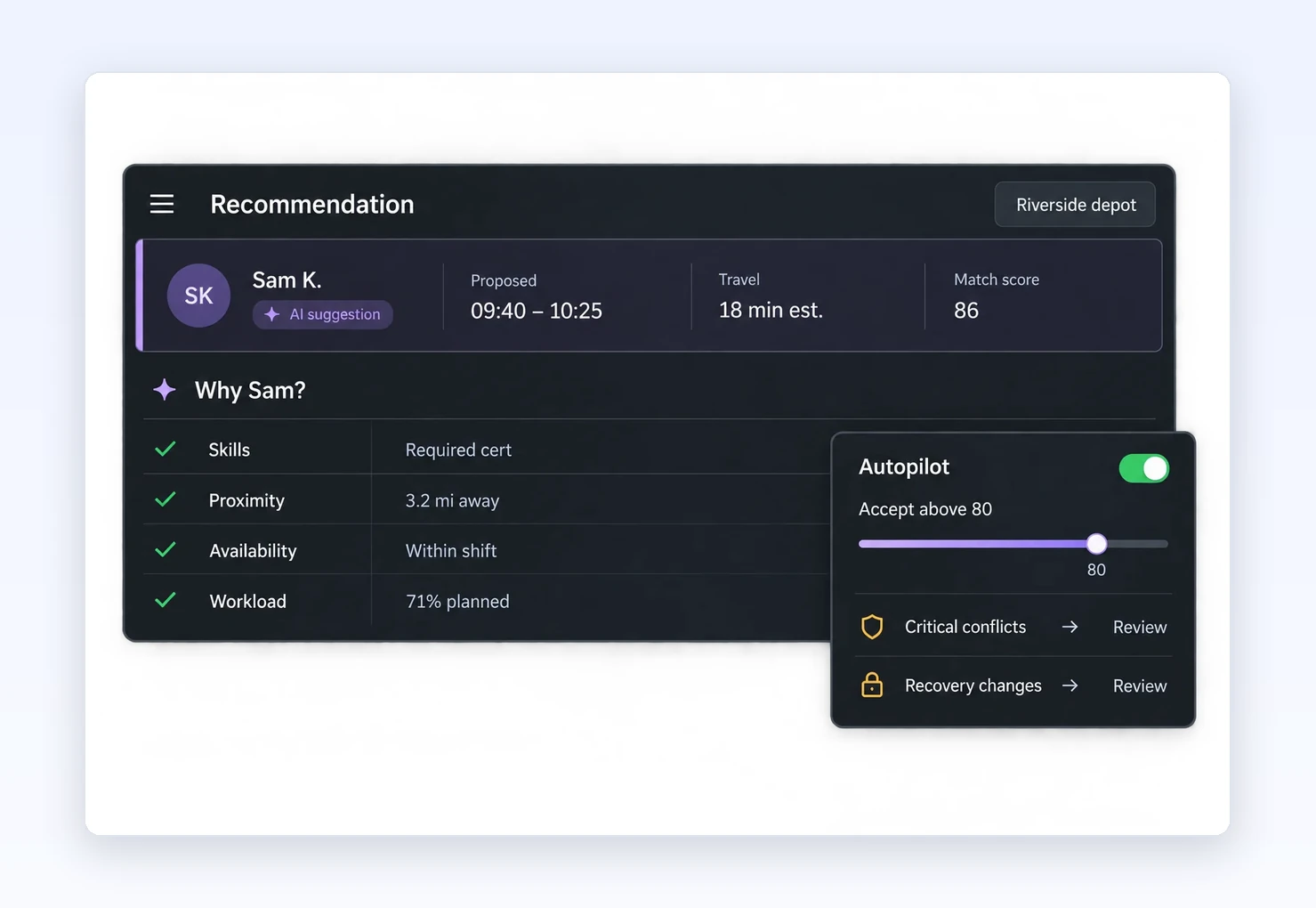
Upper AI Dispatcher is AI dispatch software that proposes and explains changes, and it is live and sold alongside Upper Crew and Upper Solo. It recommends who takes each stop by checking eligibility first. Required skills, equipment and territories are hard rules. It then weighs travel time, availability, workload and the effect on the rest of each route. Every recommendation shows the suggested driver, proposed start and finish, estimated travel, the reasoning and a confidence score.
After dispatch, it helps handle mid-day disruptions and exceptions and keeps the answer to “who takes this stop?” current:
- It assigns new stops to the best-fit driver using live location, remaining capacity, time windows and route efficiency.
- It re-optimizes when traffic, a cancellation or a rush order changes conditions.
- It suggests cover when a driver calls out or a vehicle is unavailable.
- Gap-filling agents look for pending work that could fit a cancelled slot.
Autopilot accepts routine matches above the confidence threshold you choose. Critical conflicts are never automatically accepted. They come back to the dispatcher, who can accept, change or hold the recommendation. When no driver is eligible, Upper shows the blocking reason.
- Price: on request. Upper publishes no price for AI Dispatcher. Upper Crew, sold alongside it, is on Upper’s per-user plans.
- Works with: Upper Crew for driver app, customer SMS and email updates and proof of delivery. Upper’s REST Platform API includes endpoints to create a route stop and get stops and routes, plus webhooks and an events list, with authentication by x-api-token header.
- Reviews: Upper rates 4.8/5 on G2 from 11 reviews (read Oct 30, 2026). The rating covers Upper overall.
Best suited for: same-day delivery, medical supply, recurring distribution, waste and snow routes where many rules interact and the day changes often. It suits teams that want an agent that proposes and a dispatcher who decides.
2. DispatchTrack, best for enterprise delivery teams that want an AI agent on customer messages
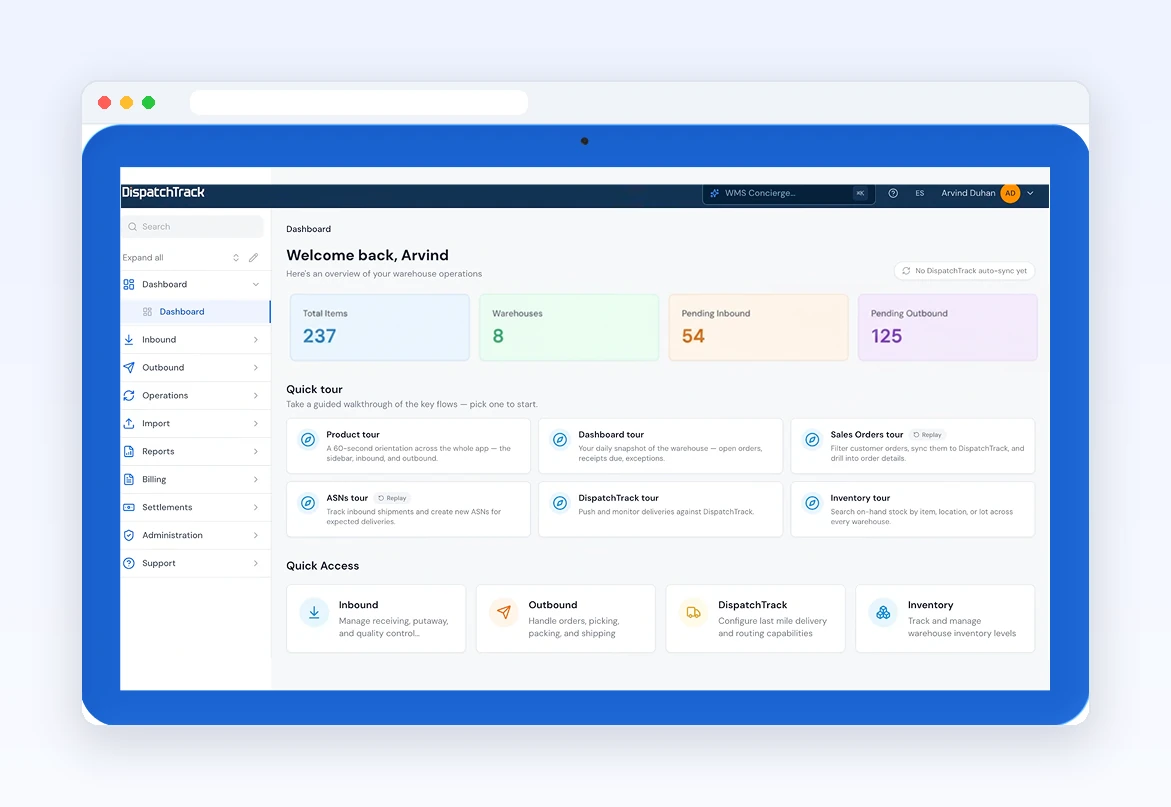
DispatchTrack is an enterprise last-mile platform that schedules, routes, dispatches, tracks and documents deliveries. Its DT Agent is a multi-agent AI layer on customer messaging. It answers “where’s my order?” from live order data, lets customers schedule and reschedule inside the capacity rules you set, asks for missing address or site-access details, and runs post-delivery surveys. It escalates to staff when a request falls outside the rules. DT Agent is included with DispatchTrack’s two-way messaging at no extra cost (dispatchtrack.com, Jul 8, 2026).
- Price: by quote, with no published price (Oct 2026).
- Reviews: 4.5/5 on G2 from 13 reviews (Oct 30, 2026).
Best suited for: large delivery operations buying through a sales-led process whose bottleneck is customer contact around the delivery.
3. eLogii, best for distribution and field service fleets that need live re-planning
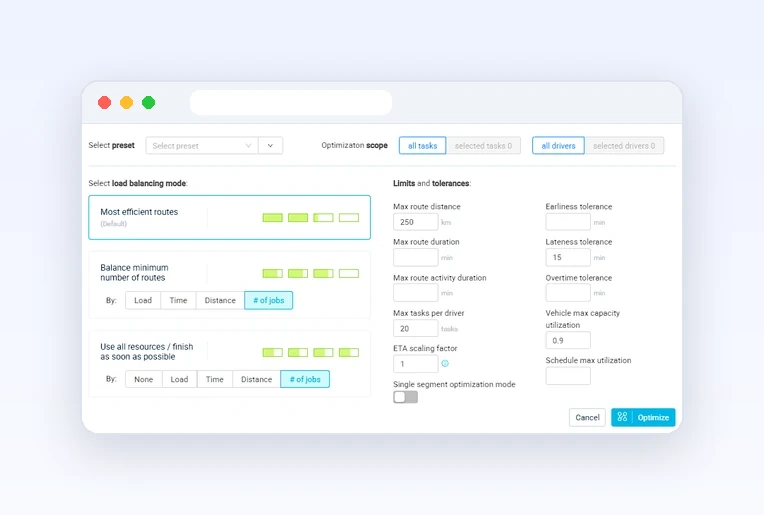
eLogii is a route optimization and dynamic scheduling platform for distribution and field service. It decides who goes where, in what order and with what priority, accounting for skills, SLA windows and business rules, and re-runs those decisions when the day changes. Dispatch, live tracking, customer notifications, a REST API and webhooks sit in the same platform (elogii.com, Oct 30, 2026).
- Price: custom quote (elogii.com/pricing, Oct 30, 2026).
- Reviews: 4.8/5 on Capterra from 57 reviews (Oct 30, 2026).
Best suited for: fleets of 10+ vehicles with 100+ daily orders or visits, which is the fit eLogii itself describes.
4. FarEye PILOT, best for enterprise last-mile teams that want an agentic dispatcher on their existing stack
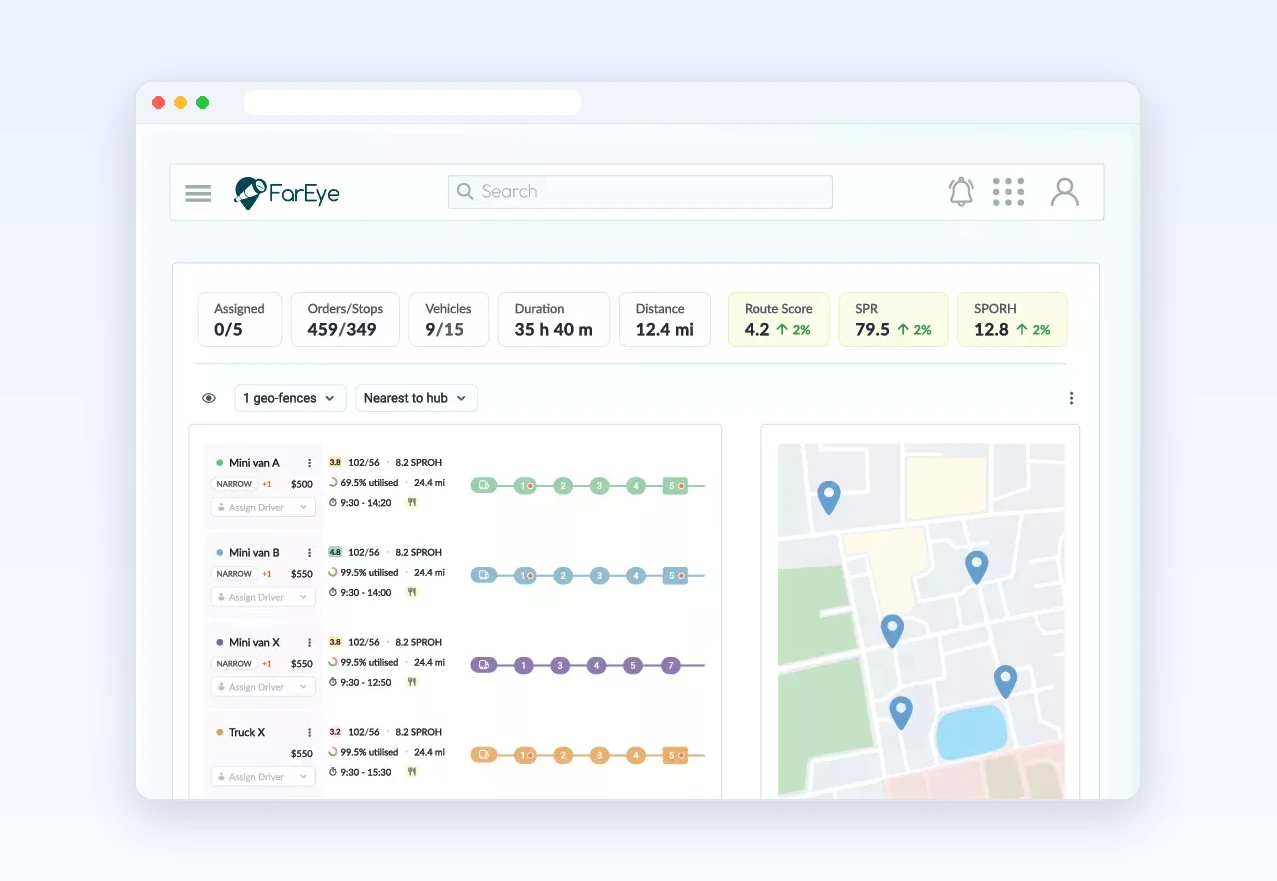
FarEye PILOT is an agentic AI dispatcher for last-mile logistics, launched on April 23, 2026. FarEye says it runs 11 specialized AI sub-agents across planning, execution and control: route planning, driver rosters, delivery slot booking, address and order data checks, delay recovery, and proof-of-delivery and invoice checks. It acts on routine decisions on its own and sends high-risk exceptions to a person. It is built as an MCP-first add-on to an existing TMS, OMS and WMS, and FarEye offers a 4-week proof of value on a single hub (fareye.com, Apr 23, 2026).
- Price: not published; sold for enterprise deployments through sales.
- Reviews: 4.8/5 on G2 from 326 reviews (Oct 2026). The rating covers FarEye’s platform overall, not PILOT alone.
Best suited for: enterprise retailers, 3PLs and carriers running many hubs who want an agent on top of the systems they already use.
Enterprise supply chain suites
5. project44, best for shippers that need AI agents on multi-carrier freight visibility
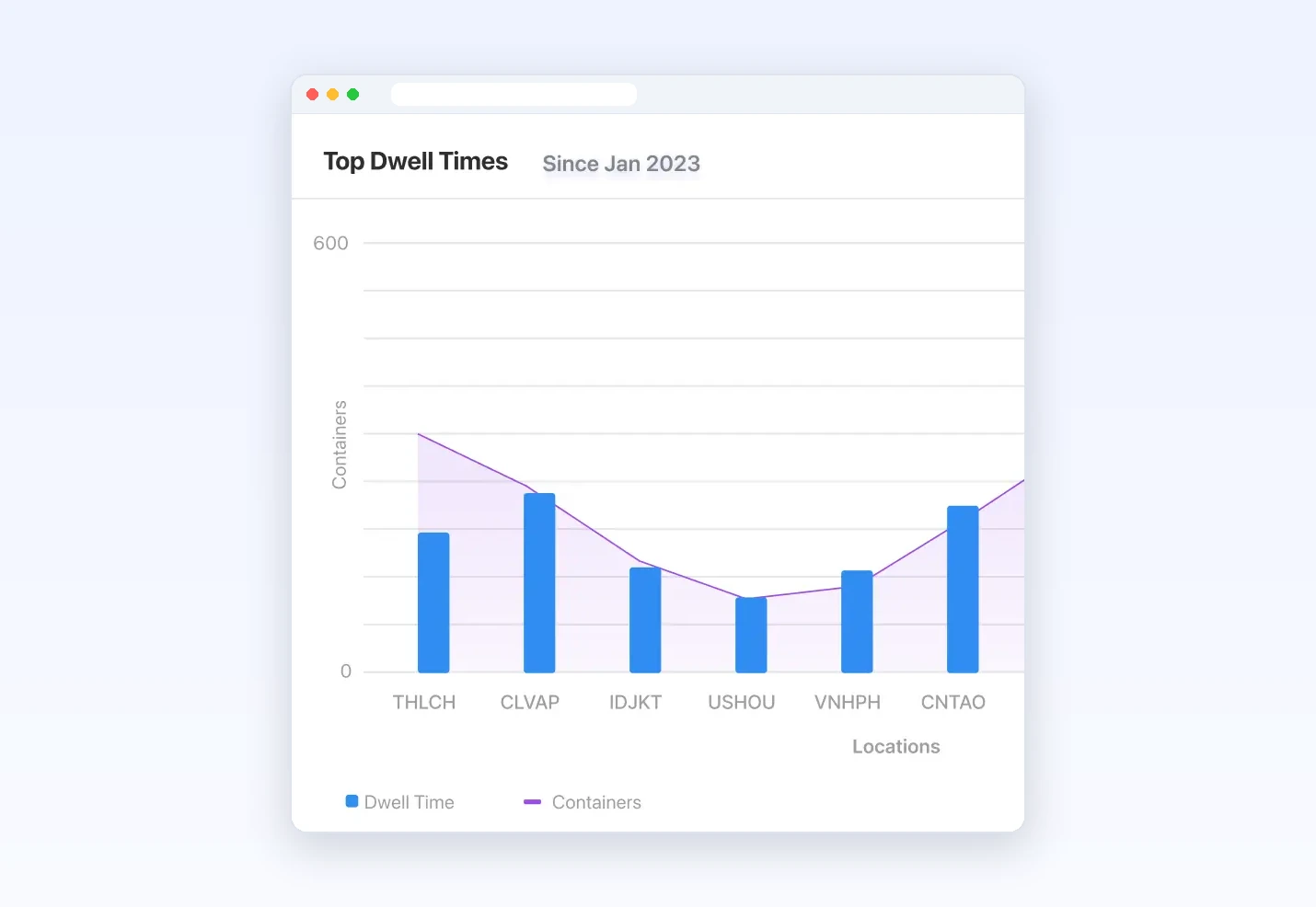
project44’s Movement is a Decision Intelligence Platform built on real-time shipment visibility across carriers and modes (ocean, truckload, LTL, parcel and more). Its AI Agents act on those signals, from carrier outreach to exception resolution, and its Agentic Workflow Manager is a no-code tool for deploying agents across supply chain workflows (project44.com, Oct 30, 2026).
- Price: not published; sold through sales.
- Reviews: 4.7/5 on G2 from 750 reviews (Oct 30, 2026). Some reviewers note heavy setup and integration work and a price that is hard to justify for small teams.
Best suited for: manufacturers, retailers and shippers tracking freight across many carriers who want exceptions caught and worked automatically. It is not a tool for dispatching your own drivers.
6. Kinaxis Maestro, best for enterprises whose bottleneck is supply chain planning
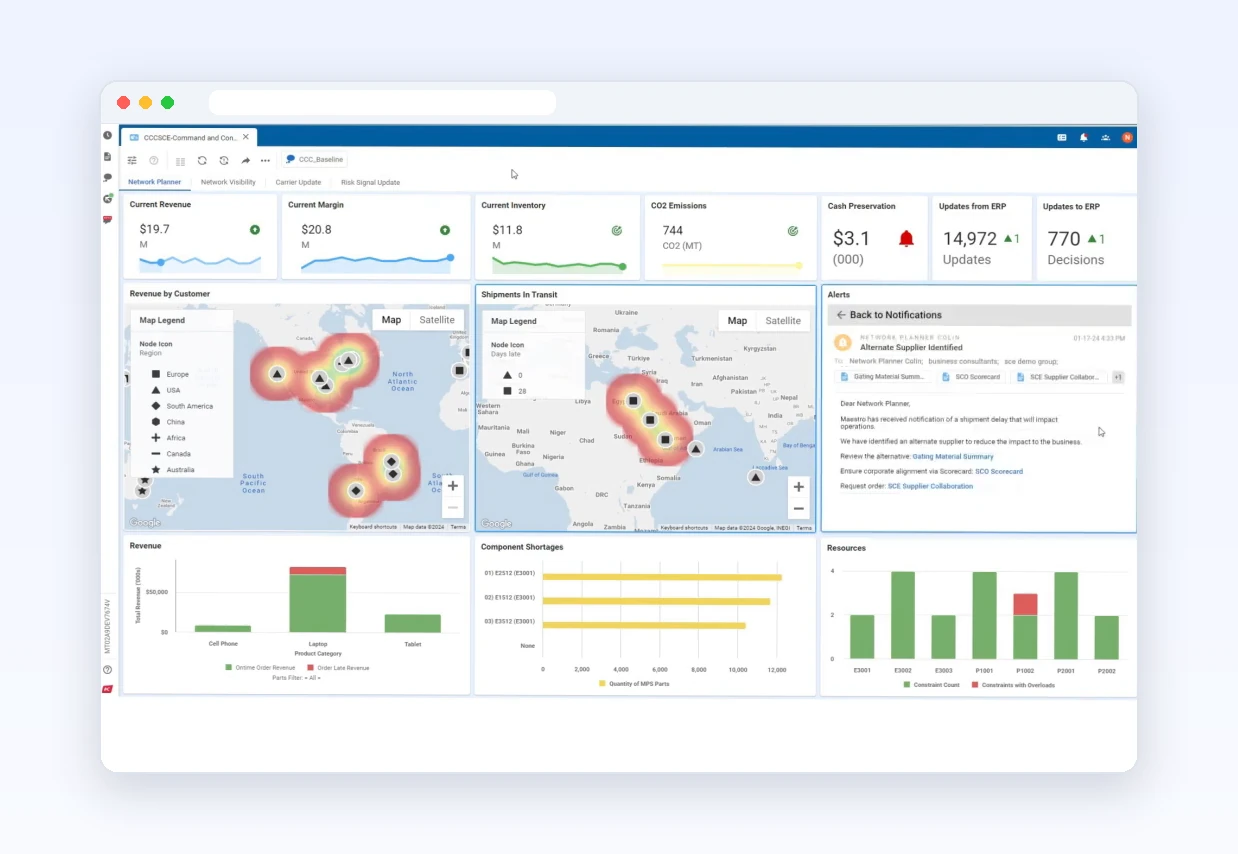
Kinaxis Maestro is a planning suite whose agents work at the planning layer, across company-wide supply chain data rather than one day of routes.
- Price: not published; sold through sales.
- Reviews: 4.5/5 on Capterra from 26 reviews (Oct 2026).
Best suited for: enterprises planning across the whole supply chain.
7. o9 Solutions, best for enterprises that plan supply chain and commercial decisions together
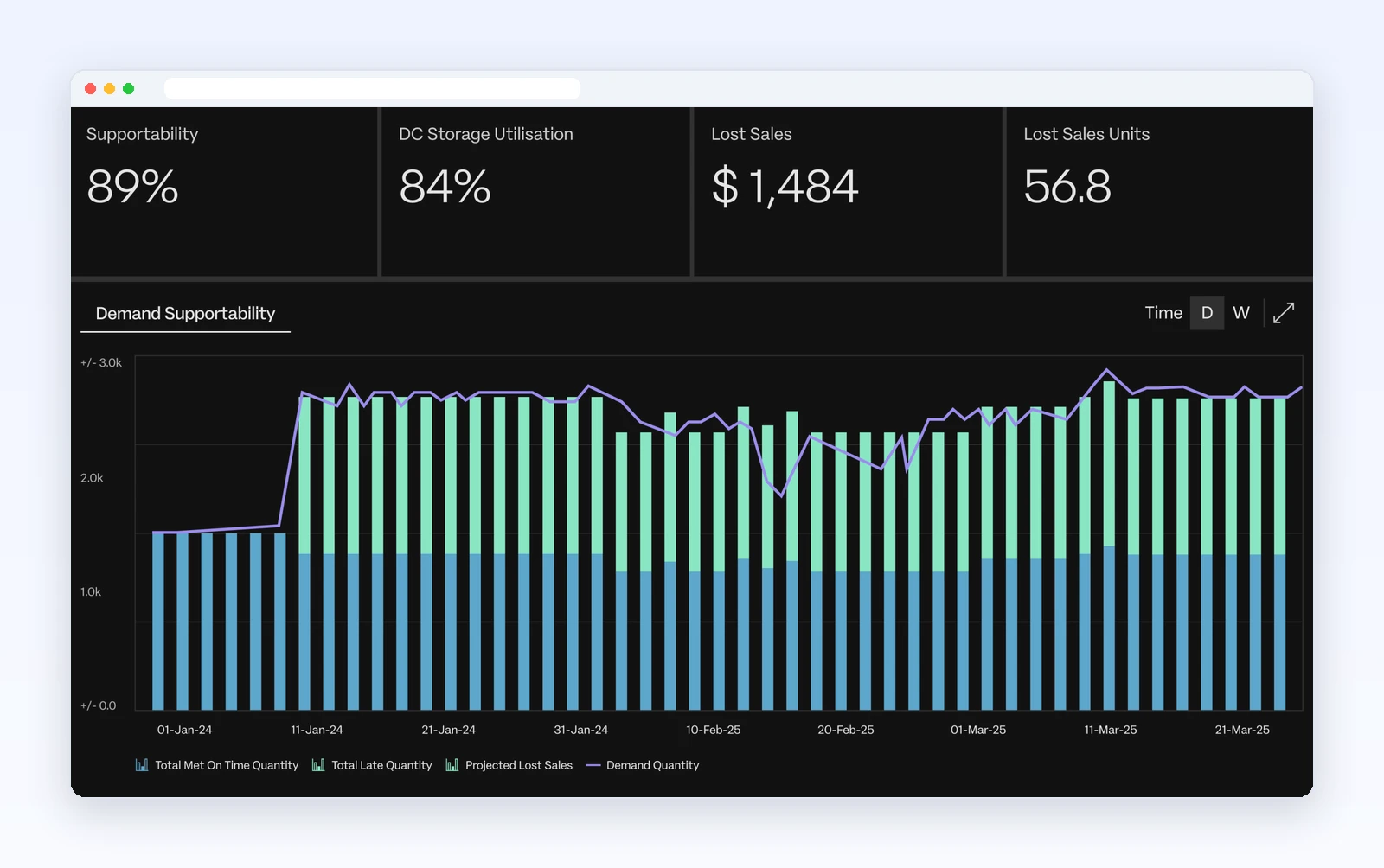
o9’s Digital Brain is an AI-powered platform for enterprise planning and execution. In June 2025, o9 made specialized AI agents generally available inside it. They analyze large volumes of planning data to find risks and opportunities, explain what happened and why, and recommend cross-functional actions to improve the plan. The platform connects data through o9’s Enterprise Knowledge Graph and covers horizons from execution to long-range planning (o9solutions.com, Jun 3, 2025).
- Price: not published; sold through sales.
- Reviews: 4.2/5 on G2 from 19 reviews (Oct 2026). o9 also reports a 4.8/5 rating from 54 reviews in Gartner Peer Insights’ 2025 Voice of the Customer report for supply chain planning.
Best suited for: large manufacturers, retailers and distributors planning demand, supply and commercial decisions in one place. It is not a tool for dispatching drivers.
Document processing agents
8. Raft, best for freight forwarders and customs brokers buried in paperwork
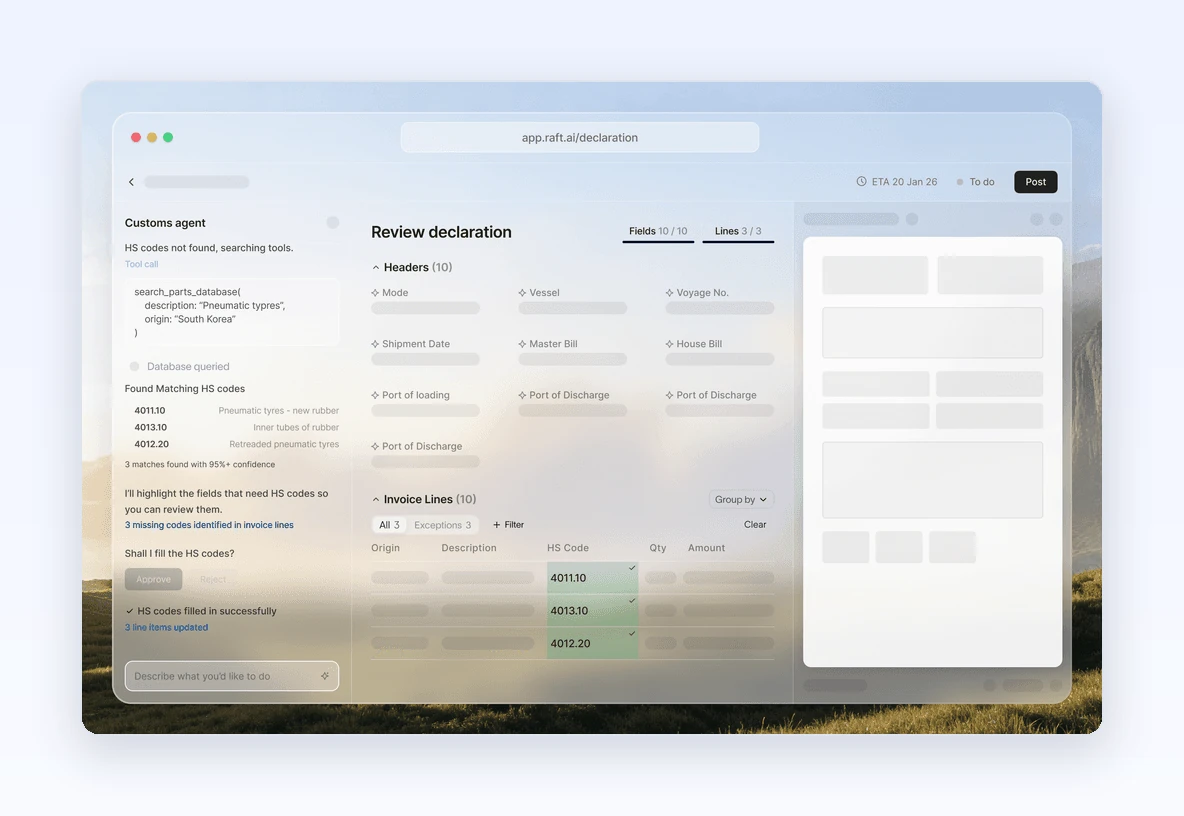
Raft offers document-processing agents that read and process logistics documents, so staff stop rekeying them. Raft publishes no prices; pricing is through a demo. Its site now positions it as “The AI Workforce For Supply Chain” for freight forwarders and customs brokers (raft.ai, Oct 30, 2026).
Best suited for: freight forwarders and customs brokers whose bottleneck is documents, not routes.
9. Rossum, best for teams buried in invoices, bills of lading and customs documents
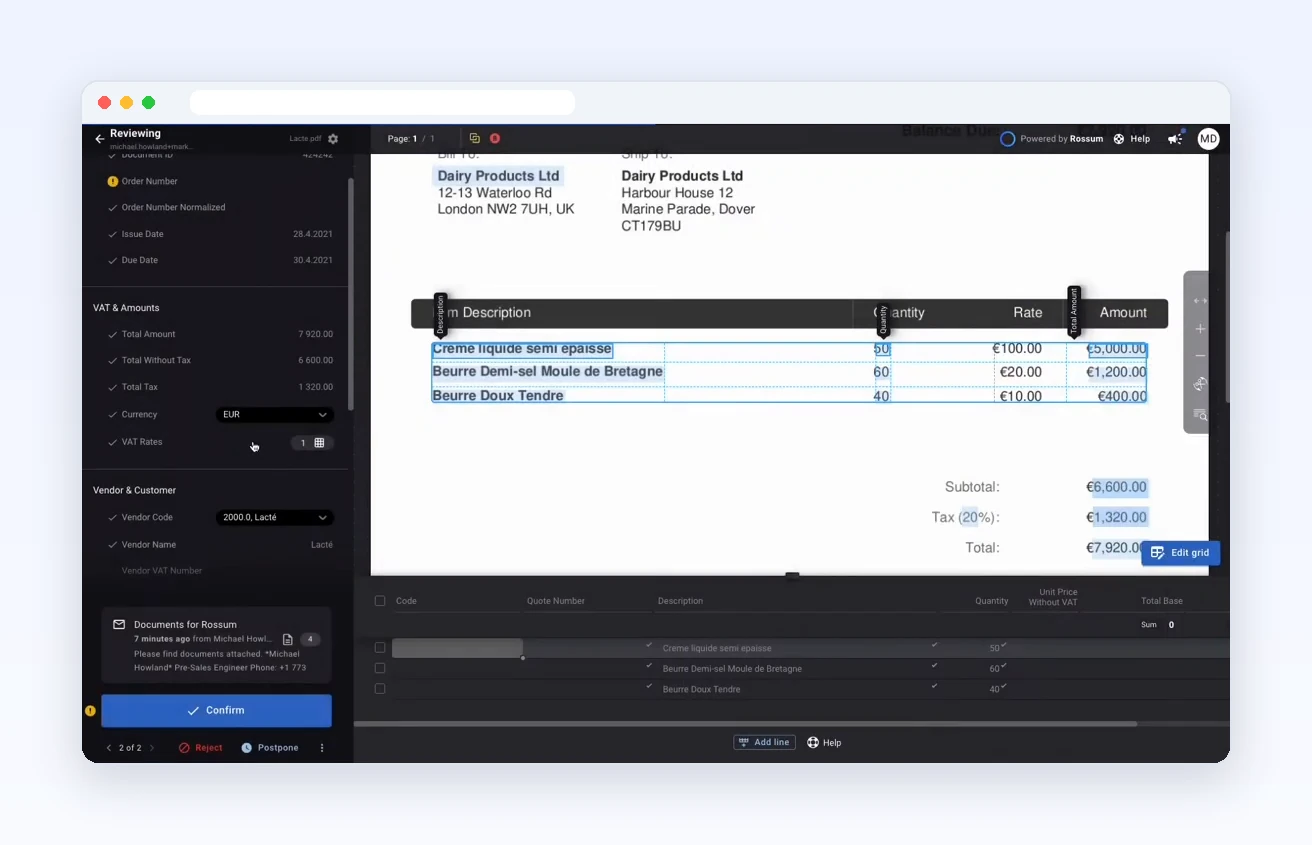
Rossum is an AI document processing platform, now part of Coupa after an acquisition announced on May 12, 2026. Its Aurora Document AI extracts and validates data from documents such as commercial invoices, bills of lading, packing lists and customs paperwork. Documents that pass confidence and validation checks can go through automatically, while exceptions go to a validation screen for a person to review (rossum.ai, Oct 2026).
- Price: the Starter plan starts at $18,000 per year, with a one-year minimum contract and a 14-day free trial (rossum.ai/pricing, Oct 31, 2026).
- Reviews: 4.5/5 on G2 from 127 reviews and 4.3/5 on Capterra from 13 reviews (Oct 2026).
Best suited for: logistics, shipping and finance teams that process a high volume of documents and want a person to review only the exceptions.
Workflow builders and build-your-own frameworks
10. n8n, Gumloop, UiPath, CrewAI and LangGraph, best for teams that build their own agent
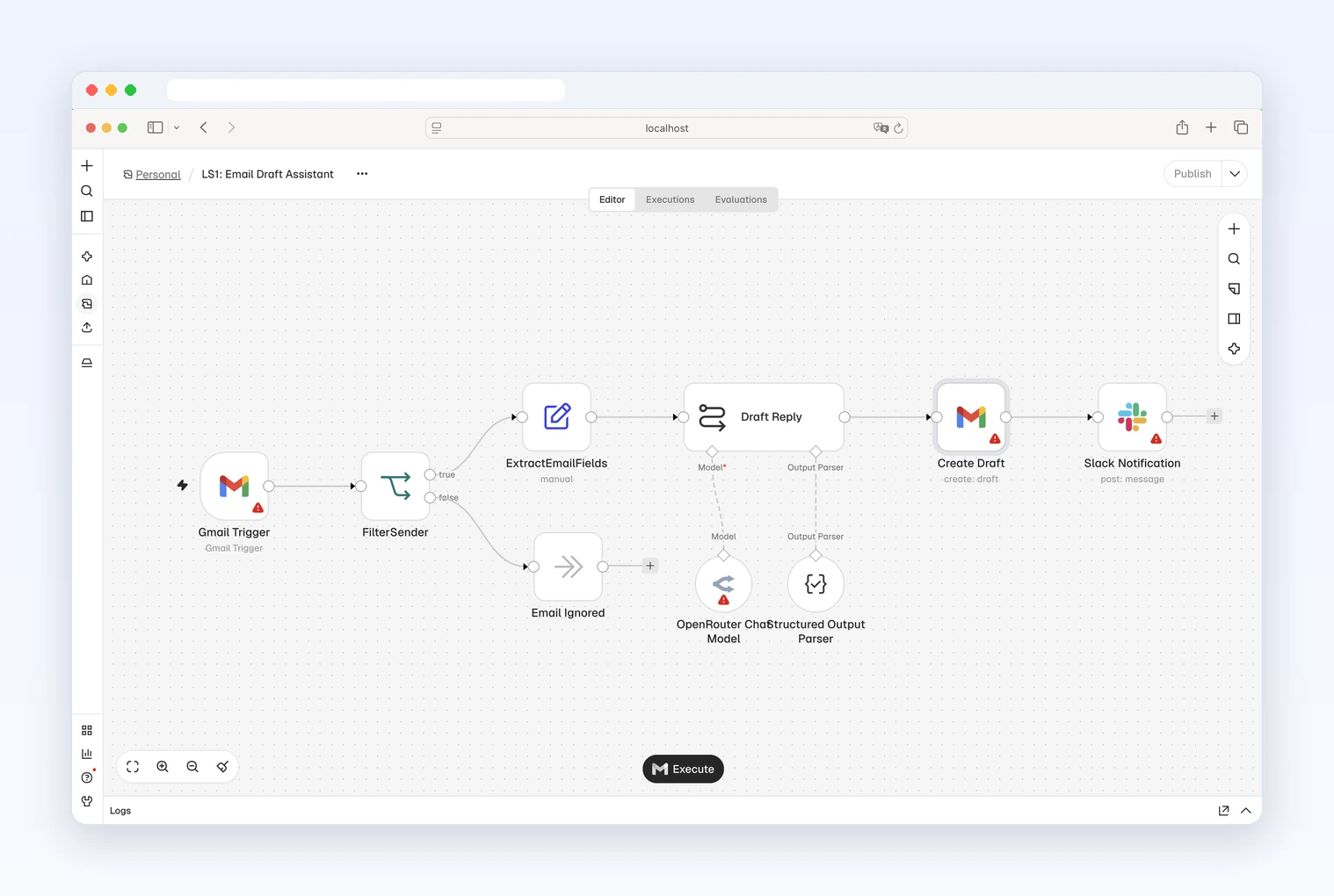
These are general tools, not logistics products. n8n is a workflow automation builder for chaining AI steps with existing apps and data, and Gumloop does the same without code. UiPath runs agentic process automation across existing business applications, which suits back-office processes. CrewAI (a framework for groups of cooperating agents) and LangGraph (agents built as stateful graphs of steps and decisions) are for engineering teams writing agents in code. Upper Crew is unrelated to the CrewAI framework.
Best suited for: teams with a process only they understand, and the engineering time to own testing, edge cases and upkeep.
Apart from Rossum’s Starter plan, no published price for the suites, document agents or frameworks was covered in the sources this page draws on.
How do the best AI agents for logistics compare on route and dispatch decisions?
They differ most on what happens after dispatch. This table compares categories by the decision each one makes.
| Agent type | Replans mid-day | Explains decisions | Dispatcher control | Live customer ETAs | Pricing |
|---|---|---|---|---|---|
| Upper AI Dispatcher + Upper Crew | Yes: traffic, cancellations, rush orders, callouts | Yes: reasoning + confidence score | Accept, change or hold; Autopilot only above your threshold | Yes, via Upper Crew | Crew $50 to $89/user/mo; Dispatcher on request |
| Route planners | No, the plan ends at the morning build | No | No proposals to review | Depends on the product | Per order, driver or user |
| Stacks of separate apps | Only if someone carries the change | No | Manual by default | Only if the messaging app gets the change | Several subscriptions |
| Enterprise supply chain suites | Varies by vendor | ||||
| Build-your-own frameworks | Only if you build it | Your build and running cost | |||
Prices checked October 2026.
See it in action
See an AI agent replan your delivery day.
Upper AI Dispatcher proposes changes on your own stop list.
Which AI agent fits your use case?
| Where your day breaks | Best pick | Team size |
|---|---|---|
| The route after dispatch | Upper AI Dispatcher + Upper Crew | Small to mid-size |
| One driver building tomorrow’s route | Upper Solo | Owner-operator |
| Enterprise delivery bought by quote | DispatchTrack | Enterprise |
| Customer messages around deliveries | DispatchTrack (DT Agent) | Enterprise |
| Rule-heavy scheduling, 10+ vehicles | eLogii | Mid-size |
| Agentic dispatch on an existing TMS, OMS or WMS | FarEye PILOT | Enterprise |
| Multi-carrier freight visibility | project44 | Enterprise shippers |
| Company-wide supply chain planning | Kinaxis Maestro or o9 Solutions | Enterprise |
| Paperwork at forwarders and customs brokers | Raft | Mid-size to enterprise |
| Invoices, bills of lading, customs documents | Rossum | Mid-size to enterprise |
| A process only your team understands | n8n, Gumloop, UiPath, CrewAI or LangGraph | Teams with engineers |
Which decisions should stay with a dispatcher?
Decisions that commit money, break a hard rule or change a customer promise should stay with a person, and the agent should leave a record of what it proposed and why. Sources agree on human-in-the-loop control, governance and audit trails, even where they disagree on vendors.
Separate two kinds of rule:
- Hard rules can’t be broken, such as a missing certification or a full vehicle.
- Preferences can bend, such as a preferred time window.
Upper AI Dispatcher checks hard rules before any recommendation. A preferred time window is a planning preference Upper works to honor, and when it can’t be met, Upper flags the deviation for review. Upper proposes, and your dispatcher decides. No agent replaces the person who knows which customer will call if the stop slips. We look at whether AI will replace dispatchers in a separate guide.
How do you choose an AI agent for logistics operations?
Use 3 tests:
- Data readiness: an agent needs a clean stop list, vehicles and capacity, the skills or equipment each stop requires, and your preferred time windows. It also needs one decision only you can make: which constraints are hard rules and which are preferences. Settle that before any agent sees your data.
- Integration: ask which of your systems it reads from and which it writes back to. Your CRM, billing, telematics and compliance tools should stay where they are.
- Control: can your dispatcher see and overrule every decision?
Operations that gain the most from a route agent: same-day delivery around recurring accounts, waste collection where a missed pickup needs a reason and a photo, and snow routes with priority sites and mid-storm changes. They also include owner-operators still planning in a spreadsheet and recurring distribution whose route map grew lopsided.
When an agent is the wrong tool: if your routes rarely change, a spreadsheet is enough. If your bottleneck is company-wide planning or paperwork, the suites and document agents fit better. Upper isn’t the right fit for every operation.
Which Upper product fits which operation?
- Upper Crew is for teams and fleets. It plans, dispatches, tracks and proves the day across drivers, from $50 per user per month, with a 7-day free trial and no credit card.
- Upper Solo is for one driver planning the route they drive, at up to 500 stops per route.
- Upper AI Dispatcher is for operations where skills, certifications and job dependencies decide who takes the stop. It is sold alongside, not as an upgrade tier.
What results look like for Upper customers
These are results Upper customers reported in their published stories. They are those customers’ outcomes, not a promise for your operation, and they come from Upper’s route planning and dispatch.
- GreenEdge Lawn: reorganized 800 customers into clean territories for 3 technicians in one afternoon after a merger, freeing 21 hours of drive time a week. Read the GreenEdge Lawn story.
- CleanHaul Services: planning for 25 drivers and 2,800+ nightly stops fell from 6 hours to 30 minutes a week, and missed-pickup complaints fell 85%. Read the CleanHaul story.
- Win Waste Solutions: “Upper just solved it — every photo is tied to the address, the date, the crew member.” (from Upper’s AI dispatch page). Read the Win Waste story.
Pages published by Upper are Upper’s own marketing. A customer result is that customer’s reported outcome, not a promise. Confidence scores are review aids and preferred time windows are preferences, not guarantees. Anything shown as a preview is labeled a preview.

See it in action
See an AI agent handle your real day
Bring your stop list, your hardest rule and one disruption you actually get. In 30 minutes we'll show what Upper AI Dispatcher proposes, what it checks, and what it hands back to your dispatcher.

Frequently asked questions
The best AI agents for logistics depend on your bottleneck. For multi-stop dispatch, Upper AI Dispatcher is the pick, with DispatchTrack and eLogii as alternatives. FarEye PILOT fits enterprise last-mile dispatch, project44 fits multi-carrier visibility, Raft and Rossum fit documents, and n8n or UiPath fit teams that build their own.
An AI agent in logistics is software that watches operational data, decides on a next step and carries it out within set limits. Examples are re-assigning a delayed stop, updating an ETA or flagging an exception. Unlike a fixed automation rule, it adapts to the situation and hands unclear decisions back to a person.
Agentic AI in logistics refers to AI systems that can plan and take multi-step actions toward a goal, like keeping a delivery day on schedule, rather than only answering questions or making predictions. In practice, the useful ones work inside clear rules and keep a dispatcher or planner in control of high-impact decisions.
Examples include dispatch, customer messaging, exception and document agents. Upper AI Dispatcher recommends who takes each stop and replans the day. DispatchTrack’s DT Agent answers customer delivery messages and handles rescheduling. project44’s AI Agents work freight exceptions, Raft’s and Rossum’s agents read logistics documents, and FarEye PILOT’s sub-agents plan routes and recover delayed deliveries.
AI agents follow the day’s work, catch exceptions and act on them inside the TMS, WMS and ERP systems a team already uses. Common jobs are assigning or replanning stops, answering where-is-my-order messages and reading paperwork. Start with one frequent, reversible task before giving an agent wider scope.
Classic automation runs a fixed script. An AI agent reads the current situation, picks a step within the rules you set, and hands back what it can’t decide. The question to ask any vendor is what the agent does on its own and what it returns to a person.
Only within limits you set. Most teams start with recommendations a person approves, then let the agent clear routine cases. In Upper, Autopilot accepts routine matches above your confidence threshold, while critical conflicts are never automatically accepted and come back to the dispatcher.
Most logistics AI agents are sold by quote. DispatchTrack, eLogii, FarEye and project44 quote, Rossum’s Starter plan starts at $18,000 a year, and Upper AI Dispatcher is priced on request. Upper Crew, sold alongside it, is $50 to $89 per user a month (Oct 30, 2026). Build-your-own frameworks shift the cost to your team’s build and upkeep time.
To shortlist the best AI agents for logistics, run a pilot on one real, messy week of your own data, not a sample route, and compare it with how your team handled that week. Treat confidence scores as review aids, treat customer results as that customer’s outcome, and ask for reference customers in your industry.
They can be, because size matters less than how many rules interact and how often the day changes. A small team juggling skills, time windows and same-day changes can gain more than a large fleet on stable routes, which gains little.