


How much fuel does snow plow route optimization save? Several published snowplow routing projects report routes 5% to 10% shorter, according to Clear Roads report CR14-07, published by the Minnesota Department of Transportation. One project in that report recorded a reduction as high as 50%. Fewer miles for the same work means less diesel, but the report measured route length, not gallons. Any fuel figure is therefore an estimate built from your own route miles, and this guide shows how to make it.
Each gallon you save is worth more this winter. The U.S. average on-highway diesel price was $6.127 a gallon in the week of November 9, 2026, $2.29 higher than a year earlier, according to the U.S. Energy Information Administration.
- Clear Roads report CR14-07 found snowplow route optimization projects cut route length by about 5% to 10%, with one case reaching 50%. It measured miles, not fuel.
- Your saving depends mostly on how inefficient your current routes are. Routes that grew one contract at a time have the most wasted miles to remove.
- Estimate fuel saved as (seasonal driving miles ÷ working mpg) × reduction × diesel price. In the worked example below, a 10% cut saves 60 gallons, about $368, in a season.
- Shorter routes only save fuel while trucks run them. Mid-storm changes handled by phone add miles no optimizer planned.
- Upper Crew plans multi-stop plow routes, pushes changes to the driver app and, from Professional, compares planned and actual routes. It does not measure fuel, so your fuel cards stay the record.
How Much Fuel Does Snow Plow Route Optimization Save?
Snow plow route optimization usually cuts route length by about 5% to 10%, and fuel falls with the miles. Clear Roads report CR14-07 reviewed nine computerized snowplow routing projects, and multiple projects reported route length reductions in that range. One project reported a reduction of up to 50%.
- What was measured: Route length. The report gives no gallons, no fuel dollars and no per-storm fuel figure.
- Why fuel still drops: A truck that drives fewer miles to cover the same work burns less diesel. The fuel saving follows from shorter routes, but nobody in these projects measured it directly.
- Where the 50% fits: It is the ceiling from a single case, not a typical result. Plan your budget around 5% to 10% and treat anything above that as a bonus your old routes would have to earn.
- What was routed: The projects routed plows over road networks, which the report says need an accurate, snowplow-specific map of the roads. A contractor visiting a list of lots has a different routing problem, so use the range as a guide, not a promise.
Most of the gap between 5% and 50% comes down to where your routes start.
Why Do Fuel Savings Vary From One Snow Operation to the Next?
Savings vary mainly because of baseline route inefficiency. Routes with a lot of wasted driving have more waste to remove, so poorly built routes gain the most and tight routes gain the least. Three factors decide where you land:
- How inefficient the old routes were: A route list that grew one contract at a time, with properties added wherever a truck had room, usually holds more wasted miles than a list someone laid out on a map.
- Whether experienced drivers shape the plan: The report found that route optimization does not replace expert judgment. Successful projects relied on close cooperation between experienced winter maintenance crews and the people running the optimization, plus time to review new routes before using them. Drivers know about the gate that stays locked until 5 a.m. and the lot that has to be cleared first. The optimizer does not know these things unless someone enters them.
- Whether routes change during the storm: If you cannot re-plan mid-storm, a well-built route starts collecting wasted miles the first time a truck gets stuck or a priority call comes in. This one is our own point, not a finding of the report.
The third factor is where most of the savings are kept or lost. The section on mid-storm changes covers it.
Where Does a Plow Truck Burn Fuel Without Clearing Anything?
A plow truck wastes fuel on 3 kinds of driving: deadheading, route overlap and backtracking. The report credits better routes with cutting deadheading, route overlap and other inefficiencies, which is what makes them more cost-efficient.
- Deadheading: Driving with the blade up and the spreader off, such as from the yard to the first property, between distant properties, or back to reload salt. The miles cost fuel and clear nothing.
- Route overlap: 2 trucks covering the same streets, or working near each other’s properties, because routes were split by habit instead of geography. One of those trips is waste.
- Backtracking: A truck crossing streets it has already passed to reach a property that a better sequence would have served on the way out.
Optimization reduces these by grouping nearby properties onto one route and ordering them so each truck keeps moving forward. Look at your planned routes and count how often a truck passes the same street twice. That count is a rough guide to how much your routes can still gain. For the step-by-step method, see how to optimize snow plow routes.
Routing does not touch the fuel a truck burns while plowing inside a lot or idling between pushes. Only the driving between properties gets shorter, so apply the reduction to driving miles, not to your whole fuel bill.
How Do I Estimate Fuel Savings for My Own Plow Routes?
Divide your seasonal driving miles by your trucks’ working miles per gallon, then multiply by a route-length reduction from the 5% to 10% range. Multiply the gallons by your diesel price to get dollars. The result is an illustrative estimate, not a measured saving, because the research measured miles and not fuel.
- Find seasonal driving miles (M): Add up the miles driven between properties on plow and salt routes across a full season. Use fuel cards, telematics or odometer logs. Leave out trips to the shop and on-lot plowing.
- Find working miles per gallon (MPG): Use your trucks’ average on storm nights. A plowing or spreading truck does not get its highway figure.
- Apply a scenario, then price it: Gallons saved = (M ÷ MPG) × reduction. Dollars saved = gallons saved × your price per gallon.
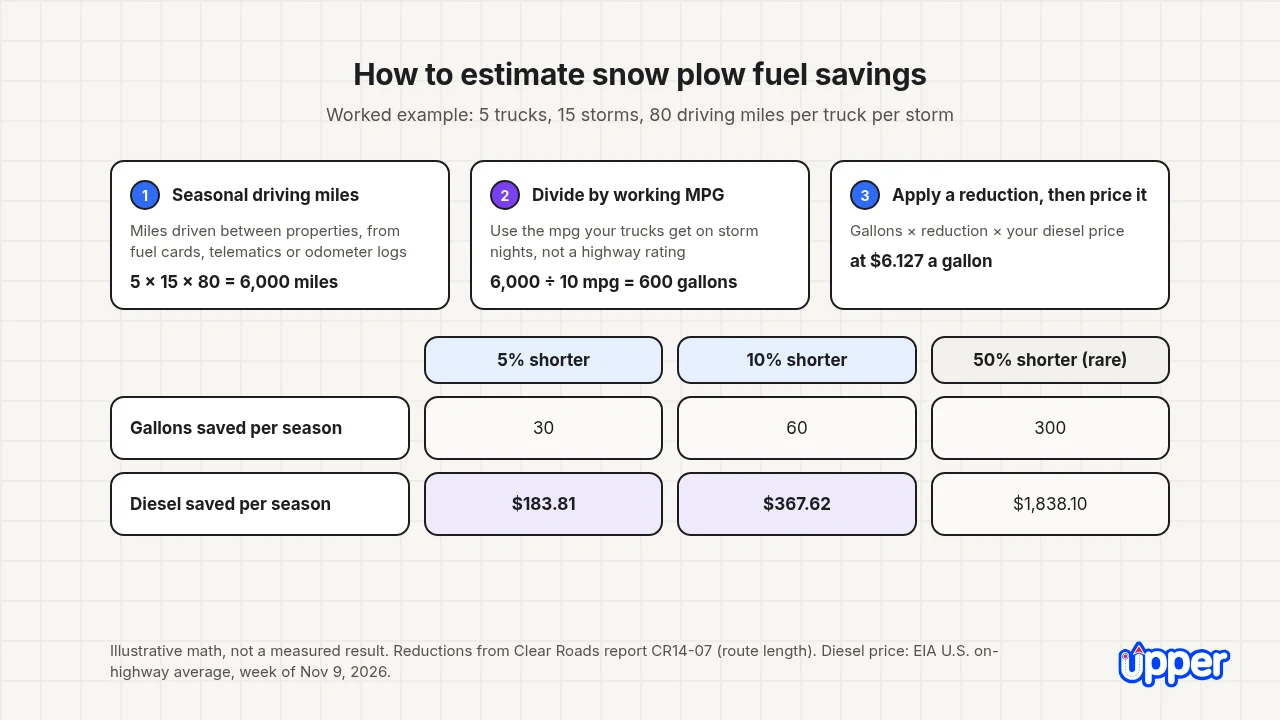
Worked example (illustrative): a contractor runs 5 trucks through 15 plowable storms. Each truck drives 80 miles between properties per storm, so M = 5 × 15 × 80 = 6,000 miles. At an assumed 10 mpg, that is 600 gallons, or $3,676.20 at the EIA average of $6.127 a gallon.
| Scenario | Route-length reduction | Gallons saved per season | Diesel saved at $6.127 | When it is plausible |
| Low end of the range | 5% | 30 | $183.81 | Routes were already laid out on a map |
| High end of the range | 10% | 60 | $367.62 | Routes show visible overlap and backtracking |
| Single highest case in the report | 50% | 300 | $1,838.10 | Routes were badly built; rare |
Report the 5% row to whoever signs the budget. Keep the 10% row as your target, and do not plan around the 50% row. Your miles, mpg and local diesel price will differ, so swap in your own numbers.
Fuel is rarely the biggest return on its own. The same 5 trucks on Upper Crew Professional, billed monthly for a 5-month season, cost $1,500 ($60 × 5 users × 5 months), so the 10% fuel saving covers about a quarter of that. The larger gains are usually the hours freed and the extra properties each truck can reach, as the full cost breakdown in how much snow removal route software costs shows. Freed hours become cash only if they cut overtime or add billable sites.
What Keeps Route Savings From Slipping Mid-Storm?
Route savings last only as long as the route the driver runs is the route you planned. Every road closure, stuck truck or new priority call handled by phone adds miles that no optimizer saw. Three habits protect the saving:
- Change the plan, not the phone call: Edit the route itself and send the new stop order to the driver, so the next truck is the nearest one with time left.
- Watch for drift: Compare where trucks actually went with the planned route after each storm, and look for detours and long idle stretches.
- Review before the next storm: Move far-off properties to a closer route and rebalance the longest route first, then re-check the plan with your drivers.
A spreadsheet can hold a stable list, but it cannot do the first two once trucks leave the yard. Upper’s comparison of snow removal route optimization vs spreadsheets covers when a sheet is still enough.
How Does Upper Crew Help Keep Plow Routes Short?
Upper Crew is route optimization software for teams that plan and run multi-stop routes. It fits contractors who plow a list of properties, as the snow removal route planning software page shows. You start from the property list you already keep in a spreadsheet, imported as-is through spreadsheet import. Upper Crew proposes the routes, and your dispatcher reviews, edits and approves them before any truck rolls.
- Plans for distance: Every plan lets you choose shortest distance or shortest time as the route priority. On Professional and higher plans, multi-driver optimization splits one property list across your trucks so each stop is assigned once.
- Changes reach the driver app: On Professional and higher plans, real-time route updates push a moved property, a priority call or a pulled truck to the driver’s current route, with stop order, customer details and navigation handoff.
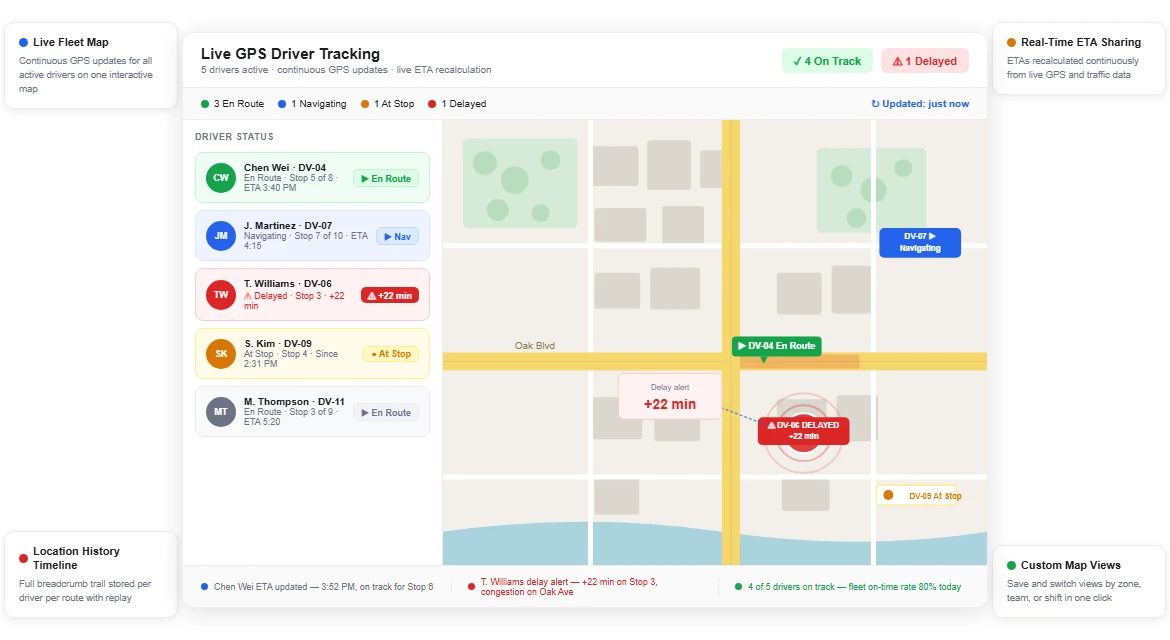
- Live tracking and off-route flags: From Professional, live GPS tracking shows every truck and its breadcrumb trail. Upper flags a driver who deviates significantly from the assigned route, so you can call the driver or move the remaining stops.
- Planned vs actual routes: Route efficiency metrics, from Professional, compare the optimized route with the route actually driven, which is how you see whether the saving held.
- Proof at each property: From Professional, proof of delivery keeps photos, signatures and notes on the stop with time and GPS location, so a disputed visit does not need a second trip to check. Route history is kept 6 months on Starter, 1 year on Professional and 2 years on Optimize.
Upper Crew has limits worth knowing. It does not measure fuel and makes no fuel-savings claim, so your fuel cards and telematics remain the record of what was burned. Time windows are preferences it works to honor, not guarantees, and vehicle capacity planning needs the Optimize plan or a $25 per driver add-on. If your property list is stable and storms rarely change it, a spreadsheet may be enough.
One snow contractor describes the effect without a fuel number. Northern Clearways Inc., a landscaping and snow removal company, says optimized routes and digital dispatching minimized redundant travel and refueling stops. That is customer-reported and gives no measured fuel figure.
See it in action
See a shorter plow plan on your own property list.
Bring last winter’s plow and salt list and one disruption. We will build the routes, push the change to the driver app and show the planned vs actual record.
How Much Does Upper Crew Cost?
Upper Crew is priced per user per month on the Upper pricing page:
| Upper Crew plan | Billed monthly (per user per month) | Billed yearly (per user per month) |
| Starter | $50 | $40 |
| Professional | $60 | $48 |
| Optimize | $89 | $71 |
| Enterprise | Custom pricing | Custom pricing |
Live tracking, real-time route updates, proof of delivery and route efficiency metrics start on Professional. The free trial runs 7 days with Professional features and no credit card; SMS customer notifications are not included. To compare vendors for snow work, see the best snow plow routing apps for contractors. For fuel tactics outside snow work, such as idling and driver habits, see Upper’s guide to reducing fuel costs with route optimization.
Price your own plow list before the next trigger with the 7 days Upper Crew free trial.

See it in action
Test Your Fuel Estimate on Your Own Routes
Bring the plow and salt list you run today and one disruption from last winter. We will build the routes, push the change to the driver app and show the planned vs actual record.

Disclosure: Upper makes Upper Crew. The fuel scenarios above are illustrative math, and a customer’s reported outcome is not a guarantee.
Frequently Asked Questions
The research we found measured route length, not gallons. Clear Roads report CR14-07 found snowplow route optimization projects cut route length by about 5% to 10%, with one case reaching 50%. Fewer miles means less diesel, so estimate your saving by applying that range to the miles your trucks drive between properties.
Divide your seasonal driving miles by your trucks’ working mpg to get gallons, multiply by a reduction such as 5% or 10%, then multiply by your diesel price. For example, 6,000 miles at 10 mpg is 600 gallons, so a 10% cut saves 60 gallons, about $368 at $6.127 a gallon.
The biggest factor is how inefficient the old routes were. Routes that grew one contract at a time, with overlap and backtracking, have the most wasted miles to remove. Experienced drivers reviewing the new routes and the ability to re-plan mid-storm also decide how much of the saving you keep.
No. Routing shortens the driving between properties, such as deadheading, overlap and backtracking. Fuel burned while plowing inside a lot or idling between pushes stays the same, so apply the reduction to driving miles rather than your whole fuel bill.
Experienced winter maintenance crews should work closely with whoever runs the routing software. The Clear Roads report found that optimization does not replace expert judgment and that successful projects left time to review new routes before using them. Drivers know details the optimizer does not, such as a gate that stays locked until 5 a.m.
Compare the planned route with the route actually driven after each storm. In Upper Crew, live GPS tracking keeps a breadcrumb trail and route efficiency metrics compare the optimized route with the actual one, both from the Professional plan. Upper also flags significant off-route driving on the dispatch dashboard. Upper Crew does not measure fuel itself.
We did not find a published, measured fuel example. The closest research result is one project in Clear Roads report CR14-07 that cut route length by as much as 50%, a ceiling case that measured miles rather than gallons. Northern Clearways Inc. reports fewer redundant trips and refueling stops after switching to Upper, without a fuel figure.


