
SparkClean Pro Home Customer Stories SparkClean Pro SparkClean Pro Saved Two At-Risk Contracts Worth $14K Monthly and Uncovered $2,800 in Time Fraud Using GPS-Verified Crew Tracking A Cleveland commercial cleaning company managing 20 crews across 60+ buildings per night replaced paper schedules with optimized routes, GPS tracking, and photo documentation, cutting transit time by 35% and eliminating client complaints about rushed jobs. In Conversation with Victor Okafor, General Manager, SparkClean Pro Key Results 35%Reduction in transit time between buildings $14,000/moSaved from two renewed contracts 60%Decrease in client complaints 30-45 minExtra time gained per crew nightly The Challenge Victor Okafor had built SparkClean Pro into a $2 million business through reputation and reliability. Twenty crews worked nightly across 60+ buildings in the greater Cleveland area—office towers, medical facilities, retail spaces, warehouses. The company had long-standing contracts worth hundreds of thousands annually. The operation was built on trust and relationships. But trust without verification is dangerous in a services business. Each crew received printed weekly schedules listing their assigned buildings and contracted service times. Once dispatched, they operated with minimal oversight. Victor knew roughly when crews were supposed to arrive and depart, but had no objective verification of what actually happened at each building. He was running a $2 million operation on the honor system. The consequences emerged when clients started complaining. Three crews were suspected of rushing jobs. Property managers at two office towers reported noticing a decline in cleaning quality—lighter touch, corners cut, rooms not fully finished. A major hospital system expressed similar concerns about inconsistent work quality. The complaints weren’t vague impressions. They were specific observations about diminished service. The specific problems were critical: Two major contracts at risk: A property management company managing 8 office buildings ($9,000/month) formally warned SparkClean about quality decline and requested improved service or threatened to find a new vendor. A hospital system ($5,000/month) requested a meeting to discuss service concerns. Combined, these two contracts represented $14,000 monthly in at-risk revenue. No verification of time spent at locations: Paper sign-in sheets that crew leaders filled out were easily falsified and proved nothing. Victor had no way to verify whether a crew actually spent the contracted time cleaning or arrived for 30 minutes and left. Suspected time fraud: Victor’s suspicions about crews rushing jobs had no foundation. One crew leader claimed they spent two hours at a building. When Victor checked security camera footage from the property, the crew had left after 50 minutes. They were being paid for two hours of work but delivering 50 minutes. That single crew likely represented $2,800 monthly in unbilled shortfalls. Inefficient travel routes: Crews self-managed their routing between buildings, choosing sequences based on convenience or familiarity rather than optimization. The inefficiency wasted 20-30% of nightly drive time—time that should have been spent cleaning but was spent driving. No documentation of work quality: When clients complained about quality, Victor had nothing to show them. No before-and-after photos. No time-stamped records of arrival and departure. No objective evidence to defend SparkClean’s work or to address the concerns. “I had a crew leader tell me they spent two hours at a building. Security cameras showed them leaving after 50 minutes. That’s when I realized I was running a $2 million business on the honor system.” Victor Okafor General Manager, SparkClean Pro The Solution Victor knew he needed visibility into crew operations, but he wanted more than a GPS tracker. Standalone GPS systems showed location history but didn’t address the underlying routing inefficiency or provide the documentation that clients wanted. He needed an integrated platform that could optimize routes, track crews, and generate reports that could be shared with clients. Upper provided the integrated solution. Victor entered all 60+ buildings as service locations with assigned service times matching the contracted cleaning duration for each building. Upper’s route optimization sequenced each crew’s nightly buildings to minimize drive time while respecting the time constraints at each location. GPS Breadcrumb Trails for Accountability Continuous GPS recording created an objective record of arrival times, duration on-site, and departure times for each crew at each building. Victor could review the data and see exactly when crews arrived, how long they stayed, and when they left. The GPS data was objective and unambiguous—no paper sign-in sheets, no he-said-she-said conversations. Within two weeks of implementation, the GPS data revealed what Victor had suspected: three crews were under-spending contracted time. One crew leader was averaging just 55% of contracted hours per building across an entire week. Instead of spending two hours cleaning an office, they were spending about one hour. Across the weekly schedule, that represented approximately $2,800 monthly in unbilled services where SparkClean was being paid for cleaning that wasn’t fully delivered. Victor addressed the issue directly. Two crews corrected their behavior immediately when confronted with the GPS data. They understood they’d been caught and returned to contracted service times. One crew leader was replaced due to repeated pattern violations. The behavior changes were immediate and measurable in the GPS records. Before-and-After Photo Documentation Victor equipped crews with the ability to photograph key areas of each building upon arrival and before departure using Upper’s proof of delivery feature. Timestamped photos were automatically attached to the building records in the system. The photos showed the condition of the space at the start and end of the cleaning shift, creating visual evidence of work completed. The property management company that had been threatening to switch providers received their first weekly photo report—30+ photos from 8 buildings showing the before-and-after cleaning results. The property manager’s response came within one day: they were satisfied with the work and ended discussions about finding a new vendor. The visual documentation was more persuasive than any verbal assurance. Optimized Routes and Recaptured Time Route sequencing cut total transit time by 35% across all 20 crews. Instead of self-managing their driving between buildings based on convenience, crews now followed computer-optimized sequences that minimized drive time. On average, each crew recaptured 30-45 minutes nightly—time previously wasted in traffic that could now be applied to cleaning work. Victor redirected the recaptured time into the actual cleaning work itself. Instead of rushing to fit in a second building, crews could spend the optimized time ensuring quality work at each location. The rushing that had triggered client complaints was eliminated. The quality issues that had put contracts at risk were resolved. The analytics dashboard also revealed which crews were most efficient and how they were sequencing work. Victor used these insights to rebalance crew assignments and coach underperforming teams toward the practices of top performers. “I thought I was buying a GPS tracker. What I got was a complete operations system. The route optimization alone saved us 35% on drive time the first week. But the real value was finally knowing what was happening at every building, every night.” Victor Okafor General Manager, SparkClean Pro The Impact SparkClean Pro’s transformation was immediate and measurable. Both at-risk contracts stabilized within the first month. The property management company renewed their 8-building contract for a full year after three consecutive weeks of photo-documented, GPS-verified reports. The hospital system’s concerns were addressed after reviewing time-on-site data showing crews meeting or exceeding contracted service times. Both contracts remained with SparkClean, preserving the $14,000 monthly revenue that had been in jeopardy. Client complaints dropped 60% over the first quarter. The remaining complaints shifted in nature—no longer quality concerns about rushed or incomplete work, but minor scheduling requests and logistical adjustments. The perception shifted from “vendor on probation” to “reliable partner.” The time fraud that had cost approximately $2,800 monthly was eliminated once crew behavior was addressed. The GPS visibility created accountability that paper sign-in sheets never could have achieved. Crews knew they were being monitored, and the visibility motivated compliance with contracted service times. Crew leaders and teams responded better to the system than Victor expected. The best crews, who had always worked diligently, appreciated the GPS and photo documentation because it proved the quality of their work. When building managers complimented their cleaning, they could see the visual evidence in the system. Good performance was now recognized and documented. Victor began using the GPS tracking and photo system as a sales advantage. When pitching for new contracts, he demonstrated the system to prospective clients—showing them how they would have real-time visibility, time-stamped documentation, and photo evidence of work quality. The system became a competitive differentiator. SparkClean won two new contracts partly because prospects appreciated the transparency and accountability that the system provided. Performance Metrics Metric Before Upper After Upper Transit Time Between Buildings Self-managed, unoptimized 35% reduction Time Fraud / Under-Spent Hours ~$2,800/mo in unbilled shortfalls Eliminated through GPS verification Client Complaints Increasing, 2 contracts at risk 60% reduction At-Risk Contract Revenue $14,000/mo in jeopardy Both contracts renewed and stable Crew Time Verification Paper sign-in sheets (easily falsified) GPS breadcrumb trails with timestamps Quality Documentation None Before/after photos per building Available Cleaning Time Per Crew Lost to inefficient transit 30-45 minutes gained nightly “My best crews love the system because it proves they’re doing great work. My clients love it because they can see the proof. And I love it because I can run this business based on data instead of hoping everyone is doing what they’re supposed to do.” Victor Okafor General Manager, SparkClean Pro
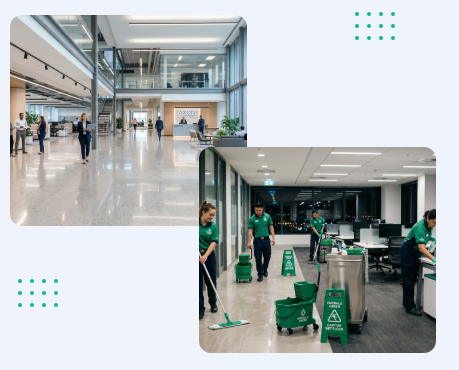
SparkClean Pro Saved Two At-Risk Contracts Worth $14K Monthly and Uncovered $2,800 in Time Fraud Using GPS-Verified Crew Tracking A Cleveland commercial cleaning company managing 20 crews across 60+ buildings per night replaced paper schedules with optimized routes, GPS tracking, and photo documentation, cutting transit time by 35% and eliminating client complaints about rushed jobs. In Conversation with Victor Okafor, General Manager, SparkClean Pro
The Challenge Victor Okafor had built SparkClean Pro into a $2 million business through reputation and reliability. Twenty crews worked nightly across 60+ buildings in the greater Cleveland area—office towers, medical facilities, retail spaces, warehouses. The company had long-standing contracts worth hundreds of thousands annually. The operation was built on trust and relationships. But trust without verification is dangerous in a services business. Each crew received printed weekly schedules listing their assigned buildings and contracted service times. Once dispatched, they operated with minimal oversight. Victor knew roughly when crews were supposed to arrive and depart, but had no objective verification of what actually happened at each building. He was running a $2 million operation on the honor system. The consequences emerged when clients started complaining. Three crews were suspected of rushing jobs. Property managers at two office towers reported noticing a decline in cleaning quality—lighter touch, corners cut, rooms not fully finished. A major hospital system expressed similar concerns about inconsistent work quality. The complaints weren’t vague impressions. They were specific observations about diminished service. The specific problems were critical: Two major contracts at risk: A property management company managing 8 office buildings ($9,000/month) formally warned SparkClean about quality decline and requested improved service or threatened to find a new vendor. A hospital system ($5,000/month) requested a meeting to discuss service concerns. Combined, these two contracts represented $14,000 monthly in at-risk revenue. No verification of time spent at locations: Paper sign-in sheets that crew leaders filled out were easily falsified and proved nothing. Victor had no way to verify whether a crew actually spent the contracted time cleaning or arrived for 30 minutes and left. Suspected time fraud: Victor’s suspicions about crews rushing jobs had no foundation. One crew leader claimed they spent two hours at a building. When Victor checked security camera footage from the property, the crew had left after 50 minutes. They were being paid for two hours of work but delivering 50 minutes. That single crew likely represented $2,800 monthly in unbilled shortfalls. Inefficient travel routes: Crews self-managed their routing between buildings, choosing sequences based on convenience or familiarity rather than optimization. The inefficiency wasted 20-30% of nightly drive time—time that should have been spent cleaning but was spent driving. No documentation of work quality: When clients complained about quality, Victor had nothing to show them. No before-and-after photos. No time-stamped records of arrival and departure. No objective evidence to defend SparkClean’s work or to address the concerns. “I had a crew leader tell me they spent two hours at a building. Security cameras showed them leaving after 50 minutes. That’s when I realized I was running a $2 million business on the honor system.” Victor Okafor General Manager, SparkClean Pro The Solution Victor knew he needed visibility into crew operations, but he wanted more than a GPS tracker. Standalone GPS systems showed location history but didn’t address the underlying routing inefficiency or provide the documentation that clients wanted. He needed an integrated platform that could optimize routes, track crews, and generate reports that could be shared with clients. Upper provided the integrated solution. Victor entered all 60+ buildings as service locations with assigned service times matching the contracted cleaning duration for each building. Upper’s route optimization sequenced each crew’s nightly buildings to minimize drive time while respecting the time constraints at each location. GPS Breadcrumb Trails for Accountability Continuous GPS recording created an objective record of arrival times, duration on-site, and departure times for each crew at each building. Victor could review the data and see exactly when crews arrived, how long they stayed, and when they left. The GPS data was objective and unambiguous—no paper sign-in sheets, no he-said-she-said conversations. Within two weeks of implementation, the GPS data revealed what Victor had suspected: three crews were under-spending contracted time. One crew leader was averaging just 55% of contracted hours per building across an entire week. Instead of spending two hours cleaning an office, they were spending about one hour. Across the weekly schedule, that represented approximately $2,800 monthly in unbilled services where SparkClean was being paid for cleaning that wasn’t fully delivered. Victor addressed the issue directly. Two crews corrected their behavior immediately when confronted with the GPS data. They understood they’d been caught and returned to contracted service times. One crew leader was replaced due to repeated pattern violations. The behavior changes were immediate and measurable in the GPS records. Before-and-After Photo Documentation Victor equipped crews with the ability to photograph key areas of each building upon arrival and before departure using Upper’s proof of delivery feature. Timestamped photos were automatically attached to the building records in the system. The photos showed the condition of the space at the start and end of the cleaning shift, creating visual evidence of work completed. The property management company that had been threatening to switch providers received their first weekly photo report—30+ photos from 8 buildings showing the before-and-after cleaning results. The property manager’s response came within one day: they were satisfied with the work and ended discussions about finding a new vendor. The visual documentation was more persuasive than any verbal assurance. Optimized Routes and Recaptured Time Route sequencing cut total transit time by 35% across all 20 crews. Instead of self-managing their driving between buildings based on convenience, crews now followed computer-optimized sequences that minimized drive time. On average, each crew recaptured 30-45 minutes nightly—time previously wasted in traffic that could now be applied to cleaning work. Victor redirected the recaptured time into the actual cleaning work itself. Instead of rushing to fit in a second building, crews could spend the optimized time ensuring quality work at each location. The rushing that had triggered client complaints was eliminated. The quality issues that had put contracts at risk were resolved. The analytics dashboard also revealed which crews were most efficient and how they were sequencing work. Victor used these insights to rebalance crew assignments and coach underperforming teams toward the practices of top performers. “I thought I was buying a GPS tracker. What I got was a complete operations system. The route optimization alone saved us 35% on drive time the first week. But the real value was finally knowing what was happening at every building, every night.” Victor Okafor General Manager, SparkClean Pro The Impact SparkClean Pro’s transformation was immediate and measurable. Both at-risk contracts stabilized within the first month. The property management company renewed their 8-building contract for a full year after three consecutive weeks of photo-documented, GPS-verified reports. The hospital system’s concerns were addressed after reviewing time-on-site data showing crews meeting or exceeding contracted service times. Both contracts remained with SparkClean, preserving the $14,000 monthly revenue that had been in jeopardy. Client complaints dropped 60% over the first quarter. The remaining complaints shifted in nature—no longer quality concerns about rushed or incomplete work, but minor scheduling requests and logistical adjustments. The perception shifted from “vendor on probation” to “reliable partner.” The time fraud that had cost approximately $2,800 monthly was eliminated once crew behavior was addressed. The GPS visibility created accountability that paper sign-in sheets never could have achieved. Crews knew they were being monitored, and the visibility motivated compliance with contracted service times. Crew leaders and teams responded better to the system than Victor expected. The best crews, who had always worked diligently, appreciated the GPS and photo documentation because it proved the quality of their work. When building managers complimented their cleaning, they could see the visual evidence in the system. Good performance was now recognized and documented. Victor began using the GPS tracking and photo system as a sales advantage. When pitching for new contracts, he demonstrated the system to prospective clients—showing them how they would have real-time visibility, time-stamped documentation, and photo evidence of work quality. The system became a competitive differentiator. SparkClean won two new contracts partly because prospects appreciated the transparency and accountability that the system provided. Performance Metrics Metric Before Upper After Upper Transit Time Between Buildings Self-managed, unoptimized 35% reduction Time Fraud / Under-Spent Hours ~$2,800/mo in unbilled shortfalls Eliminated through GPS verification Client Complaints Increasing, 2 contracts at risk 60% reduction At-Risk Contract Revenue $14,000/mo in jeopardy Both contracts renewed and stable Crew Time Verification Paper sign-in sheets (easily falsified) GPS breadcrumb trails with timestamps Quality Documentation None Before/after photos per building Available Cleaning Time Per Crew Lost to inefficient transit 30-45 minutes gained nightly “My best crews love the system because it proves they’re doing great work. My clients love it because they can see the proof. And I love it because I can run this business based on data instead of hoping everyone is doing what they’re supposed to do.” Victor Okafor General Manager, SparkClean Pro
The Challenge Victor Okafor had built SparkClean Pro into a $2 million business through reputation and reliability. Twenty crews worked nightly across 60+ buildings in the greater Cleveland area—office towers, medical facilities, retail spaces, warehouses. The company had long-standing contracts worth hundreds of thousands annually. The operation was built on trust and relationships. But trust without verification is dangerous in a services business. Each crew received printed weekly schedules listing their assigned buildings and contracted service times. Once dispatched, they operated with minimal oversight. Victor knew roughly when crews were supposed to arrive and depart, but had no objective verification of what actually happened at each building. He was running a $2 million operation on the honor system. The consequences emerged when clients started complaining. Three crews were suspected of rushing jobs. Property managers at two office towers reported noticing a decline in cleaning quality—lighter touch, corners cut, rooms not fully finished. A major hospital system expressed similar concerns about inconsistent work quality. The complaints weren’t vague impressions. They were specific observations about diminished service. The specific problems were critical: Two major contracts at risk: A property management company managing 8 office buildings ($9,000/month) formally warned SparkClean about quality decline and requested improved service or threatened to find a new vendor. A hospital system ($5,000/month) requested a meeting to discuss service concerns. Combined, these two contracts represented $14,000 monthly in at-risk revenue. No verification of time spent at locations: Paper sign-in sheets that crew leaders filled out were easily falsified and proved nothing. Victor had no way to verify whether a crew actually spent the contracted time cleaning or arrived for 30 minutes and left. Suspected time fraud: Victor’s suspicions about crews rushing jobs had no foundation. One crew leader claimed they spent two hours at a building. When Victor checked security camera footage from the property, the crew had left after 50 minutes. They were being paid for two hours of work but delivering 50 minutes. That single crew likely represented $2,800 monthly in unbilled shortfalls. Inefficient travel routes: Crews self-managed their routing between buildings, choosing sequences based on convenience or familiarity rather than optimization. The inefficiency wasted 20-30% of nightly drive time—time that should have been spent cleaning but was spent driving. No documentation of work quality: When clients complained about quality, Victor had nothing to show them. No before-and-after photos. No time-stamped records of arrival and departure. No objective evidence to defend SparkClean’s work or to address the concerns.
“I had a crew leader tell me they spent two hours at a building. Security cameras showed them leaving after 50 minutes. That’s when I realized I was running a $2 million business on the honor system.” Victor Okafor General Manager, SparkClean Pro
The Solution Victor knew he needed visibility into crew operations, but he wanted more than a GPS tracker. Standalone GPS systems showed location history but didn’t address the underlying routing inefficiency or provide the documentation that clients wanted. He needed an integrated platform that could optimize routes, track crews, and generate reports that could be shared with clients. Upper provided the integrated solution. Victor entered all 60+ buildings as service locations with assigned service times matching the contracted cleaning duration for each building. Upper’s route optimization sequenced each crew’s nightly buildings to minimize drive time while respecting the time constraints at each location. GPS Breadcrumb Trails for Accountability Continuous GPS recording created an objective record of arrival times, duration on-site, and departure times for each crew at each building. Victor could review the data and see exactly when crews arrived, how long they stayed, and when they left. The GPS data was objective and unambiguous—no paper sign-in sheets, no he-said-she-said conversations. Within two weeks of implementation, the GPS data revealed what Victor had suspected: three crews were under-spending contracted time. One crew leader was averaging just 55% of contracted hours per building across an entire week. Instead of spending two hours cleaning an office, they were spending about one hour. Across the weekly schedule, that represented approximately $2,800 monthly in unbilled services where SparkClean was being paid for cleaning that wasn’t fully delivered. Victor addressed the issue directly. Two crews corrected their behavior immediately when confronted with the GPS data. They understood they’d been caught and returned to contracted service times. One crew leader was replaced due to repeated pattern violations. The behavior changes were immediate and measurable in the GPS records. Before-and-After Photo Documentation Victor equipped crews with the ability to photograph key areas of each building upon arrival and before departure using Upper’s proof of delivery feature. Timestamped photos were automatically attached to the building records in the system. The photos showed the condition of the space at the start and end of the cleaning shift, creating visual evidence of work completed. The property management company that had been threatening to switch providers received their first weekly photo report—30+ photos from 8 buildings showing the before-and-after cleaning results. The property manager’s response came within one day: they were satisfied with the work and ended discussions about finding a new vendor. The visual documentation was more persuasive than any verbal assurance. Optimized Routes and Recaptured Time Route sequencing cut total transit time by 35% across all 20 crews. Instead of self-managing their driving between buildings based on convenience, crews now followed computer-optimized sequences that minimized drive time. On average, each crew recaptured 30-45 minutes nightly—time previously wasted in traffic that could now be applied to cleaning work. Victor redirected the recaptured time into the actual cleaning work itself. Instead of rushing to fit in a second building, crews could spend the optimized time ensuring quality work at each location. The rushing that had triggered client complaints was eliminated. The quality issues that had put contracts at risk were resolved. The analytics dashboard also revealed which crews were most efficient and how they were sequencing work. Victor used these insights to rebalance crew assignments and coach underperforming teams toward the practices of top performers.
“I thought I was buying a GPS tracker. What I got was a complete operations system. The route optimization alone saved us 35% on drive time the first week. But the real value was finally knowing what was happening at every building, every night.” Victor Okafor General Manager, SparkClean Pro
The Impact SparkClean Pro’s transformation was immediate and measurable. Both at-risk contracts stabilized within the first month. The property management company renewed their 8-building contract for a full year after three consecutive weeks of photo-documented, GPS-verified reports. The hospital system’s concerns were addressed after reviewing time-on-site data showing crews meeting or exceeding contracted service times. Both contracts remained with SparkClean, preserving the $14,000 monthly revenue that had been in jeopardy. Client complaints dropped 60% over the first quarter. The remaining complaints shifted in nature—no longer quality concerns about rushed or incomplete work, but minor scheduling requests and logistical adjustments. The perception shifted from “vendor on probation” to “reliable partner.” The time fraud that had cost approximately $2,800 monthly was eliminated once crew behavior was addressed. The GPS visibility created accountability that paper sign-in sheets never could have achieved. Crews knew they were being monitored, and the visibility motivated compliance with contracted service times. Crew leaders and teams responded better to the system than Victor expected. The best crews, who had always worked diligently, appreciated the GPS and photo documentation because it proved the quality of their work. When building managers complimented their cleaning, they could see the visual evidence in the system. Good performance was now recognized and documented. Victor began using the GPS tracking and photo system as a sales advantage. When pitching for new contracts, he demonstrated the system to prospective clients—showing them how they would have real-time visibility, time-stamped documentation, and photo evidence of work quality. The system became a competitive differentiator. SparkClean won two new contracts partly because prospects appreciated the transparency and accountability that the system provided. Performance Metrics Metric Before Upper After Upper Transit Time Between Buildings Self-managed, unoptimized 35% reduction Time Fraud / Under-Spent Hours ~$2,800/mo in unbilled shortfalls Eliminated through GPS verification Client Complaints Increasing, 2 contracts at risk 60% reduction At-Risk Contract Revenue $14,000/mo in jeopardy Both contracts renewed and stable Crew Time Verification Paper sign-in sheets (easily falsified) GPS breadcrumb trails with timestamps Quality Documentation None Before/after photos per building Available Cleaning Time Per Crew Lost to inefficient transit 30-45 minutes gained nightly
“My best crews love the system because it proves they’re doing great work. My clients love it because they can see the proof. And I love it because I can run this business based on data instead of hoping everyone is doing what they’re supposed to do.” Victor Okafor General Manager, SparkClean Pro