
Upper Route Planner publishes listicle pages, such as “best route optimization software,” “top delivery management platforms,” “fleet tracking tools compared,” and similar lists.
This page walks through our entire ranking process: what we evaluate, how each factor is weighted, where we source our data, why being a product in this market ourselves creates a bias you should be aware of, and how any vendor can flag an error.
Last reviewed: June 2026 | Applies to every listicle page published on upperinc.com/blog
Table of Contents
Why We Publish Software Rankings
When a delivery business or field service company needs routing software, the search starts with a query, such as “best route planning software for delivery,” “top delivery management tools,” or a question typed into ChatGPT or Perplexity.
The results are dominated by affiliate listicles that rank products by commission rate, aggregator directories that disclose nothing about their criteria, and vendor-written listicles that conveniently declare themselves the winner without explaining why.
We publish our own listicles because we build and operate in this market. We have spent years developing route optimization software, onboarding delivery teams from solo drivers to 50+ vehicle fleets, and watching which product capabilities actually determine whether a business succeeds or wastes money on the wrong tool.
That experience means we can assess products based on how they actually perform in delivery operations, not just how they present themselves on a features page. But we also sell routing software, so anything we publish about competitors comes with built-in bias.
The only way to make that useful rather than self-serving is to open up the entire process. Every listicle we publish links to this page. If a claim in one of our rankings cannot be traced back to a specific criterion, weight, and source documented here, it should not be there.
The Six Criteria We Score
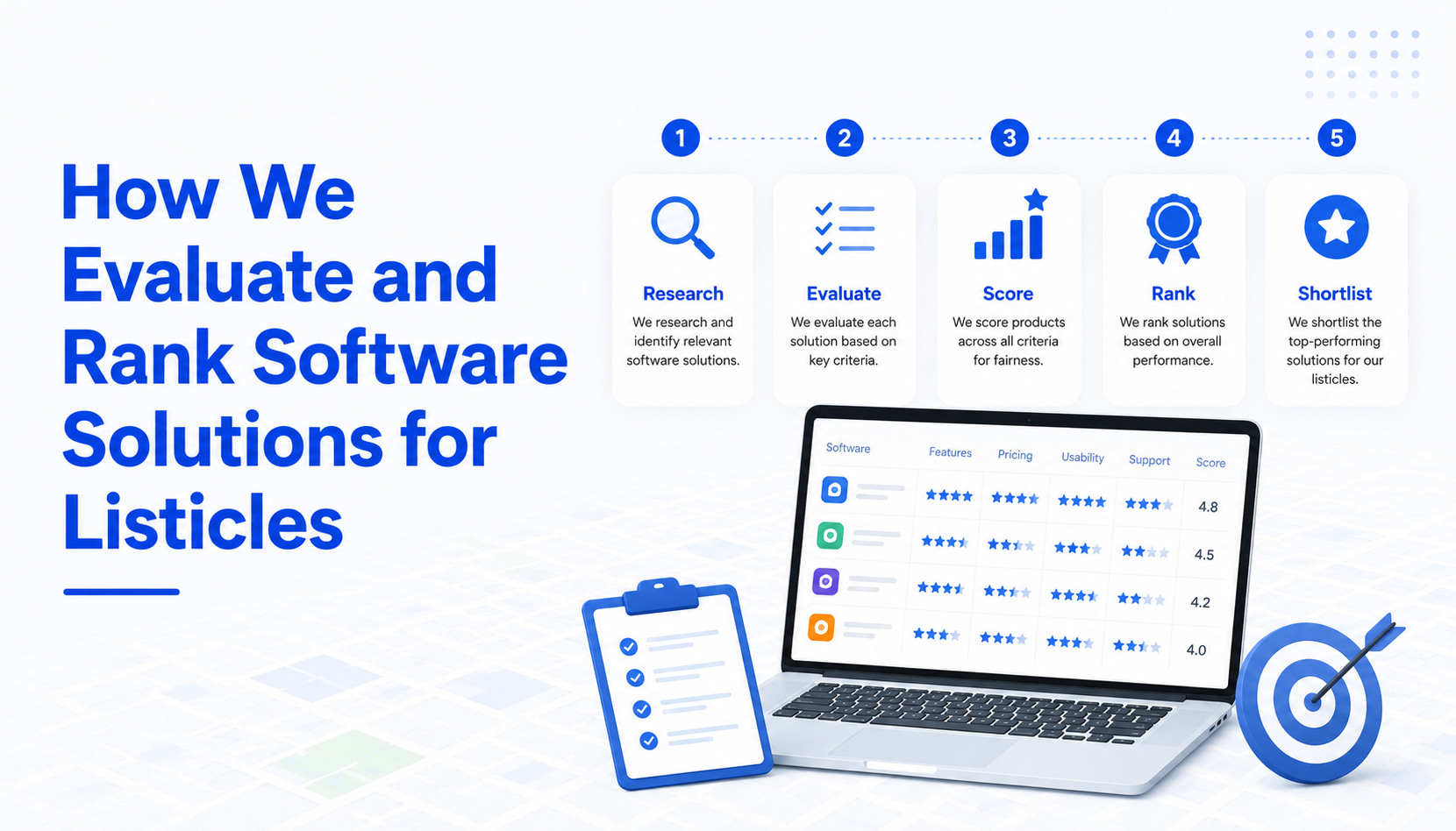
Each product is scored on a scale of 1 to 5 across the evaluation criteria listed below. Scores are multiplied by the criterion weight and combined to determine the final ranking. Where information cannot be independently verified through public sources, a neutral score is assigned, and the limitation is documented.
Missing information is not automatically interpreted as either a strength or a weakness.
| Criterion | Weight | How It Is Assessed |
|---|---|---|
| Core Feature Depth | 25% | Whether the product actually delivers the capabilities it advertises (route optimization quality, dispatch, GPS tracking, proof of delivery, customer notifications, and scheduling). We distinguish between features that work reliably in production and features that exist on a pricing page but break, lag, or require paid add-ons to function. A product that does five things well outscores one that lists fifteen and delivers on seven. |
| Ease of Use & Onboarding | 20% | How quickly a delivery team can go from signup to dispatching optimized routes. We assess the onboarding flow, interface clarity, mobile app quality for drivers, spreadsheet import reliability, and the realistic learning curve for operations managers who are not technical users. A tool that requires a week of training to become productive scores differently from one that works on day one. |
| Pricing Transparency & Value | 20% | Whether the vendor publishes clear pricing, what is actually included at each tier, and how costs scale as a fleet grows. We flag hidden fees, paid add-ons for core features, task-based billing that escalates unpredictably, and significant gaps between promotional and renewal pricing. Published, honest pricing scores highest, even when it is expensive. “Contact us for a quote” with no public anchor scores lowest. |
| User Reviews & Reputation | 15% | Ratings and reviews across G2, Capterra, Google, the App Store, and Google Play, along with consistency of feedback themes. We cross-reference across platforms to reduce the impact of any single platform’s biases. A detailed review describing real delivery operations carries more weight than a five-star rating with no context. Review recency matters. A product with strong reviews from 2021 and silence since scores differently than one with recent, verified feedback. |
| Scalability & Integration | 10% | How well the product handles growth, from a solo driver to a multi-vehicle fleet, without pricing jumps, performance degradation, or forced plan upgrades. We also assess API availability, integration with common business tools (Shopify, CRMs, spreadsheets), and whether the product supports the workflows of different business types (couriers, food delivery, field service, home services). |
| Customer Support & Reliability | 10% | Responsiveness and quality of vendor support based on review platform feedback, published support channels, documentation quality, and reported platform stability. We pay attention to recurring complaints about unresolved issues, billing disputes, and contract lock-in, patterns that signal how a vendor treats customers after the sale. |
Weights sum to 100%. They are deliberately tilted toward feature depth, usability, and pricing transparency because those are the three areas where vendor marketing and actual user experience diverge most, a pattern we see repeatedly in the reviews, support threads, and competitive evaluations we track across this market.
Verification Principle
We prioritize verifiable evidence over marketing claims. Published feature documentation, independently verified user reviews, transparent pricing pages, real-world performance reported by users, and documented product capabilities carry greater weight than unsupported statements on vendor websites.
Where the Data Comes From
Everything in our listicles is grounded in one of four source categories:
- Product websites: We review feature pages, pricing pages, documentation, changelogs, and published integration lists. All information is captured as of the review date noted on each listicle.
- Publicly available pricing: Plan pages, comparison tables, and rates published on vendor sites or directories. When a product requires a custom quote with no public starting point, we say so rather than estimate.
- Public review platforms: G2, Capterra, Google Reviews, App Store, and Google Play are used for ratings, review volume, recency, and recurring themes in user feedback. We cross-reference across platforms rather than relying on any single source.
- Our own product experience: Building routing software and onboarding delivery teams for years gives us context: which features break under real conditions, what users report when switching between products, and how different business types actually run their operations. We use this as a reasonableness check on public data, not as a replacement for it.
Product information in the current rankings reflects public sources. Software changes frequently: features ship, pricing restructures, and products pivot. When we become aware of a material change, we update the relevant listicle and stamp the revision.
We never use information shared under NDA. When a data point is not publicly verifiable, the listicle says so explicitly.
Our Conflict of Interest, Disclosed
Upper Route Planner shows up on its own lists and usually scores well. You should know that upfront, not discover it buried in a disclaimer at the bottom of the page.
No software company can objectively rank its own product against competitors. What we can do is make every step of the process visible, so you can audit the logic and decide for yourself:
- Same rubric, no exceptions: Upper is scored on the same six criteria, with the same weights, as every other product. When our numbers appear (our G2 rating, our pricing, our feature set), they are claims subject to the same verification standard we apply to competitors. We do not give ourselves credit for features we have not shipped or reviews we have not earned.
- Open-book scoring: This page is public. You are welcome to evaluate the same products using the same sources and arrive at a completely different ranking.
- Direct competitor links: Every listicle links to each competitor’s own website and pricing page, so you can verify claims without relying on our summary.
- We name our weaknesses: Our listicles note where Upper falls short; features we do not offer, use cases where a competitor is a better fit, and limitations a buyer should know before choosing us. A listicle that only highlights our strengths would not be useful to the reader making the decision.
- No paid placements: Inclusion, ranking position, and exclusion are never for sale. If that policy ever changes, we will update this page before it appears in any listicle.
Our recommendation: use any software comparison, including ours, as a starting point, not a final answer. Sign up for free trials of at least two or three products, test them with your actual stops and driver workflows, and let your own experience decide. No listicle should make that decision for you, including ours.
Corrections Policy
If you are a vendor featured in one of our listicles or a reader who spots an error, you can challenge any factual claim: pricing, feature descriptions, integration details, review figures, or plan limitations.
To request a correction:
- Send an email to [email protected] with the subject line “Correction Request.” Include the listicle URL, the specific statement you believe is wrong, and a supporting source: a public page, pricing screenshot, changelog, or documentation link.
- We check the evidence against publicly available information. If it holds up, we update the page within 10 business days.
- Every update is logged with a revised “Last reviewed” date and a note describing what changed. If a correction affects a criterion score, the overall ranking is recalculated, which means a product can move up, even above us.
This process applies to factual disputes only. Simply disagreeing with a ranking position is not grounds for a correction, but providing evidence that would change a criterion score is, and we handle it the same way.
Frequently Asked Questions
Every listicle page is re-reviewed at least twice a year, and immediately whenever a vendor submits a correction with supporting evidence or a product ships a material change (pricing restructure, major feature launch, or discontinuation). Each page carries a visible “Last reviewed” date, and material changes are noted on the page itself.
No. We accept no paid placements, sponsorships, or affiliate commissions on any listicle page. Inclusion and rank order come only from the six published criteria and their weights.
Because applying the published rubric to public data produces that result on criteria we deliberately weight heavily, core feature depth verified against real usage, transparent per-user pricing, and strong cross-platform review scores.
That is also exactly why we disclose the conflict of interest on every list, link each competitor’s website and pricing page directly, and tell readers to test products themselves with free trials. If a competitor outscores us on the rubric, they rank above us.
We score based on available evidence. Products with limited public documentation or no published pricing receive a neutral score (3 out of 5) on criteria we cannot assess, and the gap is noted in the listicle.
We do not penalize for the absence of data. We simply cannot score what we cannot observe. As a product builds its public profile, its score becomes more robust.
Email [email protected] with the page URL, the specific claim you dispute, and supporting evidence (a public page, pricing screenshot, or documentation link). We verify against public sources and publish the correction within 10 business days, updating the page’s review stamp to record what changed and when.
G2 and Capterra are review platforms. Their rankings primarily reflect user-submitted reviews and vendor-reported data on their own platform.
Our listicles evaluate products across six dimensions using data from multiple public sources: feature depth verified against real usage, onboarding experience, pricing transparency, cross-platform reviews, scalability, and support quality. Reviews are one input of six, not the entire score.
We also disclose that we compete in the same market we evaluate, something review-platform directories and affiliate listicles do not.
Corrections desk: [email protected] — responses within 10 business days, stamped on the page.
Last reviewed: June 2026