

- Define the delivery-time clock and on-time rule before comparing days, drivers, routes, or tools.
- Capture ready, release, departure, arrival, service, proof, and closeout timestamps so delay has a location in the process.
- Rank delay causes by controllable minutes and recurrence, then fix the narrowest stage with a named owner.
- Release only feasible routes and manage day-of variance through thresholds, exception authority, and versioned instructions.
- Judge improvement with counts, rates, percentiles, open-work visibility, safety checks, and a matched pilot population.
Improving delivery time does not mean telling drivers to move faster. It means removing avoidable waiting, rework, search, bad sequencing, late release, failed handoffs, and slow exception decisions while preserving safety, service rules, and proof requirements. Start by deciding which clock you want to improve: order-to-door, ready-to-depart, departure-to-arrival, arrival-to-completion, or promised-window performance.
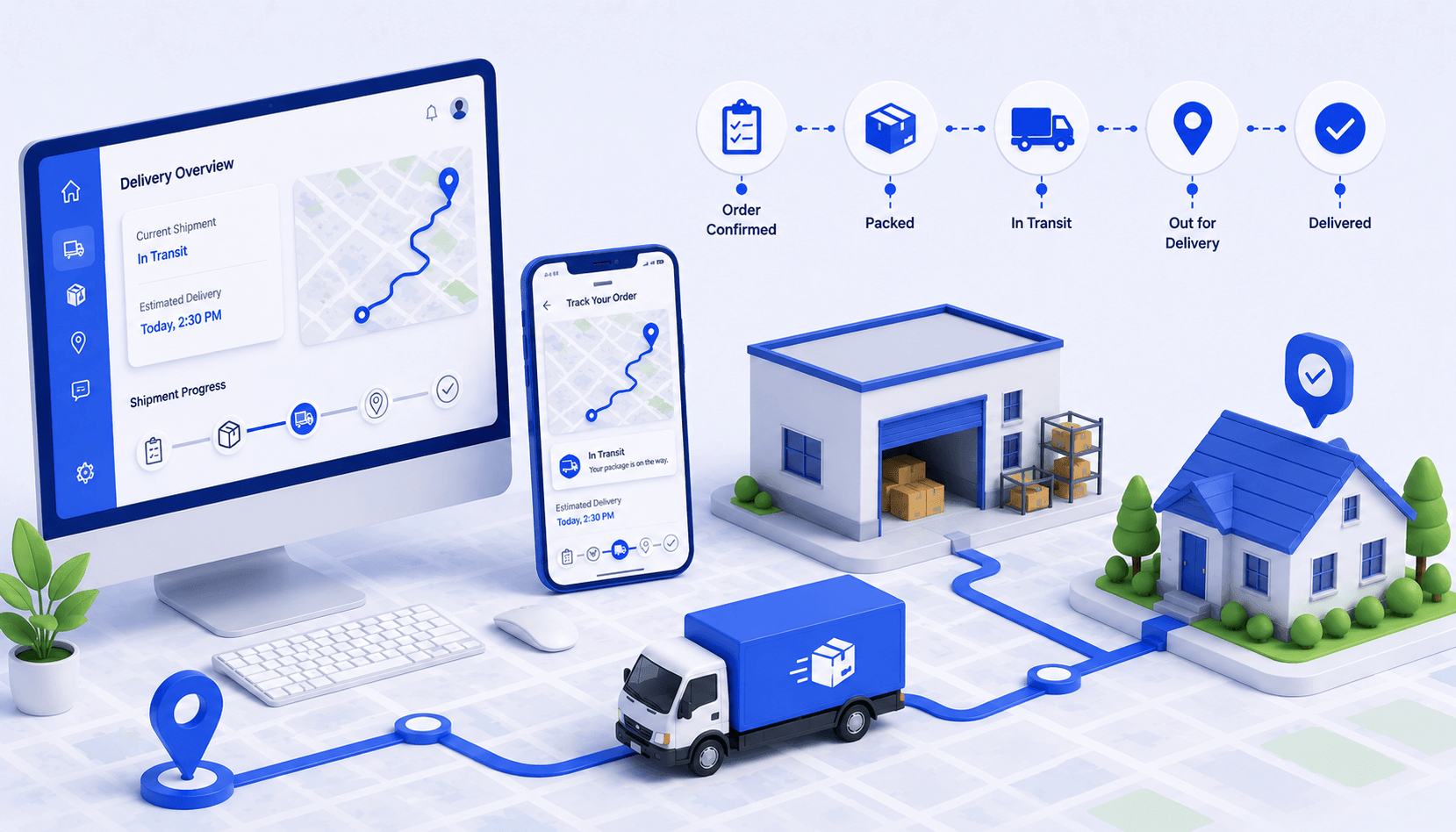
A useful delivery-time record follows each accepted stop through ready time, route release, departure, arrival, service start, service end, proof capture, and closeout. It keeps planned and actual timestamps separate. Google’s documented route metrics likewise separate travel, wait, break, visit, and total duration, which is a useful reminder that one average cannot explain the day.
This playbook shows how to define the clock, locate lost minutes, rank controllable causes, improve route and departure controls, manage day-of exceptions, reduce site friction, protect legal and workforce boundaries, and run a fixed-scope pilot. You can use it with manual tools or software because the method begins with evidence and decision ownership.
No tactic guarantees shorter deliveries in every operation. Geography, service duration, access, demand, weather, vehicle limits, driver rules, customer commitments, and data quality set real boundaries. Treat a change as successful only when the same defined population improves without moving failure, risk, or unfinished work elsewhere.
I work on delivery operations content at Upper, and the fastest wins I see are almost never in the driving time.
What Does Improving Delivery Time Actually Mean?
Improving delivery time means reducing the elapsed time or lateness of a defined delivery population by changing a known process stage without weakening safety, service, evidence, or completion rules.
Use a precise start event, end event, and on-time rule. Order-to-door measures the entire customer-facing lead time. Departure-to-completion measures field execution. Ready-to-depart isolates the origin handoff. On-time delivery asks whether completion met a promised or policy window. These measures answer different questions and should not be substituted for one another.
| Measure | Start | End | Use |
| Order-to-close time | Accepted order or job | Authorized closeout | End-to-end process and backlog |
| Ready-to-depart time | Work accepted for the day | Vehicle departure | Origin, staging, planning, and release |
| Route cycle time | Vehicle departure | Vehicle return or last required stop | Field execution at route level |
| Stop completion time | Arrival or service start | Required service and proof complete | Access, service, search, and evidence |
| On-time completion | Accepted in-scope deliveries due by the cutoff | Completion inside the agreed rule | Promise reliability |
How Should You Define on Time?
Record whether the promise applies to arrival, service start, or completion. State whether the boundary is inclusive, which timezone controls, how early arrivals are treated, and which approved cancellations or holds remain in the denominator. Keep counts beside the rate so a smaller completed population cannot appear better by hiding unfinished work.
Should Faster Delivery Be the Only Objective?
No. Pair the time measure with failed attempts, incomplete proof, open exceptions, rework, safety events, driver-rule compliance, customer commitments, and any service-quality gate your operation owns. A change that shortens recorded time by skipping required work is not an improvement.
Once the clock is defined, the next task is to show where that clock is consumed.
Where Is Delivery Time Being Lost?
Locate lost time by building a timestamp ladder for every in-scope delivery and assigning each variance to readiness, release, travel, waiting, service, exception, proof, or closeout.
Begin with the smallest timestamp set that reconstructs the flow. Preserve missing events as missing, not zero. A zero-minute stage means both boundaries were observed at the same time; a missing stage means the process cannot yet prove what happened.
| Stage | Required events | Variance question | Typical owner |
| Readiness | Accepted, picked or prepared, staged | Was the work complete when planning expected it? | Origin or service owner |
| Planning and release | Candidate created, gate passed, version released | Did validation or approval hold the route? | Planner or dispatcher |
| Departure | Driver acknowledged, load accepted, departed | Was the assigned resource ready and able to leave? | Dispatch and origin |
| Travel and waiting | Departed, arrived, service allowed | Was time spent moving, waiting, parking, or accessing? | Planning and operations |
| Service and proof | Service start, service end, proof complete | Did work, search, access, or evidence exceed the input? | Field and closeout |
| Exception and closeout | Signal, decision, new instruction, disposition | How long did ownership or approval remain unresolved? | Exception owner |
What Delay Reason Codes Should You Use?
Use mutually understandable codes with an owner, evidence rule, and correction path. Examples include not ready, invalid location, missing access instruction, resource unavailable, load mismatch, late release, traffic variance, parking or site access, customer unavailable, service-duration overrun, added work, system or communication failure, proof correction, and unresolved closeout. Keep an other code only with required notes and review it regularly.
How Do You Avoid Blaming the Driver for Every Variance?
Assign the reason to the process stage and decision owner supported by the evidence. A late completion can originate in an unrealistic route, an origin delay, a missing access code, an unplanned service request, or an unresolved dispatch decision. Driver identity may be an analysis dimension, but it is not a cause code.
The timestamp ladder produces a queue of causes. The next step is choosing which cause merits action first.
Which Delivery Delays Should You Fix First?
Fix the delay family with the largest controllable time inside the defined population, sufficient recurrence, a named owner, and a change that does not shift risk or unfinished work to another stage.
For each reason code, retain the affected delivery count, total minutes, median minutes, high-percentile minutes, operational owner, evidence quality, and current fallback. Separate controllable from external variance, but do not discard external events if they expose a planning or communication response that you can improve.
| Screen | Question | Decision |
| Population | Does the cause affect enough comparable deliveries to test? | Combine periods or narrow the claim |
| Control | Can your operation change the input, gate, method, owner, or response? | Act, monitor, or document the boundary |
| Evidence | Are start, end, reason, and affected scope observable? | Repair measurement before claiming a fix |
| Risk | Could the change weaken safety, service, proof, or workforce rules? | Reject or add a protective gate |
| Spillover | Could time fall here while rework, failure, or backlog rises elsewhere? | Add paired measures and open-work counts |
| Ownership | Can one person approve, test, and stop the change? | Name authority before the pilot |

See it in action
Need the full route-planning method?
Use the companion guide to prepare stops, time windows, durations, capacity, assignments, release evidence, and an execution-ready route version.

After priority is clear, repair the plan before trying to recover time in the field.
How Do You Improve Route Plans Before Dispatch?
Improve pre-dispatch route time by validating every stop, modeling service and waiting, applying customer and operating windows correctly, testing resource constraints, exposing rejected work, and releasing one feasible version.
A shortest path is not automatically a workable route. Feasibility depends on location quality, stop duration, access, time windows, vehicle and driver eligibility, load transitions, breaks, start and end requirements, and the return or closeout rule. Audit all accepted work, including stops that the method cannot place.
Google’s time-window documentation distinguishes global model boundaries, shipment pickup or delivery windows, and vehicle start or end windows. Shipment windows apply to visit start, while visit duration can extend beyond the shipment window only inside the vehicle and global operating windows. That distinction helps prevent a route from appearing on time merely because arrival occurs before the work can actually finish.
| Release gate | Pass condition | Failure response |
| Work coverage | Every accepted stop is routed, held, rescheduled, canceled, or rejected | Expose the missing state and owner |
| Input quality | Location, duration, window, load, access, priority, and proof fields pass | Return fields for correction |
| Resource fit | Driver, vehicle, equipment, and work rules match | Reassign or hold explicitly |
| Timed feasibility | Travel, service, waiting, breaks, windows, and route boundary fit | Revise, split if allowed, or change commitment through its owner |
| Version control | One route ID, timestamp, and approver are current | Keep the candidate unreleased |
| Execution handoff | Driver receives sequence, instructions, proof rule, and exception path | Resolve access or acknowledgment failure |
See it in action
Turn the stop list into a controlled route candidate
Import stops, set relevant constraints, inspect the proposed sequence, and preserve the released version and any work that still needs a decision.
A feasible route can still leave late if the origin handoff is not controlled.
How Do You Cut Origin-to-Departure Time?
Cut origin-to-departure time by synchronizing work readiness, route release, resource arrival, staging, load verification, and driver acknowledgment around one departure gate.
Treat departure as a handoff, not a vague target. The origin owner provides ready work, count, handling state, and staging location. The dispatcher provides the current route and assignments. The driver confirms access, load acceptance, instructions, and the exception path. The departure event closes the gate.
How Should Loads Be Staged?
Use a repeatable position rule tied to the released route, package or item identifiers, handling requirements, and access needs. Reverse-stop loading can help when the physical layout and item characteristics permit it, but do not present it as universal. Record mismatches before departure and preserve any approved substitution or route change.
What Should Happen When Work Is Not Ready?
Move the affected delivery or route into a visible hold with the missing condition, owner, decision deadline, and permitted response. Do not release an incomplete load and assume the field team will repair the record. If the commercial commitment must change, route that decision to its owner and retain what the customer was told.
| Departure checkpoint | Evidence | Owner |
| Work ready | Count, identifiers, handling state, staging location, ready timestamp | Origin |
| Route current | Released route ID, version, approval, work-state manifest | Planning or dispatch |
| Resources ready | Driver, vehicle, equipment, and eligibility acceptance | Scheduling or dispatch |
| Load accepted | Verification result, mismatch or exception record | Origin and driver |
| Instructions received | Sequence, access, proof, customer-contact, and failure rules | Dispatcher and driver |
| Departure observed | Actual time, current route version, unresolved hold count | Dispatch |
After departure, the plan becomes a stream of expected and observed events.
How Do You Improve Delivery Time During Live Execution?
Improve live delivery time by detecting meaningful variance early, assigning one exception owner, changing only the affected scope, issuing a new instruction version when needed, and retaining the decision and communication record.
Tracking by itself does not shorten a route. It becomes useful when an observed event crosses a defined threshold and an authorized person can choose a permitted response. Thresholds may concern missing departure, travel variance, service overrun, skipped work, failed contact, resource failure, or a new request. Set them from your operating policy and evidence, not a universal number.
| Signal | First check | Permitted decision | Record |
| Departure missing | Readiness, access, assignment, event feed | Confirm, correct, hold, or release again | Expected and actual state |
| Travel variance | Traffic, location, route change, timing basis | Monitor, communicate, or replan affected stops | Source, threshold, decision |
| Service overrun | Work, access, waiting, duration input, new request | Update expectation or revise later work under policy | Cause and affected scope |
| Customer unavailable | Contact, access, wait, and proof rules | Retry, reschedule, return, or fail under policy | Attempts and disposition |
| Resource failure | Driver, vehicle, equipment, load, safety state | Stop, substitute if eligible, transfer if allowed, or reschedule | Failure and new version |
| Added or canceled work | Authority, cutoff, capacity, timing, recipient impact | Accept, hold, replan, or reject | Request, approver, before and after |
When Should You Replan?
Replan when the current route cannot satisfy the remaining approved work and the expected value of a new plan justifies the handoff cost and disruption. Preserve the old version, affected stops, decision owner, new instructions, communication status, and any work left unassigned. Do not silently reorder a route already in execution.
How Should You Update Customers?
Tie messages to observed or approved events. Retain the audience, trigger, time, channel, content version, send state, delivery state if available, and fallback. A sent message is evidence of a communication attempt, not proof that the recipient received, read, or accepted the change.
See it in action
Review route progress with the released plan in context
Use driver location and stop progress to identify variances, then apply your own thresholds, ownership rules, and approved response paths.
Live control reduces only field variance. Site access, work, and evidence still need their own design.
How Do You Reduce Stop and Failed-Attempt Time?
Reduce stop and failed-attempt time by validating access and recipient requirements before release, modeling realistic service duration, organizing items for retrieval, and defining proof and failure paths before arrival.
Separate travel, waiting, access, search, service, proof, and departure from the stop. If every minute after arrival is recorded as service, the operation cannot tell whether the input duration was wrong or the driver waited for parking, entry, a recipient, an item, an approval, or a working capture method.
| Stop-time component | Prevention or response | Evidence |
| Parking and entry | Validate vehicle access, loading zone, entrance, floor, gate, and local restriction | Access instruction version and arrival notes |
| Recipient readiness | Confirm contact policy, availability condition, wait rule, and fallback | Contact attempts and response state |
| Item retrieval | Tie load position and item identifier to the released sequence | Load verification and retrieval exception |
| Service work | Model the required work and any permitted variation | Service start, end, scope, and reason |
| Proof capture | Define required fields, acceptable methods, failure path, and correction owner | Proof packet and capture state |
| Failed attempt | Define retry, reschedule, return, disposal, and customer-decision authority | Failure reason, evidence, disposition, next owner |
Should You Remove Proof Steps to Save Time?
No. Collect only the evidence required by the applicable contract, policy, cargo rule, customer instruction, and law, but do not weaken an approved requirement for a faster timestamp. If the capture method is slow or unreliable, test a safer method while preserving sufficiency, access, correction, and retention decisions.
How Do You Learn From Failed Attempts?
Keep the failed attempt inside the denominator and lifecycle. Record the attempt time, location, contact evidence, access condition, reason, required proof, disposition, and next owner. Group only comparable reasons. A failed attempt caused by an invalid address needs a different corrective owner from one caused by recipient unavailability or resource failure.
Time improvement must remain inside legal, safety, and workforce constraints.
How Do You Improve On-Time Delivery Without Unsafe Pressure?
Make safety, driver eligibility, hours, vehicle, cargo, access, and service requirements hard release and execution constraints; never use a time target to authorize speeding, skipped breaks, unsafe handling, or incomplete work.
Rules depend on jurisdiction and operation. In the United States, FMCSA defines hours of service as limits on on-duty and driving time plus required rest periods for covered commercial motor vehicle operations. Its current federal page also describes a 30-minute break requirement after 8 cumulative hours of driving time for covered drivers, subject to the complete rule, scope, and exceptions. Confirm the rules that apply to your drivers and work with qualified owners.
What Should the Release Gate Protect?
Protect driver and vehicle eligibility, required rest and work limits, safe loading, cargo handling, equipment, road restrictions, site rules, privacy, customer-contact policy, and proof sufficiency. A candidate route that depends on violating a boundary is infeasible, even if its planned completion time is attractive.
How Should Supervisors Use Driver Comparisons?
Compare like work only after controlling for route, geography, access, service type, item handling, time windows, traffic basis, and evidence requirements. Use the comparison to inspect process inputs and coaching needs, not to infer effort, fault, or safety from one average.
With the boundaries set, the scorecard can show whether the change actually improved the defined process.
Which Metrics Show Whether Delivery Time Improved?
Use counts and distributions for each time component, an explicit on-time denominator, failure and open-work measures, and paired safety and quality checks; compare matched periods rather than a single average.
Keep route-level and stop-level measures separate. A route can finish earlier while more stops fail, and a stop average can fall because long or unfinished work was excluded. Publish the population, cutoff, source, timezone, exclusions, missing-event count, and owner with every result.
| Measure | Definition | Required companion |
| On-time completion rate | Accepted in-scope deliveries completed inside the defined rule divided by all accepted in-scope deliveries due | Counts for on-time, late, failed, canceled, held, and open |
| Stage elapsed time | End event minus start event for readiness, release, departure, travel, wait, service, proof, or closeout | Missing-event count and percentiles |
| First-attempt completion | Accepted deliveries completed on the first due attempt divided by accepted deliveries due for an attempt | Failure reasons and follow-up state |
| Exception decision time | Decision event minus threshold or exception event | Reason, owner, affected scope, and unresolved count |
| Route completion | Last required route event minus departure | Completed, failed, skipped, held, added, and returned work |
| Proof closure | Accepted proof packets divided by all in-scope packets due for review | Returned, corrected, missing, and open packets |
Google’s Route Optimization response is one example of why component measures matter. Its documented response distinguishes travel, wait, delay, break, visit, total duration, distance, performed shipments, and vehicle use. It also warns that when all modeled costs are zero, a constraint-satisfying solution may not have an optimized visit order. Keep your input objective and constraints with the result you evaluate.
Why Use Percentiles as Well as Averages?
Averages can hide a long tail of late routes or stops. Report the median and a chosen high percentile beside the count and average, and define the population before calculation. Do not select the percentile after seeing which one makes the pilot look best.
How Often Should You Review Delivery-Time Data?
Use a cadence matched to the decision. Day-of thresholds support execution; daily closeout repairs records; weekly or service-cycle review finds recurring causes; a longer matched period tests structural changes. The cadence should not outrun the data quality or create constant policy changes.
The scorecard supplies the evidence needed for a controlled implementation decision.
How Do You Run a Delivery-Time Improvement Pilot?
Run a fixed-scope pilot on comparable work, change one primary control at a time, retain normal and stress cases, and decide whether to keep, revise, reject, or expand the change from the complete scorecard.
Choose one route family, service type, or operating period with stable definitions and an owner. Capture a baseline before changing the method. Include a normal case and the exception cases most likely to expose the control, such as late readiness, bad access data, a resource failure, added work, customer unavailability, or proof-capture failure.
| Step | Action | Output | Decision gate |
| 1 | Define population, clocks, on-time rule, constraints, and owners | Metric and responsibility contract | Comparable scope is explicit |
| 2 | Validate event coverage and delay codes | Timestamp ladder and missing-data queue | Stages can be reconstructed |
| 3 | Select one controllable delay family | Hypothesis and protected measures | Change has an authorized owner |
| 4 | Record the current method on normal and stress cases | Baseline scorecard and failure path | Open work remains visible |
| 5 | Apply the candidate change with stop authority | Versioned pilot method | Safety and quality gates remain active |
| 6 | Compare matched counts, rates, distributions, failures, and backlog | Pilot result and limitations | No denominator or scope drift |
| 7 | Keep, revise, reject, or expand | Decision, owner, next scope, and rollback | Evidence supports the recorded decision |
What Invalidates the Pilot?
Stop or qualify the result when the population changes materially, required events disappear, drivers or routes are not comparable, safety or quality gates fail, policy changes during the test, unfinished work is excluded, or the method depends on unsupported manual work. Record the limitation instead of converting a partial result into a general claim.
When Is the Change Ready to Expand?
Expand only when the change is repeatable, its owner and fallback are clear, protected measures remain acceptable, open work reconciles, stress cases have a permitted response, and another reviewer can reproduce the result from retained records. Expansion is a new scope decision, not proof that every route will improve.
A controlled pilot now supports a bounded product evaluation.
Conclusion: How Can Upper Support Delivery-Time Improvement?
Upper can be evaluated for stop import, constraint-based route planning, route editing, route progress, driver location, and customer tracking links while your operation retains responsibility for commitments, source data, safety, eligibility, exception authority, proof rules, and outcome measurement.
Bring one matched route-day baseline and one stress case to the evaluation. Include the accepted-work manifest, stop and service inputs, time windows, resource rules, release gate, delay reasons, expected events, exception thresholds, protected measures, and closeout scorecard. Test whether the configured workflow preserves held and failed work, one released version, the approved response path, and enough evidence to reproduce the decision.
Do not credit a product for shorter planned time if the candidate drops work, relaxes constraints, ignores service or waiting, changes the denominator, or leaves a manual exception queue unmeasured. Compare your current and candidate methods on the same accepted work and record the product ceiling.
Use the pilot to decide whether Upper fits the controls your delivery operation actually uses. Book an Upper demo.
See it in action
See Where Your Delivery Time Actually Goes
Bring one route with planned and actual times, and see how Upper separates readiness, travel, and stop work.
The most common questions concern the first step, route design, warehouse delays, live tracking, customer communication, failed attempts, and safe measurement.
Use these answers as operating checks. Your service promise, contracts, jurisdiction, workforce, cargo, customer, data, and approved product configuration determine the final rule set.
What Are the Frequently Asked Questions About Improving Delivery Time?
Define the start event, end event, on-time rule, denominator, scope, cutoff, and owner. Then capture the timestamp ladder for the same population before choosing a tactic.
No. A route method can improve a defined objective only within the inputs, constraints, costs, and work it models. Validate locations, durations, windows, resources, waiting, service, breaks, and rejected work, then compare the complete outcome with the current method.
Synchronize work readiness, route release, staging, load verification, driver access, and departure around one gate. Measure each event separately so you know whether the delay came from preparation, planning, assignment, loading, acknowledgment, or release.
Tracking can provide events for an approved response. It helps only when the operation defines a meaningful threshold, gives one owner authority, changes the smallest affected scope, communicates the new instruction, and retains the result.
Messages can support recipient readiness and exception handling when tied to observed or approved events. Retain the trigger, audience, time, content version, send state, and fallback, and do not treat a sent message as proof of receipt or acceptance.
Validate location, contact, access, recipient, time-window, item, handling, and proof requirements before release. Define the wait, contact, retry, reschedule, return, and failure paths, and keep every due attempt in the denominator.
There is no universal target. Set a local target from a defined baseline, service promise, feasible route, safety and driver rules, cargo requirements, customer needs, and protected quality measures. Reject any target that depends on speeding, skipped breaks, unsafe handling, or incomplete work.