

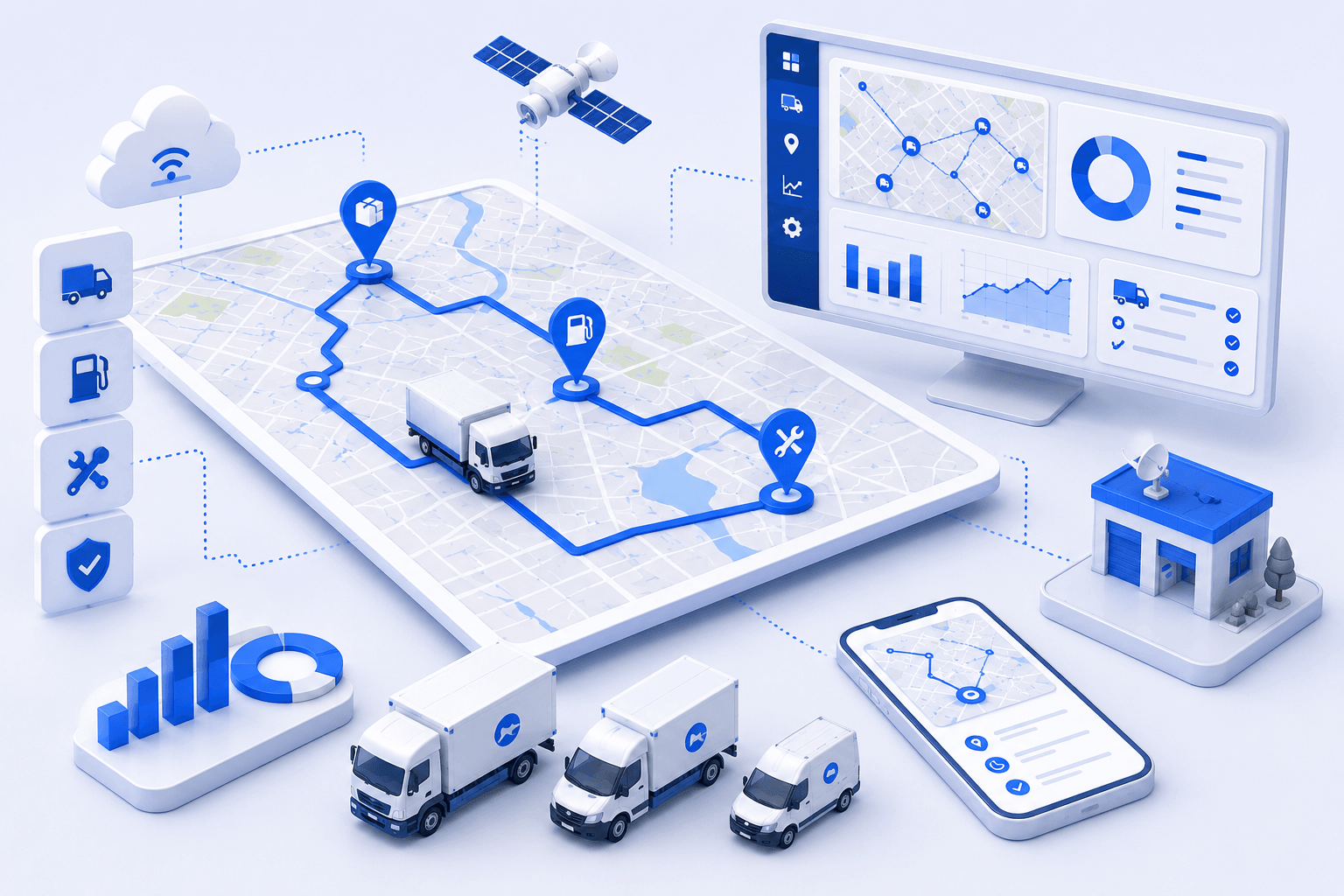
If you’re researching AI in logistics, you’re likely hearing about billion-dollar enterprise transformations while wondering how any of it applies to your 15-vehicle delivery fleet. For fleet operators running 5 to 100 vehicles, the gap between AI headlines and daily operations feels enormous.
According to Precedence Research, “the AI in logistics market was valued at 17.96 billion in 2024 and is projected to reach $707 billion by 2034 at a 42.8% CAGR,” but most of that growth coverage focuses on warehouse robotics and global supply chains, not the mid-size fleets doing the actual delivering.
Without understanding which AI applications deliver practical ROI, fleet operators either overspend on enterprise tools or miss out on AI capabilities already embedded in modern fleet management software. The most impactful AI applications for delivery fleets are not experimental. They are production-ready features inside platforms that fleet managers use every day.
This guide covers what AI actually means for fleet and delivery operations, the practical AI applications that deliver measurable ROI, how to get started without a data science team, the challenges you will face and how to overcome them, and what to look for in an AI-powered fleet management platform. Let’s get started.
Table of Contents
- What Does AI in Logistics Actually Mean?
- Practical AI Applications in Fleet and Delivery Operations
- How to Get Started With AI in Fleet Operations
- Challenges of Getting Started With AI in Logistics (and How to Overcome Them)
- AI-Powered Fleet Management: What to Look For
- Run Smarter Fleet Operations With Upper’s AI-Powered Platform
- Frequently Asked Questions on AI in Logistics
What Does AI in Logistics Actually Mean?
AI in logistics is a broad term that covers everything from autonomous warehouse robots to machine learning algorithms that predict delivery times.
For fleet operators, the practical definition is much narrower: AI refers to software that learns from your operational data and uses those patterns to make better decisions about routes, schedules, driver assignments, and customer communication. Understanding the distinction between AI, automation, and optimization helps fleet managers evaluate tools and cut through vendor hype.
AI vs. Automation vs. Optimization
These three terms get used interchangeably in fleet technology marketing, but they describe fundamentally different capabilities.
Automation refers to rule-based systems that execute predefined tasks without human intervention. Auto-dispatch that assigns the nearest driver to a new order, scheduled maintenance reminders, and automated end-of-day reports are all automations. The system follows instructions. It does not learn or adapt.
Optimization refers to algorithms that calculate the best solution from a defined set of constraints. Route optimization that sequences 40 stops across 5 drivers to minimize total drive time is an optimization. The algorithm solves a math problem. It delivers the same answer every time, given the same inputs.
AI and machine learning refer to systems that learn from data, improve over time, and make unstructured decisions. An AI-powered routing engine that factors in historical traffic patterns, learns which time windows drivers consistently miss, and adjusts future routes based on actual performance goes beyond static optimization. It gets smarter with every route you run.
Here is the key insight: most fleet operators already use AI-powered features without realizing it. Modern route optimization algorithms incorporate machine learning principles to improve accuracy over time. The question is not “should I adopt AI?” but “how do I get more value from the AI capabilities already built into my tools?”
Where AI Fits in the Logistics Value Chain
AI touches every stage of the logistics value chain, but not every application is relevant for fleet operators:
- Warehousing and inventory: AI powers picking optimization, demand forecasting, and inventory placement. This matters for large distribution operations but is outside the scope of most delivery fleets.
- Transportation and routing: AI-powered route optimization, ETA prediction, and dynamic dispatch directly impact fleet efficiency. This is where delivery fleets see the most immediate ROI.
- Last-mile delivery: Delivery time prediction, automated customer communication, and proof of delivery automation improve the customer experience and reduce failed deliveries.
- Fleet management: Driver performance scoring, maintenance prediction, and fuel optimization use AI to convert operational data into actionable insights.
The next section breaks down the specific AI applications fleet operators can use today, with real examples and ROI benchmarks.
Practical AI Applications in Fleet and Delivery Operations
This is where AI stops being abstract and starts being operational. The following applications represent the AI capabilities that deliver measurable results for delivery fleets, from 5-driver operations to 100-vehicle enterprises. Each application includes how the technology works, the ROI it delivers, and who benefits most.
AI-Powered Route Optimization
Route optimization is the single highest-ROI AI application for any fleet running multi-stop routes. It is also the most accessible, requiring zero AI expertise from the fleet operator.
How It Works
Machine learning algorithms analyze historical traffic patterns, delivery time windows, stop density, vehicle capacity constraints, and driver performance data to calculate optimal routes for every driver in the fleet.
Unlike static route planners that calculate a single best path, an AI-powered route optimization platform like Upper improves as it processes more data. The algorithm learns which intersections slow down at 3 PM, which customer locations take longer for service, and which drivers handle dense urban stops more efficiently than rural spreads.
ROI for Fleet Operators
- 15-30% reduction in total miles driven
- 25-40% fuel savings from eliminating backtracking and redundant travel
- 15-25% more stops per driver per day
- 95% reduction in route planning time
Who Benefits
Any fleet with 5 or more drivers running multi-stop routes. This is the most accessible and highest-ROI AI application for small-to-mid-size fleets. Solo drivers running 20 stops see meaningful improvement. A 50-driver fleet running 500 daily stops sees transformational efficiency gains.
Predictive Delivery ETAs
Telling a customer “your delivery arrives between 8 AM and 5 PM” is not a service window. It is an admission that you have no idea when your driver will arrive. AI-powered ETA prediction replaces guesswork with accuracy.
How It Works
AI models analyze historical delivery data, real-time traffic conditions, and individual driver patterns to predict accurate arrival windows. This goes beyond simple GPS-based ETAs that calculate distance divided by speed.
Predictive ETAs factor in service time at each stop, parking patterns in different neighborhoods, stop complexity based on package size or access difficulty, and the cumulative impact of running behind schedule across a multi-stop route.
ROI for Fleet Operators
- 40-60% fewer “where is my delivery?” calls to dispatch and customer service
- Improved customer satisfaction scores and higher retention rates
- More accurate scheduling for time-sensitive deliveries
- Reduced failed deliveries because customers know when to expect the driver
Dynamic Dispatch and Rerouting
No delivery plan survives first contact with reality. Cancellations, new rush orders, traffic incidents, vehicle breakdowns, and driver delays happen every day. AI-powered dynamic dispatch handles disruptions without requiring dispatchers to rebuild the entire plan manually.
How It Works
When conditions change mid-day, AI recalculates the optimal assignment of remaining stops across available drivers. A cancellation on Driver A’s route might free up capacity that allows them to absorb two stops from an overloaded Driver B, while a traffic incident on the highway triggers an automatic reroute for three drivers whose paths now converge on an alternate road.
The system evaluates every possible reassignment and selects the option that minimizes total fleet impact.
ROI for Fleet Operators
- Faster response to disruptions with minimal dispatcher intervention
- Higher daily stop completion rates despite mid-day changes
- Reduced overtime from a more balanced workload distribution
- Lower stress for dispatchers managing high-volume operations
Driver Performance Analytics
You cannot improve what you cannot measure. AI-powered driver analytics replace gut feelings with data-driven coaching that improves efficiency across the entire fleet.
How It Works
AI analyzes driver behavior patterns, including speed, idle time, route adherence, stops per hour, service time per delivery, and fuel efficiency to score performance and surface coaching opportunities.
The system identifies outliers, both top performers and drivers who need support, and tracks improvement trends over time. Instead of reviewing a spreadsheet with 50 columns, fleet managers see a ranked dashboard with actionable insights: one driver is consistently 20% faster on suburban routes but struggles with downtown parking stops, while another has the lowest idle time but the highest rate of missed time windows.
ROI for Fleet Operators
- 10-15% improvement in fleet-wide driver efficiency
- Reduced fuel waste from poor driving habits like excessive idling and hard braking
- Data-driven coaching that replaces subjective performance reviews
- Faster identification of training needs before they become retention issues
Demand Forecasting for Delivery Planning
Overstaffing on slow days wastes payroll. Understaffing on busy days means missed deliveries and overtime costs. AI-powered demand forecasting helps fleet operators plan capacity before the orders arrive.
How It Works
Machine learning models analyze historical order volumes, seasonal patterns, day-of-week trends, promotional calendars, and external factors like weather and local events to predict future delivery demand.
The system learns that Tuesdays after holiday weekends spike 30%, that rainy Fridays in Q4 reduce suburban orders by 15%, and that the first week of each month consistently requires two additional drivers.
ROI for Fleet Operators
- Better fleet sizing decisions that reduce over-staffing and under-staffing
- Proactive capacity planning weeks in advance rather than scrambling day-of
- Reduced overtime costs from predictable workload distribution
- Improved driver satisfaction from consistent, manageable daily routes
Automated Customer Communication
Every “where is my delivery?” call costs time, money, and customer goodwill. AI-triggered communication eliminates most of those calls before they happen.
How It Works
AI-triggered notifications send personalized delivery updates based on real-time route progress, predicted arrival time, and delivery status changes. When a driver departs for their route, customers on the early stops receive a “your delivery is on its way” message with a predicted arrival window.
As the driver completes stops, automated delivery notifications update downstream customers with increasingly accurate ETAs. When the driver is 15 minutes away, the customer gets a final heads-up.
ROI for Fleet Operators
- 60-80% reduction in inbound status inquiry calls
- Improved delivery success rates because customers are home and prepared
- Stronger customer satisfaction and repeat business
- Reduced customer service staffing burden
With these six applications covered, the next step is understanding how to adopt them practically, starting from wherever your fleet operates today.

See it in action
See AI-Powered Route Optimization in Action
Upper calculates the most efficient routes for your entire fleet in under a minute. Upload stops, set constraints, and let the algorithm handle the rest.

How to Get Started With AI in Fleet Operations
Adopting AI in fleet operations does not require a technology overhaul, a data science team, or a six-figure consulting engagement. The most effective approach starts with the highest-ROI application and layers additional capabilities as confidence and data fluency grow.
Step 1: Start With Route Optimization
Route optimization delivers the highest ROI with the lowest implementation effort for any fleet size. If your drivers currently follow routes built in spreadsheets, on paper, or from memory, this is where to begin.
No AI expertise is required. Upload your stops, set your constraints (time windows, vehicle capacity, driver availability), and let the algorithm calculate optimal routes. Most teams see measurable fuel savings and productivity improvements within the first week. A fleet running 100 daily stops across 8 drivers can typically cut 15-25% of total miles driven from day one.
Step 2: Add Real-Time Tracking and Automated Notifications
Once routes are optimized, the next layer is visibility. Real-time GPS tracking with AI-powered ETAs and automated customer notifications requires minimal setup and delivers immediate impact on both operations and customer experience.
Dispatchers gain live visibility into every driver’s location, progress, and estimated completion time. Customers receive proactive delivery updates instead of calling to ask where their order is. Most fleet management platforms set this up in hours, not days. The combination of optimized routes and real-time tracking creates a foundation for every advanced AI capability that follows.
Step 3: Use Built-In Analytics to Identify Patterns
Fleet management platforms with AI-powered analytics surface insights automatically: which routes consistently underperform, which drivers need coaching, where costs are rising, and which time slots generate the most failed deliveries.
Start with 3-5 key performance indicators: miles per stop, fuel cost per delivery, on-time delivery rate, stops per driver per day, and average service time. Review these weekly. As the data builds, patterns emerge that guide operational decisions you could not make without AI-driven analysis. Let the numbers tell you where to focus next.
Step 4: Evaluate Advanced Capabilities as You Scale
Dynamic dispatch, demand forecasting, and predictive maintenance become increasingly valuable as fleet size grows beyond 20-30 vehicles. These capabilities require more operational data to deliver accurate results, which is why starting with steps 1-3 first makes the most sense.
Let the data from your route optimization, tracking, and analytics guide where to invest next. If mid-day disruptions are your biggest pain point, prioritize dynamic dispatch. If seasonal demand swings cause staffing headaches, invest in forecasting. The data makes the decision for you.
Starting with these steps gives fleet operators a clear, low-risk path to AI adoption. But getting started also means facing real obstacles. Here is what to expect and how to handle each one.
Challenges of Getting Started With AI in Logistics (and How to Overcome Them)
Every fleet that adopts AI-powered tools faces friction during the transition. The operators who succeed are the ones who anticipate these challenges and plan for them before they stall progress. Here are the five most common obstacles and practical strategies for overcoming each.
“AI Sounds Expensive and Complex”
The perception that AI requires data scientists, custom machine learning models, and enterprise budgets keeps many fleet operators from even evaluating the technology. When you hear “artificial intelligence,” you picture a team of engineers building algorithms from scratch.
How To Overcome This Challenge
Most AI capabilities for fleet operations are embedded in SaaS fleet management platforms at standard subscription prices, typically $30-100 per driver per month. You do not build AI. You use tools that have AI built in. The route optimization algorithm, the predictive ETA engine, and the performance analytics dashboard are all standard features, not add-on modules requiring technical expertise or additional licensing fees.
Data Quality and Quantity Concerns
AI improves with data, and small fleet operators often worry they do not generate enough data to make AI useful. A 10-vehicle fleet running 80 stops per day might question whether their data volume justifies an AI-powered platform.
How To Overcome This Challenge
Modern fleet management platforms pool insights across thousands of customers. Your routes benefit from the platform’s collective intelligence, not just your data alone. A 10-driver fleet gets the same quality of traffic pattern recognition and stop-time estimation as a 200-driver fleet using the same platform.
Start running routes through the system, and the data builds from day one. Most operators see measurable improvement within the first week, even with zero historical data loaded.
Driver and Team Resistance
Experienced drivers resist AI-driven route decisions. A 10-year veteran who knows every shortcut and customer preference does not want a computer telling them how to do their job. Dispatchers who built routes for years worry about losing control over daily planning.
How To Overcome This Challenge
Start with AI that augments decisions rather than replacing them. Present optimized routes as suggestions that drivers can review before departure. Show drivers the results within the first week: fewer miles, faster completion, less backtracking, and earlier finish times. When peers see the tool simplify their day, adoption spreads faster than any mandate.
Measuring AI ROI
It is difficult to attribute operational improvements specifically to AI when multiple factors change simultaneously. You adopted new software, changed some routes, hired two drivers, and switched fuel vendors all in the same quarter. How do you know which improvement came from AI?
How To Overcome This Challenge
Establish baseline metrics before adopting AI-powered tools. Record your current miles per stop, fuel cost per delivery, on-time delivery rate, stops completed per driver per day, and customer complaint volume.
Then track changes over 60-90 days after adoption. The before-and-after comparison isolates the AI impact and makes the ROI case clear for stakeholders. Most fleet operators see enough improvement in the first 30 days to justify the investment decisively.
Choosing the Right Starting Point
Too many AI capabilities are available, and it is unclear which one to prioritize first. Route optimization, driver analytics, demand forecasting, predictive maintenance, and automated communication all sound valuable. Fleet operators freeze because they cannot evaluate everything at once.
How To Overcome This Challenge
Start with route optimization. It delivers the highest ROI with the lowest implementation effort for any fleet size. Add tracking, analytics, and automated notifications as confidence builds. This is not a guess.
It is a pattern validated across thousands of fleet operations: optimize routes first, add visibility second, layer analytics third. Each step generates the data and confidence that makes the next step obvious.
See it in action
Smarter Routes, Smarter Fleet Operations — with Upper
Upper uses AI-powered optimization to reduce miles, save fuel, and complete more deliveries per driver.
AI-Powered Fleet Management: What to Look For
Not all AI in logistics requires building custom models or hiring data engineers. For fleet operators, the most practical path to AI-powered operations runs through fleet management platforms that embed AI capabilities as standard features. Here is how to evaluate your options.
Embedded AI vs. Bolt-On AI Tools
Standalone AI tools require data pipelines, custom integrations, and technical setup that small-to-mid-size fleets rarely have the resources to support. A standalone route optimization API, for example, requires you to build the interface, connect your stop data, and manage the integration yourself.
Fleet management platforms with embedded AI deliver route optimization, performance analytics, predictive ETAs, and automated notifications as standard features inside the same dashboard you use for dispatch and tracking. For fleets under 100 vehicles, embedded AI covers 90% or more of practical use cases. The AI works in the background. You interact with the results.
Key Capabilities to Evaluate
When comparing AI-powered fleet management platforms, prioritize these five capabilities:
- AI-powered route optimization with traffic awareness, time window constraints, and vehicle capacity balancing that improves with every route you run
- Real-time fleet tracking with predictive ETAs that go beyond simple GPS distance calculations to factor in service time, traffic patterns, and driver behavior
- Performance analytics with driver scoring and trend detection that surface coaching opportunities and efficiency patterns automatically
- Automated customer communications triggered by real-time route progress, giving customers accurate delivery windows without manual outreach
- Centralized dispatch that adapts to real-time conditions, allowing dispatchers to manage the full fleet from one screen and respond to disruptions without rebuilding routes from scratch
A platform that checks all five boxes gives fleet operators a complete AI-powered operations layer without requiring any technical expertise beyond uploading stops and dispatching drivers.
Run Smarter Fleet Operations With Upper’s AI-Powered Platform
AI in logistics is no longer an enterprise-only concept reserved for companies with data science teams and seven-figure technology budgets. The most impactful AI applications for fleet operators — route optimization, predictive ETAs, driver analytics, and automated customer notifications — are already embedded in modern fleet management platforms. The path forward is clear: start with the highest-ROI application, build from there, and let your operational data guide every decision.
Upper’s fleet management platform delivers these AI-powered capabilities for fleets of any size, with no data science team, no complex integrations, and no separate AI licensing fees:
- AI-powered route optimization that uses advanced algorithms to calculate the most efficient routes for your entire fleet, learning from traffic patterns, delivery windows, and operational constraints to get smarter with every route you run
- Real-time GPS tracking with predictive ETAs that show every driver’s location, progress, and estimated arrival time on a live map, giving dispatchers and customers the visibility they need
- Smart Analytics dashboards that surface performance insights automatically, including driver scoring, route efficiency trends, and cost patterns, without requiring you to build manual reports
- Automated customer notifications triggered by route progress, keeping customers informed with accurate delivery windows and reducing inbound status calls by up to 80%
- Centralized dispatch that adapts to real-time conditions, letting fleet managers coordinate drivers, handle disruptions, and balance workloads from a single dashboard
- Driver management with performance analytics that turns raw operational data into targeted coaching opportunities, helping every driver on the team improve efficiency
Every route you run generates data that makes the next one more efficient. Book a demo to see how Upper’s AI-powered fleet management tools can transform your delivery operations.
Frequently Asked Questions on AI in Logistics
Frequently Asked Questions on AI in Logistics
Yes. Small fleets with 5-50 vehicles often see the largest relative improvements because AI-powered route optimization addresses the most common inefficiency: poor route sequencing. Modern fleet management platforms make AI accessible through embedded features that require no technical setup. A 10-driver fleet benefits from the same algorithmic intelligence as a 200-driver fleet using the same platform.
AI-powered route optimization uses machine learning algorithms to calculate the most efficient stop sequence and route for multiple drivers, factoring in traffic patterns, time windows, vehicle capacity, and driver availability. Unlike manual planning or basic mapping tools, AI-powered routing improves over time as it processes more delivery data, learning which routes perform best under different conditions.
AI-powered fleet management platforms typically cost $30-100 per driver per month, with no separate AI licensing fees. The AI capabilities are embedded in the platform’s core features, not sold as add-on modules. ROI typically exceeds the subscription cost within the first month through fuel savings and productivity gains alone. There is no need for custom development, data engineering, or specialized hardware.
Start with a fleet management platform that includes AI-powered route optimization, GPS tracking, and analytics as built-in features. Upload your stops, set your constraints, optimize routes, and dispatch drivers. Track key metrics like miles per stop, fuel cost per delivery, and on-time rate to measure impact. Most teams see measurable results within the first week of use, with no technical expertise required beyond basic software proficiency.