

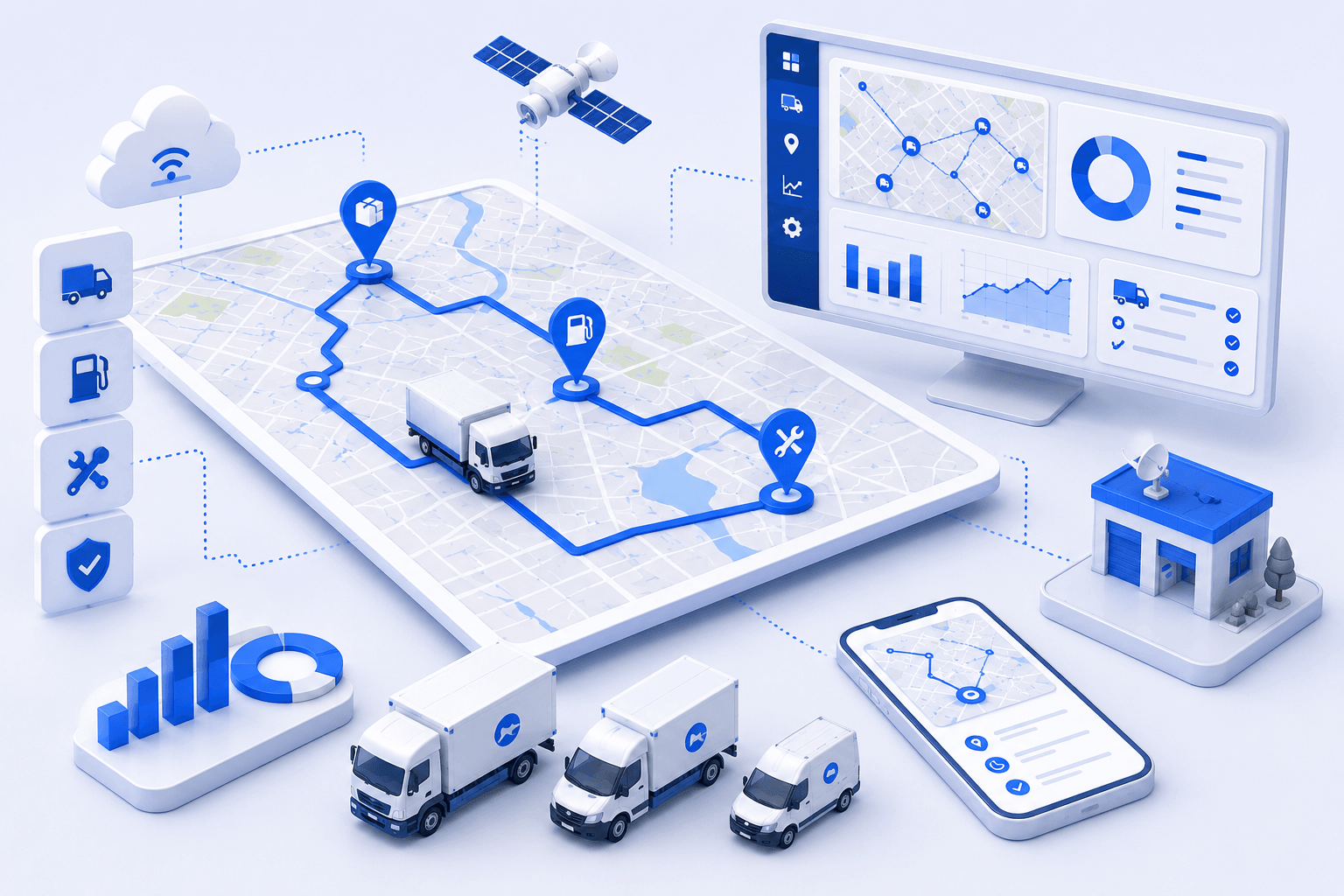
Every fleet manager has asked the same question during a busy delivery day: where are my drivers right now? The frustrating part is that many of them cannot answer it, even with tracking tools installed on their vehicles.
According to Fortune Business Insights, the fleet management software market was valued at USD 32.36 billion in 2025 and is projected to reach $152.89 billion by 2034. Yet the majority of small-to-mid delivery fleets still rely on phone calls and text messages to check driver status during live operations.
The problem is not a lack of GPS hardware. It is that raw location data does not tell you which stop a driver just completed, how far behind schedule they are running, or when their next customer can expect a delivery. That disconnect between the data you collect and the insight you actually need has a name: the fleet visibility gap.
This article defines the visibility gap, breaks down what it costs your operation daily, and walks through a five-layer framework for what genuine real-time fleet visibility actually looks like in practice.
Table of Contents
- What the Fleet Visibility Gap Actually Is
- Why the Visibility Gap Persists in Modern Fleets
- The Operational Cost of Not Knowing Where Your Drivers Are
- What Real-Time Fleet Visibility Actually Looks Like
- How to Close the Visibility Gap Step by Step
- See Every Driver in Real Time With Upper
- Frequently Asked Questions
What the Fleet Visibility Gap Actually Is
The fleet visibility gap is the distance between the data a fleet collects and the actionable insight dispatchers need to manage operations in real time. Having tracking technology installed does not automatically mean you have visibility. Many fleets learn this the hard way.
Common Signs Your Fleet Has a Visibility Gap
If any of these sound familiar, your fleet likely has a visibility problem that GPS alone cannot solve:
- Dispatchers call or text drivers multiple times per day to ask for ETAs
- Customer service representatives cannot answer delivery status questions without contacting a driver first
- Route changes are communicated by phone or text rather than pushed through a system
- End-of-day reconciliation is the first time anyone confirms which deliveries were completed
- A fleet management dashboard shows vehicle locations but not task progress
Understanding the gap is the first step. The next question is why it persists even in fleets that have invested in tracking technology.
Why the Visibility Gap Persists in Modern Fleets
Investing in tracking technology does not automatically close the gap. Three structural issues keep fleets blind even when they own the tools that should provide answers.
Fragmented Tools That Do Not Talk to Each Other
A GPS tracker sits in the vehicle. The route plan lives in a spreadsheet. Proof of delivery gets captured in a separate app. Driver schedules exist in yet another system. When data is spread across four or five platforms with no integration, no single screen can show the full picture. Dispatchers end up toggling between tabs and filling in the blanks manually.
Hardware-Only Solutions Miss the Operational Layer
Telematics boxes track vehicles, not tasks. They can tell you a truck is parked at a loading dock, but they cannot tell you whether the driver is completing stop number 12 or dealing with a failed delivery attempt. There is no connection between the vehicle’s position and the route plan, delivery sequence, or customer notification. The result is a monitoring tool that watches vehicles move but cannot explain what the driver is actually doing.
Driver Resistance and Adoption Gaps
Complicated apps that require multiple steps to log each stop create friction. Under time pressure, drivers skip check-ins, forget to update statuses, or abandon the app altogether. A 15-vehicle pharmacy delivery fleet rolled out a driver app and within two weeks, half the drivers stopped using it because it took too long between stops. Without consistent driver adoption, even well-designed systems produce incomplete data.
These structural issues mean the gap is not solved by adding another device. It requires rethinking how visibility is delivered across the entire operation. You can use an automated driver stop tracking software that uses GPS data to auto-track time spent on each stop. This helps identify friction points and reduce the time spent on manual logging.
The Operational Cost of Not Knowing Where Your Drivers Are
The visibility gap is not just an inconvenience. It carries a measurable financial cost that compounds every day your fleet operates without real-time insight.
Wasted Dispatcher Time on Phone-Based Status Checks
According to FleetOwner, dispatchers at delivery-focused fleets spend an average of two to three hours per day on manual driver check-ins. That is time not spent handling exceptions, adjusting routes, or responding to urgent customer requests. For a fleet running five dispatchers, that translates to 10 to 15 lost hours daily, or roughly 250 hours per month spent on phone-based status checks that a live dashboard could eliminate.
Missed Delivery Windows and Customer Churn
When dispatchers cannot see that a driver is running behind, they cannot reroute or reallocate in time to protect a delivery window. According to McKinsey, “72% of consumers now expect real-time delivery tracking as standard.” Late deliveries with no communication drive customer complaints, refund requests, and churn. For subscription-based delivery services, a single missed window can cost a recurring customer.
Fuel and Overtime From Unmonitored Route Deviations
Without visibility into live driver behavior, unauthorized detours and excessive idling go unnoticed. Routes that run longer than planned generate overtime costs with no early warning for dispatch. Fleets using real-time tracking reduce unauthorized vehicle use by up to 15%, according to industry benchmarks from Automotive Fleet.
The cost compounds daily. Closing the gap is not a technology upgrade. It is an operational strategy shift, and the next section lays out what that shift looks like.

See it in action
See Your Entire Fleet on One Screen
Upper shows live driver locations, route progress, and delivery status without hardware. Full visibility in minutes, not months.
What Real-Time Fleet Visibility Actually Looks Like
True fleet visibility goes far beyond dots on a map. It requires five layers of real-time insight working together to give dispatchers complete operational awareness. Here is the framework.
Layer 1: Live Driver Location on a Unified Map
Every driver’s current position displayed on a single dashboard, updated continuously, with no switching between apps or calling for updates. This gives dispatchers geographic awareness of the entire fleet at a glance. When an urgent order comes in, a dispatcher can identify the nearest available driver in seconds and reassign accordingly.
To implement this, use a platform that provides app-based real-time driver tracking without requiring hardware installation in every vehicle. The map view should be the dispatcher’s default workspace, not a secondary screen buried behind three clicks.
Layer 2: Route Progress and Stop Completion Status
Visibility into which stops each driver has completed, which stop is next, and how many remain. Percentage-based route progress indicators answer the question “where is my driver in their route?” rather than just “where is the vehicle?”
The difference is significant. Knowing a van is on a specific street tells you nothing about delivery progress. Seeing that the driver has finished 14 of 22 stops and is running five minutes ahead changes how a dispatcher manages the rest of the afternoon.
Link driver tracking to the route plan so every stop update is automatic. Display progress as a visual timeline rather than raw data points.
Layer 3: Estimated Arrival and Delivery Time Windows
Dynamic ETAs for each remaining stop, recalculated as conditions change throughout the day. Customer-facing notifications tied to actual driver position eliminate inbound “where’s my delivery?” calls and build trust through proactive communication.
Automate customer notifications at key milestones: en route, arriving soon, and delivered. This turns your customer notification system from a reactive tool into a proactive customer experience feature.
Layer 4: Proof of Delivery and Exception Capture
Photo, signature, or note captured at each stop and visible to dispatch immediately. Exceptions like failed deliveries, customer not home, or access issues get logged in real time rather than discovered at end of day. This closes the loop on every delivery without waiting for drivers to return to the warehouse.
Equip drivers with a mobile app that captures proof of delivery as part of the stop workflow. Ensure proof data syncs to the dispatch dashboard without manual upload.
Layer 5: Alerts and Exception-Based Notifications
Automated alerts when a driver deviates from the route, runs late, or encounters an issue. This transforms the dispatcher role from constant monitoring to strategic exception handling. Instead of watching every driver all day, dispatchers only intervene when something goes wrong.
Configure threshold-based alerts for lateness, deviation distance, and idle time. Prioritize alerts by severity so the most critical exceptions surface first. Route deviation alerts alone can reduce fuel waste by 8 to 12% annually, according to Deloitte research.
These five layers form a complete visibility stack. The next step is putting them into practice without overhauling your entire operation.
How to Close the Visibility Gap Step by Step
Closing the visibility gap does not require a six-month implementation project. Most delivery fleets can move from fragmented tracking to unified visibility in weeks by following a structured approach.
Audit Your Current Visibility Coverage
Map which of the five layers you currently have and where the gaps are. Many fleets discover they have Layer 1 (basic location tracking) but lack Layers 2 through 5 entirely. Identify which data already exists but is trapped in a separate system that does not connect to your dispatch workflow.
Consolidate Tracking and Routing Into One Platform
The single most impactful step is eliminating the gap between “where is the vehicle?” and “where is the driver in their route?” Prioritize platforms that combine route planning, dispatch management, tracking, and proof of delivery in one interface. When these functions share the same system, visibility becomes automatic rather than something dispatchers have to assemble manually.
Onboard Drivers With a Simple Mobile Experience
Adoption is the bottleneck that kills visibility initiatives. Choose tools that require minimal training and fit naturally into the driver’s stop-by-stop workflow. Start with a pilot group of your most tech-comfortable drivers, measure compliance rates for two weeks, and expand from there. The simpler the app, the higher the adoption rate.
Closing the visibility gap is achievable in weeks, not months. The key is choosing a platform that delivers all five layers without requiring hardware installations or complex integrations.
See it in action
Close Your Fleet's Visibility Gap with Upper
Upper requires no hardware and takes minutes to set up. Start seeing every driver's real-time status today.
See Every Driver in Real Time With Upper
The visibility gap is the distance between having a tracking tool and having true operational awareness of your fleet. Closing it requires live location, route progress, ETAs, proof of delivery, and exception alerts working together in one dashboard. If your dispatchers are still calling drivers for updates, your fleet is paying for that gap every day in wasted time, missed windows, and frustrated customers.
Upper delivers all five visibility layers through a single platform built for delivery fleets. Dispatchers see every driver on a live map with route progress, stop completion status, and dynamic ETAs updated throughout the day. When a driver finishes a stop, the dashboard reflects it instantly. When a delivery fails, the exception surfaces in real time with the driver’s notes and photos attached.
Drivers use a lightweight mobile app that captures proof of delivery automatically as part of their natural workflow. No extra steps, no complicated check-in processes, and no hardware to install in vehicles. The app runs on the phones your drivers already carry, which means onboarding takes minutes rather than weeks.
Upper is built for fleets that need operational visibility without the complexity or cost of enterprise telematics. GPS tracking, driver management, fleet dashboards, dispatch tools, smart analytics, proof of delivery, and customer notifications all work together from one screen.
See how Upper closes the visibility gap for your fleet. Book a demo
Frequently Asked Questions
Software-based tracking platforms use the GPS in drivers’ smartphones to provide live location updates. Drivers download a mobile app, and their position syncs to a dispatch dashboard automatically. This eliminates the need for dedicated GPS hardware in each vehicle.
GPS tracking shows you where a vehicle is located on a map. Real-time fleet visibility goes further by showing route progress, stop completion status, estimated arrival times, proof of delivery, and exception alerts. GPS tracking is one layer; fleet visibility requires all five layers working together.
Common signs include dispatchers calling drivers for ETAs, customer service unable to answer delivery status questions, route changes communicated by phone or text, and end-of-day reconciliation being the first time completed deliveries are confirmed.
Software-based platforms with no hardware requirements can be implemented in days. Drivers download a mobile app, dispatchers access a web dashboard, and routes begin syncing immediately. Most fleets are fully operational within one to two weeks including driver onboarding.
Yes. Fleets with real-time visibility can identify delays as they happen and either reroute drivers or proactively notify customers. Automated delivery notifications reduce inbound “where’s my order?” calls significantly, and proactive communication improves customer satisfaction even when delays occur.