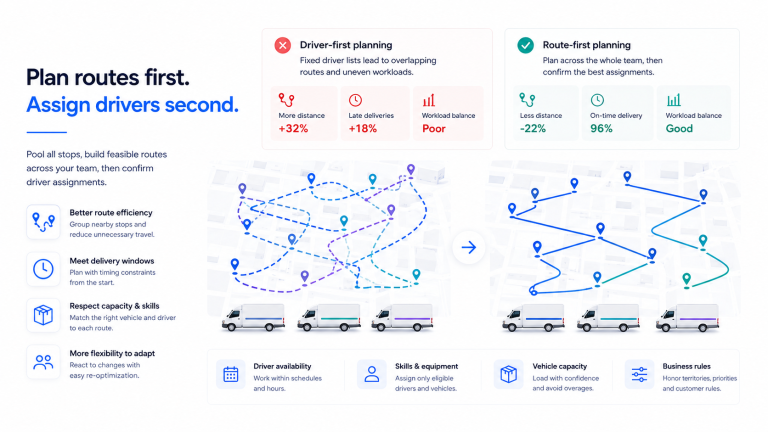

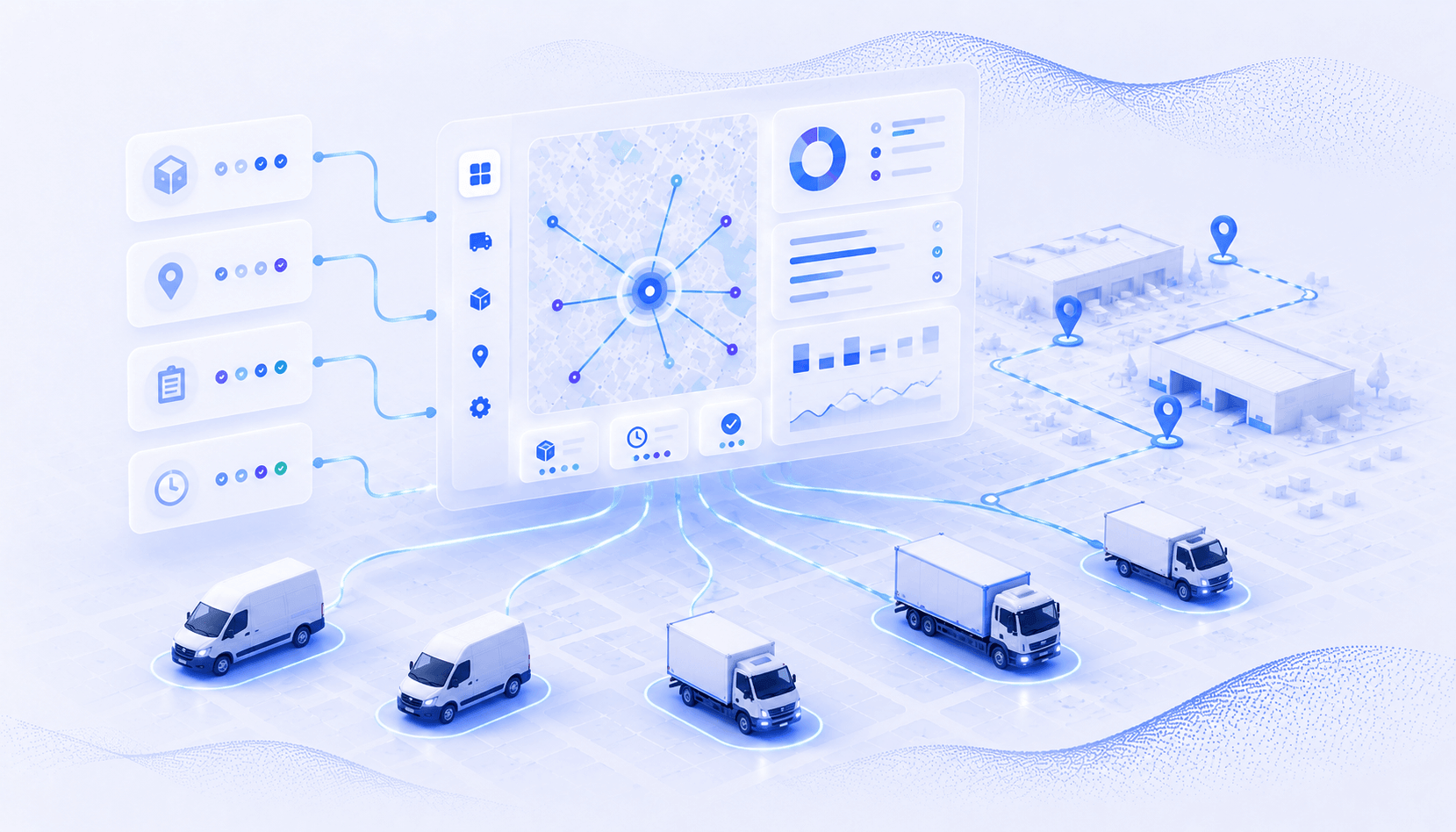
The interface evolution in fleet dispatch has been steady. Paper route sheets gave way to spreadsheets. Spreadsheets gave way to software dashboards. Dashboards gave way to AI-powered optimization.
The next step is now visible on the horizon: voice. A dispatcher who can say “Reassign Driver 4’s afternoon stops to the nearest available driver” and have it done in seconds, without touching a keyboard or screen.
This shift isn’t speculation. Voice assistants are already embedded in vehicles, phones, and smart speakers. Fleet operations are a natural next frontier because dispatchers are the kind of high-tempo, multi-tasking operators who benefit most from hands-free, eyes-free interaction.
This article explores how voice-controlled dispatch will work, what it means for dispatchers and drivers, the challenges ahead, and what fleet operators should do today to prepare for voice-driven fleet management.
Table of Contents
- What Is Voice-Controlled Dispatch?
- Why Voice-Controlled Dispatch Matters for Fleet Operations
- How Voice-Controlled Dispatch Will Work in Practice
- Challenges Facing Voice-Controlled Dispatch
- How to Prepare Your Fleet for Voice-Controlled Dispatch
- Get AI Dispatch-Ready With Upper
- Frequently Asked Questions
What Is Voice-Controlled Dispatch?
Voice-controlled dispatch is the use of spoken commands and voice AI to manage fleet dispatch operations. Issuing assignments, checking driver status, making mid-day adjustments, capturing proof of delivery: all through natural spoken language instead of typing or clicking.
The technology combines speech recognition, natural language processing, and integration with the underlying dispatch platform. The voice layer is the interface. The AI dispatch engine underneath does the actual optimization and execution.
The Voice Interface for Fleet Management
Voice-controlled dispatch lets dispatchers and fleet managers issue commands, ask questions, and receive updates using spoken language. Sample interactions:
- “What’s the on-time rate for Team B today?”
- “Move the priority delivery at 500 Elm Street to the front of Driver 3’s route”
- “Reassign Driver 6’s last four stops, she’s running 30 minutes behind”
- “Add an express pickup at 200 Pine Street to the nearest refrigerated truck”
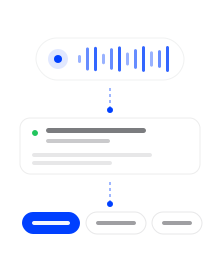
The AI processes the spoken input, understands the intent against fleet context, and executes or recommends an action. Critical changes get verbal confirmation before execution. Routine queries return spoken or visual responses.
Why Voice-Controlled Dispatch Matters for Fleet Operations
Voice-controlled dispatch isn’t just a faster interface. It changes the operational economics of dispatch in four important ways.
Speed Up Decision-Making During Peak Hours
Voice commands are faster than navigating menus. During the busiest parts of the day, seconds matter. A dispatcher handling 3 phone calls can still issue voice commands to adjust routes. A dispatcher monitoring multiple screens can speak a command without losing focus on what they’re watching.
For high-volume fleets where every minute counts, voice dispatch compresses minutes of dashboard work into seconds of spoken input.
Reduce Cognitive Load on Dispatchers
Context switching between screens, tools, and communication channels drains mental energy. Open the dispatch dashboard. Switch to GPS tracking. Open the order system. Send a message. Return to dispatch. Each switch costs cognitive overhead.
Voice lets dispatchers stay in one cognitive mode while managing multiple tasks. The interface doesn’t require them to remember UI paths. They just describe what they need.
Improve Driver Safety
Hands-free interaction keeps drivers focused on the road. Voice updates and POD capture reduce phone-in-hand time while driving and at stops. For fleets running thousands of miles weekly, even small reductions in distracted driving translate into meaningful safety improvements.
Make Dispatch Accessible to More Team Members
Complex dispatch software requires training. Voice interfaces lower the learning curve. Backup dispatchers, customer service reps covering for sick dispatchers, or new hires can issue dispatch commands without mastering the full platform UI. The voice interface democratizes access to the dispatch system without adding training overhead.
The benefits are real, but voice-controlled dispatch comes with genuine challenges. Fleet operators need to plan for them.

See it in action
Optimize Routes for Multiple Drivers Automatically
Upper's AI route optimization handles time windows, vehicle capacity, and workload balancing for your entire fleet.
How Voice-Controlled Dispatch Will Work in Practice
Voice-controlled dispatch shows up in two distinct experiences: the dispatcher’s office and the driver’s vehicle. Each has different needs, different commands, and different value.
The Dispatcher Experience
For dispatchers, voice is about speed and multi-tasking. Anything that requires multiple clicks today becomes a single sentence. Anything that requires opening a separate screen becomes a quick verbal query.
Voice Commands for Assignment and Routing
Dispatchers issue command-style requests:
- “Optimize routes for tomorrow’s stops with the morning crew”
- “Move the priority delivery at 500 Elm Street to the front of Driver 3’s route”
- “How many stops does the South Zone team have left?”
The AI processes each command against live fleet data and either executes or asks for clarification. “Optimize routes for tomorrow” might prompt: “Optimizing for the morning crew’s standard 8 AM start. Confirm or specify a different shift?”
Voice for Real-Time Adjustments
Mid-day disruptions are where voice dispatch shines. A driver runs behind. A new urgent order comes in. Traffic shuts down a route. Voice lets the dispatcher react instantly without breaking from whatever else they’re doing.
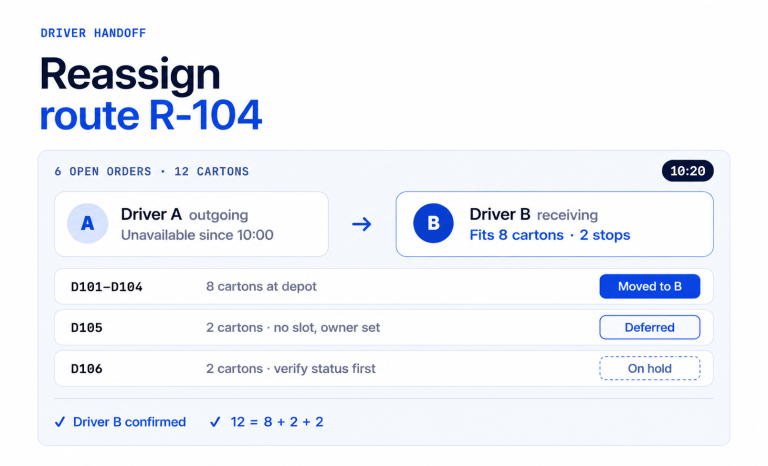
“Driver 6 is running 30 minutes behind. Redistribute her last four stops” triggers the AI to identify the four stops, find the best alternative drivers based on capacity and proximity, recalculate routes, notify the affected drivers, and update customer ETAs. The dispatcher confirms verbally and moves on.
Voice for Status and Analytics
“What’s our on-time rate today?” returns a spoken or visual answer in seconds. “Which driver has the lightest load right now?” produces a name. “What was our average time per stop in the West Zone last week?” pulls analytics through conversation instead of opening reports and configuring filters.
The Driver Experience
For drivers, voice is about safety and efficiency. Hands-free, eyes-on-the-road interaction reduces distraction and speeds up routine actions at each stop.
Hands-Free Navigation and Updates
Drivers in vehicles receive route updates and instructions via voice without touching their phone. “Next stop: 123 Main Street. ETA 12 minutes. Customer note: use the side entrance.” Updates from dispatch arrive as spoken alerts. Route changes are confirmed verbally.
The safety benefit is significant. According to the National Highway Traffic Safety Administration, distracted driving contributes to a meaningful share of vehicle accidents, and any interaction that reduces phone-in-hand time helps.
Voice-Activated Proof of Delivery
At each stop, drivers can capture proof of delivery hands-free: “Mark stop 7 as delivered. Customers signed. No damage.” The system records the action, timestamps it, and pushes the update to the central platform. Voice POD reduces the time drivers spend on their phones at each stop and creates a consistent record.
Driver-to-Dispatch Communication
“Tell dispatch I need 15 more minutes at this stop.” “Report: loading dock closed, need reroute.” Voice replaces fragmented phone calls and text messages with structured, logged communication. The AI parses the message, formats it for dispatch, and creates an audit trail automatically.
The Technology Stack Behind Voice Dispatch
What makes all of this possible is a stack of integrated technologies, each playing a specific role.
Speech Recognition and NLP
Advanced speech-to-text converts spoken commands into structured data. Modern speech recognition has reached 95%+ accuracy in controlled environments and continues to improve. NLP engines interpret fleet-specific vocabulary and context, distinguishing “Driver 3” from “Driver 30” and recognizing dispatch shorthand.
Integration With the Dispatch Platform
Voice is an interface layer. It connects to AI route optimization, GPS tracking, order management, and driver profiles. The same engine that powers the dashboard powers the voice interface. Without strong dispatch capabilities underneath, voice can’t deliver real value.
Confirmation and Safety Protocols
Critical actions require verbal confirmation. “Reassigning 5 stops. This affects 3 customer time windows. Confirm?” The system distinguishes between queries (no confirmation needed) and actions (confirmation required). High-impact actions trigger additional safeguards.
See it in action
See Upper's AI-Powered Fleet Dispatch Platform
Centralized AI dispatch, route optimization, and real-time driver tracking in one dashboard.
Challenges Facing Voice-Controlled Dispatch
Voice dispatch is an emerging technology. Four challenges shape where it works well and where it still struggles.
Noise and Environment
Dispatch offices are noisy. Vehicles are noisy. Voice recognition accuracy drops in high-noise environments. Wind, road noise, conversations, sirens, and HVAC systems all interfere with accurate speech-to-text.
Solutions are improving rapidly. Noise-canceling AI, directional microphones, and headsets designed for voice command environments mitigate the issue. But fleet operators evaluating voice dispatch should test it in their actual operating conditions, not just controlled demos.
Handling Complex Multi-Step Commands
“Reassign the priority stops from Driver 2 to Driver 5, but keep the time-windowed ones with Driver 2 and re-optimize both routes” is hard for voice AI to parse in one command. Complex operations may still require breaking into steps or using the visual interface.
The best implementations recognize this and gracefully offload complex decisions to the dashboard. “I can reassign the priority stops and re-optimize. The time-windowed exceptions are best handled visually. Open the dispatch view?”
Accuracy and Misinterpretation Risks
A misheard address or driver name could send the wrong driver to the wrong location. “Driver 13” misheard as “Driver 30” can create real problems. Confirmation protocols and undo capabilities are essential safeguards.
The key design principle is: actions that are easy to reverse can execute on first command, actions that are hard to reverse require explicit confirmation. Most enterprise voice dispatch platforms follow this pattern.
Privacy and Data Considerations
Voice commands in shared spaces may expose sensitive business data. Customer addresses spoken aloud. Driver performance issues discussed in earshot of others. Order values mentioned during status checks.
Fleet operators need clear policies on when and where voice dispatch is appropriate. Private offices vs. open call centers. Private vehicles vs. shared environments. Voice is powerful but it’s also audible by anyone nearby.
These challenges are solvable. Most are already being addressed by the platforms building voice capabilities into their products. What matters more is what fleet operators should do today.
How to Prepare Your Fleet for Voice-Controlled Dispatch
Voice dispatch is coming, but you don’t need to wait for it to start preparing. The work that makes voice dispatch valuable also makes your operation better today.
Build a Strong Digital Dispatch Foundation
Voice dispatch sits on top of digital infrastructure. Centralized stop data. Driver profiles. GPS tracking. Route optimization. If you’re not using AI dispatch software today, that’s where to start. Voice is the interface layer, not the foundation.
Without the foundation, voice dispatch has nothing to control. You can’t tell an AI to “reassign Driver 6’s stops” if your stops aren’t in a system, your drivers don’t have profiles, and your routes aren’t optimized.
Invest in Clean, Structured Data
Voice AI needs structured data to work. Standardize how you record addresses, driver info, time windows, and order details. Inconsistent data formats break the matching engine before voice ever enters the picture.
This investment pays off immediately. Even before voice arrives, clean data makes your existing dispatch system faster, your AI optimization smarter, and your reporting more useful.
Train Your Team on AI-Assisted Workflows
Start with AI-assisted dispatch (route optimization, automated suggestions, intelligent matching) before voice. Teams that are comfortable with AI recommendations will transition to voice commands more easily because the underlying mental model is the same: trust the AI for routine decisions, override for exceptions.
This is where many fleets stall. They want to jump from manual dispatch directly to voice. The intermediate step (AI-assisted dashboards) is where dispatchers build the trust and habits that make voice dispatch effective.
Choose Platforms Built for Integration
When evaluating dispatch software, look for API access, webhook support, and a platform architecture that can accommodate new interface layers like voice. Platforms with closed architectures will struggle to add voice capabilities later, even if they want to.
Open, integrated platforms become more valuable over time as new interfaces emerge. The dispatch platform you choose today should be one that can grow with technology.
Build Your Digital AI Dispatch Foundation With Upper
Upload stops from a spreadsheet, optimize routes in minutes with AI, dispatch to drivers with one click. Start here.
Try Upper Free
The fleets that prepare today will be ready when voice dispatch matures. The ones that wait will be playing catch-up.
Get AI Dispatch-Ready With Upper
Voice-controlled dispatch is the next evolution in fleet management. Natural spoken commands compressed into seconds. Hands-free interaction for both dispatchers and drivers. Faster decisions, lower cognitive load, safer operations. The technology is maturing fast, and the fleets that build the right foundation today will be ready when voice dispatch becomes standard.
The foundation is what matters most. Voice is the interface. The AI dispatch engine underneath does the actual work of optimization, assignment, tracking, and execution. Without that engine, voice is just a chatbot. With it, voice becomes a powerful new way to manage fleet operations.
Upper‘s AI dispatch provides that foundation today. The platform’s AI route optimization engine handles multi-stop, multi-driver assignment in real time, factoring in time windows, vehicle capacity, and operational constraints.
Centralized fleet management gives dispatchers full control from a single dashboard. Real-time GPS tracking keeps fleet data current. AI-driven driver management tracks performance and supports intelligent matching. Integrated proof of delivery captures photos, signatures, and notes that voice-enabled drivers will eventually be able to log hands-free.
Upper’s AI dispatch delivers the optimization, automation, and data infrastructure that powers smarter fleet operations regardless of the interface. Book a demo to see how Upper builds the AI dispatch foundation your fleet needs for the future.
Frequently Asked Questions on Voice-Controlled Dispatching
Yes, in several ways. Drivers can receive route updates through voice, capture proof of delivery hands-free, communicate with dispatch verbally, and request route changes without touching their phone. The safety benefits of hands-free interaction make voice particularly valuable on the driver side.
Four main risks: noise interference reducing accuracy, misinterpretation sending wrong instructions, complex commands that voice can’t easily parse, and privacy concerns when voice exposes sensitive data in shared environments. All four are manageable with the right platform design and operational policies.
Build the foundation first: digitize your dispatch operations, adopt AI route optimization, implement GPS tracking, standardize your data, and train your team on AI-assisted workflows. Voice is the interface layer that gets added on top. Without the underlying AI dispatch infrastructure, voice has nothing to control.
No. Voice is an interface that makes human dispatchers faster and more effective, not a replacement. Complex judgment calls, customer relationships, and exception handling still require human dispatchers. Voice dispatch frees them from routine UI navigation so they can focus on higher-value work.