

Table of Contents
- What Is Delivery ETA?
- Why Delivery ETA Accuracy Matters
- How Delivery ETA Is Calculated
- Common Challenges With Delivery ETA Accuracy
- Best Practices for Improving Delivery ETA Communication
- How Technology Improves Delivery ETA Reliability
- Deliver Accurate ETAs With Upper's Route Optimization and Tracking
- Frequently Asked Questions
If you manage a delivery operation, you already know what happens when delivery ETA accuracy falls short. Customers flood your support lines with “where is my order” calls, drivers arrive to find frustrated recipients who gave up waiting, and your operations team spends hours fielding complaints instead of improving routes.
The gap between what customers expect and what most delivery businesses actually deliver is widening. 83% of consumers expect an accurate estimated time of arrival for their orders, and WISMO (“where is my order”) inquiries account for up to 35% of customer service contacts, costing $5-12 per interaction to resolve.
Every missed delivery ETA window compounds the problem, eroding customer trust and increasing the cost of future deliveries through support overhead and lost repeat business.
This article covers what delivery ETA means, how it is calculated across every influencing factor, the challenges that undermine accuracy, and best practices for improving ETA reliability and communication.
What Is Delivery ETA?
Delivery ETA (estimated time of arrival) is the predicted date and time when a shipment or package is expected to arrive at the customer’s location. It is a dynamic estimate that updates based on real-time conditions like traffic, driver progress, and service time at previous stops, not a fixed timestamp set at order placement.
For example, a courier company dispatching 80 daily stops across a metro area generates an initial ETA for each delivery at the start of the route. As the driver progresses, GPS data feeds back into the system, and the ETA for each remaining stop shifts to reflect actual conditions on the road.
Why Delivery ETA Accuracy Matters
ETA accuracy is not a nice-to-have metric. It is a core driver of customer satisfaction, repeat purchases, and support cost reduction. Delivery businesses that treat ETA as an operational priority see measurable returns across retention, support volume, and first-attempt delivery success.
Build Customer Trust and Satisfaction
76% of shoppers say a positive delivery experience influences their decision to repurchase from a brand. Accurate ETAs reduce delivery anxiety and create a perception of professionalism and reliability that generic tracking pages cannot match.
Customers who receive precise, accurate ETAs are significantly more likely to leave positive reviews and recommend the service. For delivery businesses competing on experience rather than price, ETA accuracy is a differentiator.
Reduce WISMO Support Volume
WISMO inquiries account for 18-35% of customer service contacts during normal operations, with some businesses seeing spikes to 50% during peak periods. Each interaction costs $5-12 to resolve through support staff.
Proactive ETA notifications with real-time tracking links can reduce WISMO volume by 30-50%, freeing support teams for higher-value interactions. Instead of reacting to “where is my order” calls, businesses that send automated updates shift customers from callers to self-service trackers.
Strengthen On-Time Delivery and Retention
On-time delivery rates directly correlate with customer lifetime value and contract renewals for B2B delivery operations. Businesses that consistently meet their stated ETA windows report higher Net Promoter Scores and lower customer churn.
For subscription delivery services and recurring B2B deliveries, ETA reliability is often the single most influential factor in retention. A delivery that arrives on time reinforces the relationship. A delivery that misses the window forces customers to question whether the service is worth renewing.
Lower Failed Delivery and Redelivery Costs
Inaccurate ETAs increase the rate of failed first-attempt deliveries because recipients are not home or available when the driver arrives outside the expected window. Each failed delivery attempt costs $12-20 in driver time, fuel, and vehicle wear.
Accurate ETAs give recipients the information they need to be present and prepared, improving first-attempt success rates. For delivery operations running 500+ stops per day, even a 5% reduction in failed deliveries translates to significant weekly cost savings and recovered driver capacity.
The financial impact of ETA accuracy extends beyond customer satisfaction. Every percentage point improvement in on-time delivery performance reduces support costs, increases retention, and strengthens competitive positioning.

See it in action
See Real-Time ETA Tracking in Action
Upper's GPS tracking updates delivery ETAs dynamically as drivers progress through their routes. Watch it work with your own delivery data.

How Delivery ETA Is Calculated
Delivery ETA calculation is a multi-layered process that combines static inputs like distance, addresses, and vehicle capacity with dynamic variables like traffic, weather, and service time. The accuracy of a delivery ETA is only as strong as the weakest variable in the calculation. Understanding each layer helps you identify where your own estimates break down.
Distance and Route Geometry
ETA starts with the distance between origin and destination, calculated using road network data rather than straight-line distance. Highways, urban streets, residential roads, and service roads each carry different average speed profiles that affect transit time. Left turns, traffic signals, and complex intersections add time that simple distance-over-speed formulas miss.
How Route Sequencing Affects Distance
Multi-stop delivery routes require optimized stop sequencing to minimize total distance and transit time. The order in which stops are visited changes the distance calculation for every subsequent stop. Poor stop sequencing can add 20-40% to total route distance, compounding ETA inaccuracy across every remaining delivery. This is why route planning that accounts for stop orders is the first building block of accurate ETAs.
Traffic Modeling and Congestion Data
Historical traffic patterns provide the baseline: average speeds by road segment, time of day, and day of week. Real-time traffic feeds from GPS probes, traffic sensors, and mapping services adjust ETAs based on current congestion. AI-powered predictive traffic modeling forecasts conditions 30-60 minutes ahead, allowing ETAs to account for situations that have not yet developed.
Time-of-Day and Day-of-Week Variations
Morning and evening rush hours can double transit times on the same route. Weekend versus weekday delivery patterns require different traffic models entirely. Holiday periods, school schedules, and seasonal tourism affect road capacity in predictable patterns that historical data captures over time.
Service Time at Each Stop
Dwell time, the minutes a driver spends at each delivery location, parking, walking to the door, waiting for the recipient, and capturing proof of delivery, adds directly to the ETA for subsequent stops. Commercial deliveries to loading docks average different service times than residential front-door deliveries. Heavy, bulky, or multi-package deliveries require longer service times than single small parcels.
Why Service Time Is the Most Underestimated Factor
Most ETA calculations default to a flat 2-3 minute service time per stop, but actual dwell times range from 1 minute to 15+ minutes depending on delivery context. Apartment complexes, gated communities, and commercial buildings with security checkpoints consistently extend service time beyond default estimates. Cumulative service time errors across a 20-30 stop route can shift the final delivery ETA by 30-60 minutes.
Historical Delivery Data and Pattern Recognition
Route-level patterns from historical data reveal consistent time-of-day variations, construction zones, and seasonal slowdowns. Driver-level patterns capture individual speed profiles, break schedules, and stop efficiency. Customer-level patterns at repeat delivery addresses build a history of access difficulty, parking availability, and recipient responsiveness.
Machine Learning for Pattern Refinement
Machine learning models analyze thousands of completed deliveries to identify non-obvious patterns that improve ETA predictions. Regression-based models predict delivery times by weighing historical factors against current conditions. Each completed delivery feeds back into the model, improving accuracy over time through continuous learning.
Real-Time GPS Adjustments
Live position tracking from driver GPS devices provides the actual current location, replacing estimated positions with real ones. Current vehicle speed and heading allow the system to recalculate remaining transit time based on actual progress. When a driver deviates from the planned route, the system recalculates ETA based on the new path.
Dynamic ETA Recalculation
Modern delivery platforms recalculate ETAs every 30-60 seconds based on GPS position updates. Recalculated ETAs flow to customer-facing notifications, keeping the estimate aligned with reality. The gap between static (planned) ETA and dynamic (real-time) ETA is the clearest indicator of route execution quality.
Weather and External Conditions
Rain, snow, ice, and extreme heat affect driving speeds, road closures, and delivery accessibility. Weather-adjusted ETA models apply speed reduction factors based on precipitation type and intensity. Seasonal conditions like flooding, wildfires, or extreme cold require regional adjustments that blanket traffic models miss.
Each of these factors contributes a layer of uncertainty to the delivery ETA. The most accurate ETAs come from systems that model all six layers simultaneously and update continuously as conditions change.
See it in action
Solve ETA Accuracy From Route to Doorstep
Upper's route optimization creates reliable ETA baselines, and real-time tracking maintains accuracy throughout the delivery day.
Common Challenges With Delivery ETA Accuracy
Even sophisticated ETA systems face accuracy challenges that erode customer trust over time. Understanding where your own estimates break down is the first step toward fixing them. Here are the most common culprits.
Relying on Static Routing Without Real-Time Data
Delivery operations that plan routes in the morning and never update them cannot account for traffic changes, delays, or driver deviations throughout the day. Static ETAs become increasingly inaccurate as the delivery day progresses and cumulative delays compound across every remaining stop.
Using Flat Service Time Assumptions
Applying a uniform service time estimate, such as 3 minutes per stop, ignores the wide variance between delivery types, locations, and recipient behavior. This single assumption is often the largest source of ETA error on multi-stop routes, and it is the easiest one to fix with better data.
Ignoring Driver Variability
Experienced drivers complete routes faster than new drivers, but many ETA systems use identical time estimates regardless of who is driving. Break schedules, vehicle loading efficiency, and navigation familiarity all vary by driver, creating a gap between planned and actual performance.
Accepting Poor Data Quality and Geocoding Errors
Incorrect address geocoding places delivery pins in the wrong location, causing navigation detours and time overruns. Missing apartment numbers, suite identifiers, or gate codes create access delays that the ETA system cannot predict. Address validation at the point of data import catches these errors before drivers hit the road.
Operating Without Feedback Loops
ETA systems that do not incorporate completed delivery data into future predictions repeat the same errors indefinitely. Without a continuous learning mechanism, accuracy plateaus regardless of how many deliveries are completed. Feeding actual delivery times back into the ETA model is the only way to improve predictions over time.
Recognizing these challenges is the first step toward solving them. The most effective approach combines better data inputs, smarter algorithms, and proactive communication to close the gap between estimated and actual delivery times.
See it in action
Automate ETA Notifications for Every Delivery
Upper sends SMS and email updates at every milestone: driver dispatched, approaching, and arrived. No manual follow-up needed.
Best Practices for Improving Delivery ETA Communication
Improving delivery ETA accuracy and communication is a progression, from foundational data quality to advanced real-time dynamic ETAs with proactive notifications. These five practices build on each other to create a system where accurate ETAs become the default.
Use Route Optimization for Accurate Baselines
Optimized route sequences produce more realistic total route times than manually planned routes. Route optimization accounts for stop order, vehicle capacity, time windows, and driver schedules, all of which affect ETA accuracy. Starting with an optimized route gives every downstream ETA calculation a stronger foundation.
Incorporate Real-Time Tracking Into ETA Updates
GPS-based tracking allows ETAs to reflect actual driver progress rather than planned schedules. Real-time ETA updates catch delays early and adjust customer expectations before the delivery window is missed. 51% of online shoppers expect real-time visibility into their order status, making this a baseline expectation rather than a premium feature.
Send Proactive ETA Notifications
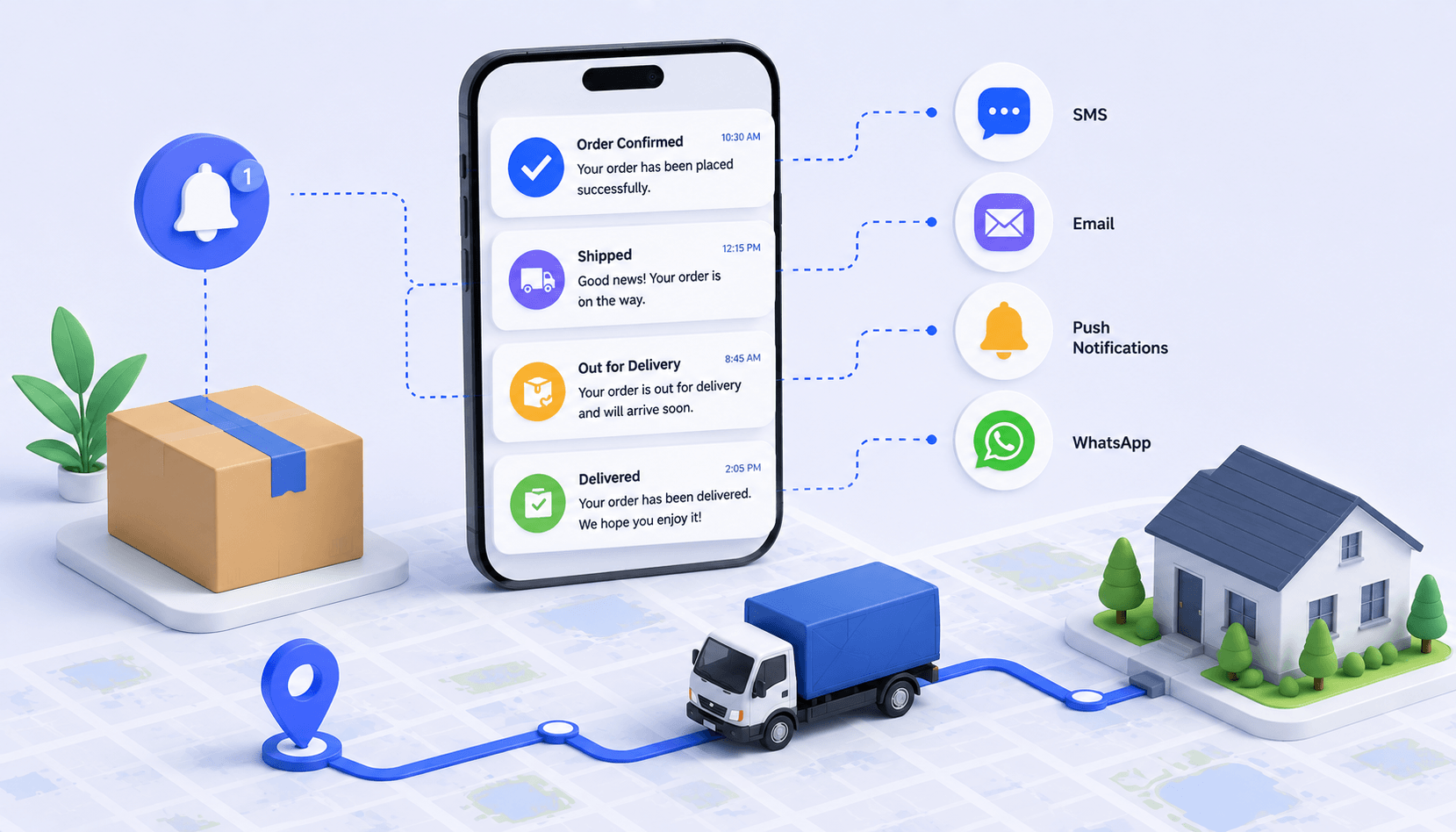
Automated notifications at key milestones, such as order confirmed, driver dispatched, 30 minutes away, and arriving now, reduce customer uncertainty. SMS and email notifications with live tracking links give customers self-service visibility without calling support. Proactive communication turns a potential negative, a delayed delivery, into a positive: the business kept the customer informed.
Calibrate Service Time Estimates by Stop Type
Segment delivery addresses by type, residential, apartment, commercial, and rural, and apply different service time defaults to each. Track actual dwell times at each stop and feed this data back into the ETA model. Even a rough segmentation between residential and commercial improves accuracy significantly over a flat 3-minute default.
Provide ETA Windows Instead of Exact Times
Communicating a 30-60 minute delivery window is more accurate and less risky than promising an exact minute. Narrow the window as the driver approaches, moving from a 2-hour window to a 30-minute window to “arriving in 10 minutes” using real-time tracking data. Customers prefer a reliable window over an exact time that is frequently missed.
These practices work together as a system. Route optimization creates accurate baselines, real-time tracking maintains accuracy throughout the day, proactive notifications keep customers informed, and calibrated service times close the largest accuracy gap on multi-stop routes.
How Technology Improves Delivery ETA Reliability
Manual ETA management does not scale. As delivery volumes grow and customer expectations increase, technology becomes the only way to maintain delivery ETA accuracy across a growing fleet. Three technology layers work together to make reliable ETAs possible.
Optimize Routes With Algorithms That Minimize Total Time
Algorithms that solve the traveling salesman problem across 20-100+ stops per driver produce route sequences that minimize total time and distance. Dynamic re-optimization adjusts routes mid-day based on new orders, cancellations, or delays.
Optimized routes produce tighter, more reliable ETA windows from the start of the delivery day. Upper Route Planner handles this by generating optimized routes in under a minute, even for complex multi-driver fleets with time windows and capacity constraints.
Track Drivers With GPS for Real-Time Visibility
Continuous GPS tracking provides the live position data needed for dynamic ETA recalculation. Fleet-wide visibility allows dispatchers to identify delays across all drivers simultaneously and redistribute workload. Customer-facing tracking pages powered by GPS data give recipients direct ETA visibility without contacting support.
Automate Customer Notifications at Every Milestone
Notification systems triggered by geofence events, such as driver departed, driver approaching, and driver arrived, send updates without dispatcher intervention. Customizable notification templates let businesses match ETA communication to their brand voice. Multi-channel delivery through SMS, email, and in-app notifications reaches customers on their preferred platform.
The most effective delivery ETA systems combine these three technology layers. Route optimization sets the baseline, GPS tracking maintains accuracy, and automated notifications communicate updates to customers. When all three work together, ETA becomes a competitive advantage rather than a source of complaints.
Deliver Accurate ETAs With Upper’s Route Optimization and Tracking
Delivery ETA is the single most visible promise a delivery business makes to its customers. When the estimate is accurate, customers trust the service, support costs drop, and retention improves. When it misses, the cost compounds across every touchpoint: support calls, failed deliveries, negative reviews, and lost repeat business.
Achieving consistent ETA accuracy requires a platform that handles the entire chain. That means route optimization that sequences stops for minimal transit time, GPS tracking that feeds live position data into dynamic ETA updates, and automated notifications that keep customers informed at every milestone.
Upper Route Planner combines route optimization, real-time driver tracking, and customer notification automation in a single platform. Routes are optimized across distance, traffic, time windows, and vehicle capacity, giving every delivery a reliable ETA baseline. As drivers progress through their routes, GPS tracking updates ETAs dynamically, and automated SMS and email notifications deliver those updates directly to customers.
See how Upper’s route optimization and real-time tracking deliver accurate ETAs across your entire fleet. Book a demo to experience the platform with your own delivery data.
Frequently Asked Questions
Delivery ETA is calculated by combining the distance between stops, historical and real-time traffic data, estimated service time at each location, and driver speed profiles. Advanced systems layer in machine learning models trained on historical delivery data, weather conditions, and time-of-day patterns. The most accurate ETAs use continuous GPS tracking to recalculate estimates every 30-60 seconds based on actual driver progress.
83% of consumers expect an accurate ETA for their orders. When ETAs are reliable, customers feel confident about the delivery and do not need to contact support for updates. Inaccurate ETAs generate WISMO ("where is my order") calls that account for up to 35% of customer service volume and erode trust in the delivery brand.
The most common causes of ETA inaccuracy are flat service time assumptions that ignore stop-type variation, static routes that do not update based on real-time conditions, poor address geocoding, driver variability, and limited feedback loops that prevent the system from learning from completed deliveries. Cumulative errors across a multi-stop route can shift final delivery ETAs by 30-60 minutes.
Start with route optimization to create accurate time baselines, then layer in real-time GPS tracking for dynamic ETA updates. Calibrate service time estimates by stop type (residential vs. commercial vs. apartment), send proactive notifications at key delivery milestones, and use delivery windows instead of exact times. Feed completed delivery data back into your ETA model for continuous improvement.
Delivery ETA is a specific time estimate (e.g., 2:35 PM), while a delivery window is a time range (e.g., 2:00 PM to 3:00 PM). Many delivery operations communicate windows rather than exact ETAs because windows account for the inherent uncertainty in delivery timing. Best practice is to start with a wider window and narrow it as the driver approaches, using real-time tracking data.