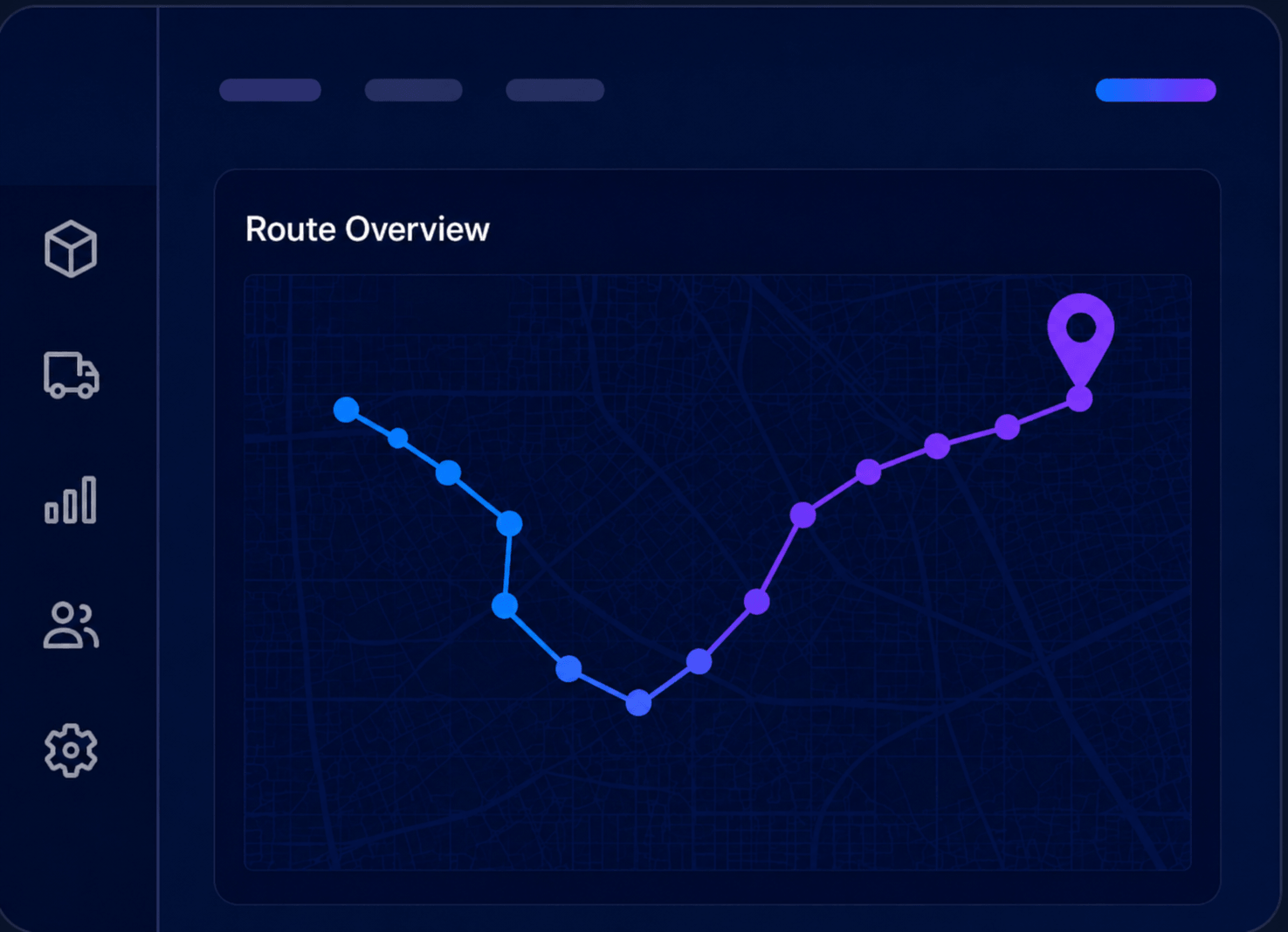

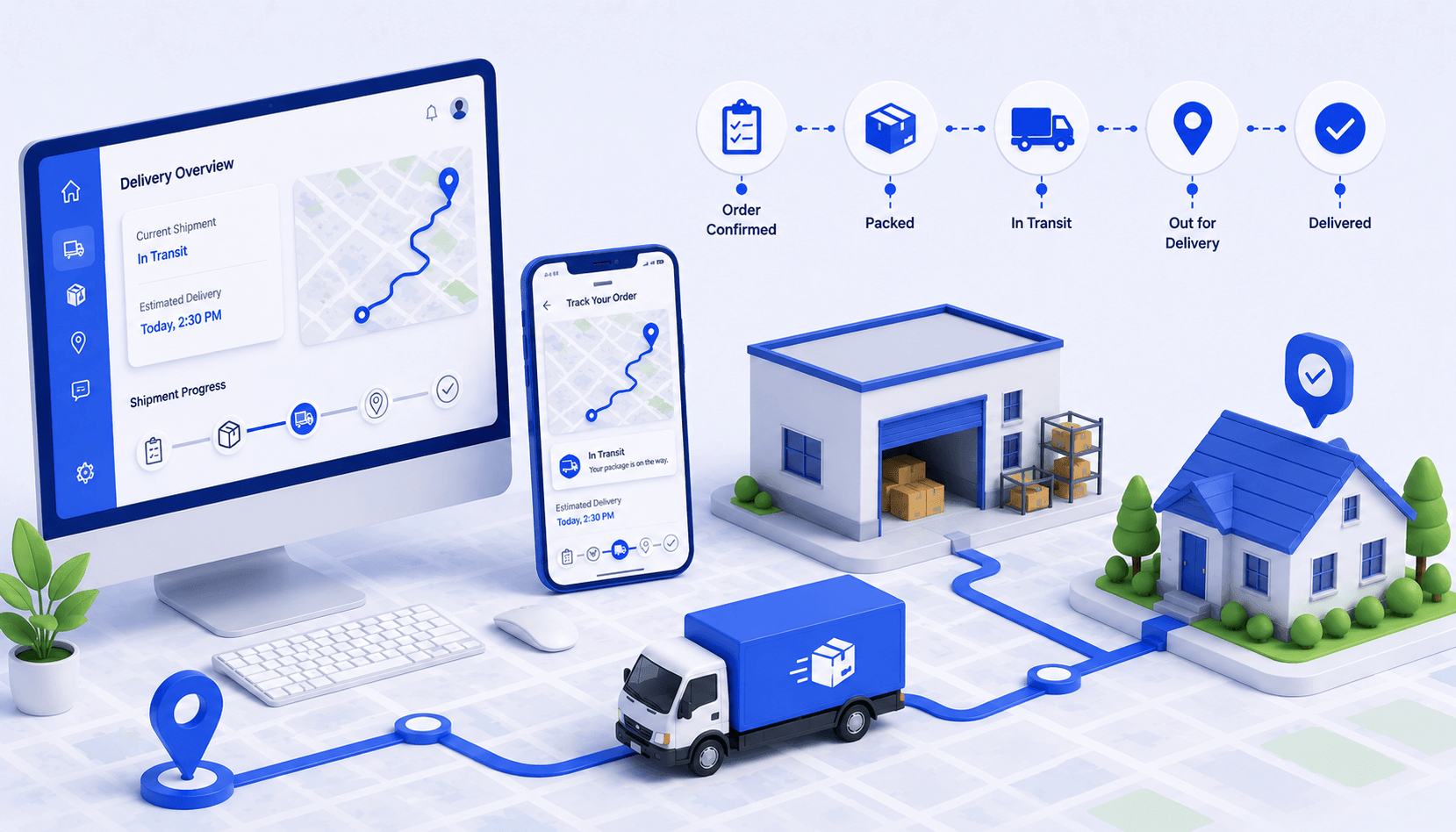






- A delivery time window defines the earliest and latest allowable time for service; it is different from both an appointment and an estimated arrival time (ETA).
- Clearly define whether the latest time applies to arrival or service completion, because leaving this rule unstated is a common cause of delivery window disputes.
- Hard time windows cannot be violated in an approved route, while soft windows can be missed at a defined cost; mixing the two without clear labels can create infeasible routes.
- Narrow delivery windows reduce routing flexibility and can increase the number of vehicles required to complete all stops.
- Measure performance against the exact commitment made, since arrival-within-window and completion-within-window produce different performance metrics.
That ambiguity is expensive. Last-mile delivery now accounts for 53% of total shipping costs, up from 41% in 2018, according to Statista. Windows sit at the center of tIf you are trying to pin down what a delivery time window is, you are probably standing on one side of a disagreement. Your customer thinks the window is a promise. Your dispatcher thinks it is a preference. Your driver arrives at 10:50 for an 11:00 deadline and finds out the 30-minute job was supposed to be finished by then, not started.
hat cost. Set them too wide and customers lose confidence. Set them too narrow and drivers wait, routes fragment, and you buy a vehicle you did not need. Get the definition wrong and you fail the window while believing you hit it.
This guide separates the customer-facing meaning of a delivery window from the operating rule your routes are actually planned against.
In this guide, you will learn:
- What a delivery time window is, and what a complete window record has to contain.
- How hard and soft windows differ, and why the distinction decides feasibility.
- A worked route example showing why the shortest sequence misses a deadline.
- How to choose window widths, spot windows that are too narrow, and measure the result.
What Is a Delivery Time Window?
A delivery time window is a time range during which a delivery or service visit is expected or allowed to occur, such as 9:00 to 11:00 a.m.
The window has an earliest time and a latest time. It is not the same as an exact appointment, and it is not the same as the live estimate a tracking page shows. When you plan routes, the window has to be weighed against travel time, service duration, vehicle capacity, and the rest of the day’s work.
For example, if a customer selects 1:00 to 3:00 p.m. and unloading takes 20 minutesutes, the route should plan an arrival that lets the work finish under your stated rule. That rule has to be explicit. Some businesses measure arrival inside the window. Others require service completion before the latest time. The difference is 20 minutesutes of margin, and it decides whether route optimization treats the stop as feasible.
What Does a Delivery Time Window Include?
A complete window record contains eight fields, not two clock times.
Two clock times are where most operations stop, and it is why the same entry means different things to the person who sold it and the person who drives it. Capture the following against every stop that carries a timing rule.
A useful time-window record contains:
- Earliest permitted or preferred arrival.
- Latest permitted or preferred arrival.
- Expected service duration.
- Whether early arrival is allowed.
- Whether waiting is possible, and where.
- Whether the latest time applies to arrival or to completion.
- The consequence of missing the window.
- The customer’s contact and access instructions.
Without these details, two people can interpret the same “10:00 to 12:00” window differently.
Delivery Window vs. Delivery Date, ETA, and Appointment
These five terms get used interchangeably in customer conversations, and each one carries a different level of commitment.
| Term | Meaning | Example |
|---|---|---|
| Delivery date | The calendar day planned for service | Tuesday, August 18 |
| Delivery time window | A range in which service is expected or allowed | 1:00 to 3:00 p.m. |
| ETA | A current estimate of arrival, often updated as the route progresses | Approximately 1:42 p.m. |
| Exact appointment | A specific committed time, usually with a defined tolerance | 2:00 p.m. appointment |
| Operating hours | The broader period in which a location can receive service | 8:00 a.m. to 5:00 p.m. |
A tracking estimate may move as traffic, service duration, or route order changes. A customer-selected delivery window is a planning input. An exact appointment is a stronger commitment and should be modeled accordingly.
Treat the tracking estimate as information and the window as an instruction. A customer who selected a window has given you a planning input. A customer holding an exact appointment has been given a stronger promise, and your route needs to model it that way.
Once the record is complete, the next question is how binding each window actually is.

See it in action
Put Time Windows Into the Plan, Not the Notes Field
Upper takes the earliest time, latest time, and service duration for every stop and builds routes around them.
Hard vs. Soft Delivery Time Windows
A hard window cannot be broken in an approved plan. A soft window can be missed at a defined cost or priority trade-off.
This is not academic vocabulary. It is the distinction routing systems are built on, and labeling every stop one way or the other is what separates a plan that holds from a plan that looks fine until 2:00 p.m. Google’s route optimization time window documentation draws the same line, treating hard bounds as feasibility constraints and soft bounds as penalized preferences.
Hard Time Window
A hard window cannot be violated in the approved plan. If a stop cannot be served within the rule, the plan is infeasible. Examples include a facility that locks its receiving gate at noon, a scheduled clinical visit, or a permit that restricts service to a specific period.
The correct response to an infeasible hard window is to change the route, assignment, capacity, date, or commitment. Hiding the conflict behind a better-looking sequence does not solve it.
Soft Time Window
A soft window is preferred, but the plan may accept an early or late visit at a defined cost or priority trade-off. A customer may prefer the afternoon, for example, while accepting a morning delivery after notification.
Soft does not mean unimportant. It means the operation has defined what can happen when competing constraints make the preference impossible to satisfy.
In practice the soft window carries a cost value, so the optimizer can weigh a small preference miss against a large detour. The Google Route Optimization API reference models this explicitly with separate earliest and latest soft bounds and a cost per hour outside them. If your system offers the same control, use it rather than converting every preference into a hard rule.
Mixed Rules
Some operations combine the two. A stop may have a preferred range of 10:00 a.m. to noon inside a hard operating period of 8:00 a.m. to 3:00 p.m. That gives the planner room to make a trade-off without scheduling the visit outside receiving hours.
A Worked Delivery Window Example
Assume a route starts at 8:00 a.m. and contains these four stops.
| Stop | Window | Service time | Planning note |
|---|---|---|---|
| A | 8:30 to 10:30 a.m. | 15 minutes | Early arrival allowed; wait off-site |
| B | Before 11:00 a.m. | 30 minutes | Hard completion deadline |
| C | 12:00 to 2:00 p.m. | 20 minutes | Soft customer preference |
| D | 9:00 a.m. to 4:00 p.m. | 45 minutes | Loading dock often adds delay |
The shortest geographic sequence may place B after a long stop at D. That route is risky because B has a hard completion deadline. A constraint-aware plan may serve B earlier even if the map distance is slightly longer.
The example also shows why service time matters. Reaching B at 10:50 is too late when the 30-minute job must finish by 11:00. If the rule measures arrival instead, 10:50 may be acceptable. Document the measurement rule.
Two lessons come out of this table. The first is that distance is not the planning unit. The second is that a window without a service duration attached is only half a constraint.
With the rules defined, the practical question becomes how wide to make each window in the first place.
See it in action
Test a Window Before You Promise It
Upper checks every time window against the full route, so you find the conflict at the desk instead of in the field.
How to Choose a Delivery Time Window
Start with the true site restriction, measure your real service and travel variability, test the window against the whole route, then say what the window means.
The instinct is to ask what the customer wants and enter it. That produces windows nobody can plan around. Work through these six steps in order, because each one narrows what the next can promise.
1. Start With the Customer or Site Requirement
Identify when the recipient, facility, crew, or equipment is actually available. Separate a preference from a true restriction. Ask what happens if the visit is early or late.
2. Measure Service Duration and Variability
Use actual service times for similar stops. A narrow window paired with highly variable unloading or access time can make the rest of the route unstable.
3. Account for Travel-Time Variability
Review time-of-day traffic, bridges, school zones, security checks, parking, and site approach. Straight-line distance does not describe arrival reliability.
4. Test the Window Against the Full Route
Do not judge a window in isolation. Add it to the route with all other stops, shifts, breaks, capacities, and priority rules. If the plan fails, determine which input must change.
5. Decide How Much Customer Choice to Offer
Offer windows the operation can consistently plan. More choices are not automatically better. A large set of narrow windows can fragment routes and reduce the ability to group nearby work.
6. State What the Window Means
Tell the customer whether the window is an estimate, preference, arrival commitment, or completion deadline. Explain how updates will be communicated.
Whatever you decide, communicate it the same way every time. Customer notifications only build trust when the message matches the rule the route was planned against.
Choosing a width is one half of the job. Recognizing when a width has quietly become unworkable is the other.
What Makes a Delivery Window Too Narrow?
A window is too narrow when normal variation in travel or service repeatedly makes the route infeasible, or causes avoidable waiting and reassignment.
Narrow windows feel like better service, so they rarely get challenged. The cost shows up somewhere else: an extra vehicle, a driver idling at the curb, or a dispatcher quietly overriding the plan every morning. Watch for these signals.
Review these signals:
- Drivers often arrive early and wait.
- The same stop is frequently late despite reasonable planning.
- A single window forces large cross-town moves.
- Dispatchers repeatedly override the optimized sequence.
- The route has no recovery time after one long stop.
- Extra vehicles are needed only to protect narrow preferences.
- Customer availability is broader than the entered window.
Widening a window is one option. Others include moving the stop to another route, changing the service date, adding capacity, setting a preferred window inside broader operating hours, or confirming a paid appointment level.
Before you widen anything, find out which constraint is actually binding. If drivers are waiting, the window opens too late for your route shape. If stops run late, the problem is usually service duration rather than the window itself. Widening a window that was never the cause just moves the failure somewhere less visible.
Even a well-chosen window still has to survive the day it is executed.
See it in action
Stop Buying Vehicles to Protect Narrow Windows
Upper shows which windows are forcing extra routes so you can fix the constraint instead of adding capacity.
How to Manage Delivery Windows on the Day of Service
Flag the tightest stops before dispatch, protect hard commitments first when a delay hits, and tell affected customers before they call you.
A window is a plan until the first delay, and then it becomes a set of decisions. The operations that handle this well decide the order of those decisions in advance rather than improvising at 11:00 a.m.
Before Dispatch
Before dispatch, flag stops with the least timing margin. Give drivers the relevant access and contact notes. During execution, use actual progress to identify which future windows are at risk.
Rank the day’s stops by timing margin and make the bottom five visible to whoever is watching the board. A stop with 10 minutes of slack and a stop with two hours of slack should not look identical on a dispatcher’s screen.
During Execution
When a delay occurs, protect hard commitments first, then evaluate soft preferences and downstream workload. Contact affected customers with an updated estimate when appropriate. If the remaining work is infeasible, reassign, reschedule, or escalate it clearly.
None of this is measurable without agreeing first on which number you are judging yourself against.
Use actual progress rather than the original plan to judge which future windows are now at risk. GPS tracking matters here for one specific reason: it tells you a route is slipping while you can still move work, not after the window has closed.
When the Window Will Be Missed
Protect hard commitments first, then evaluate soft preferences against downstream workload. Contact the affected customer with an updated estimate before they contact you. If the remaining work is genuinely infeasible, reassign it, reschedule it, or escalate it clearly. Leaving a stop on a route that cannot reach it is a decision to fail quietly.
How to Measure Delivery Time Window Performance
Track arrival within window, completion within window, early waiting time, late minutes, and window-related reassignments and failures.
The single most common measurement mistake is reporting arrival performance while having promised completion performance. Pick the measure that matches the promise, define it once, and keep the definition stable so the trend means something.
Track measures that match the rule you promised:
| Metric | Definition |
|---|---|
| Arrival within window | Share of stops where arrival occurs between the earliest and latest time |
| Completion within window | Share completed before the defined latest finish |
| Early waiting time | Minutes spent waiting because service could not start |
| Late minutes | Minutes past the latest allowed or preferred time |
| Window-related reassignments | Stops moved because the original route could not protect the window |
| Window-related failures | Stops not completed because timing or availability broke down |
Segment results by route type, customer, zone, day, and window width. A single overall percentage can hide one location or one time band that causes most of the problem. These window measures also sit inside a broader set of last-mile delivery metrics worth tracking together, because a window failure and a failed first attempt often have the same root cause.
Once you can see which windows fail and why, the tooling question becomes concrete.
See it in action
See Which Windows You Are Actually Hitting
Route analytics in Upper compare planned windows against actual arrival and completion on every stop.
How Upper Handles Delivery Time Windows
Upper lets you attach preferred windows and service times to every stop, optimize around them, dispatch, track progress, notify customers, and review the result.
Manual planning copes with time windows until you have more than a handful of them. Past that point, every new window multiplies the sequences a dispatcher has to hold in their head, and the plan stops being checkable by eye.
Upper lets planners add preferred time windows and service times to stops, optimize routes, assign and dispatch work, follow progress, notify customers, and review performance. Preferred windows guide the plan; they do not guarantee an exact arrival. The quality of the result depends on the other inputs and the feasibility of the day’s work.
Preferred windows guide the plan. They do not guarantee an exact arrival, and the article above explains why no routing system honestly can. For multi-driver operations, Upper Crew balances windowed work across the fleet rather than protecting one route at the expense of the rest.
The quality of the result still depends on your inputs. Accurate service times and honest window rules produce feasible routes. Optimistic ones produce a plan that fails politely.
Customer Results: WinWaste
WinWaste plans 200 to 300 stops per day across 5 field crews on recurring collection routes with fixed site access periods.
- Route planning time: 45 to 60 minutes before Upper, under 10 minutes after.
- Stops completed per crew per day: 40 to 50 before Upper, 55 to 65 after.
Read the full WinWaste customer story. The planning time drop matters most for windowed work, because it is the difference between testing one sequence and testing several before the crews leave.
Conclusion: Set Windows Your Routes Can Actually Keep
A delivery time window is only as good as the rule behind it. Define whether the latest time means arrival or completion, label each window hard or soft, attach a realistic service duration, and test it against the whole route rather than in isolation. Do those four things and most window disputes disappear before they reach a customer.
This is the part of delivery operations where good intentions cause the most damage. Narrow windows get promised because they sound like better service, and the cost lands on drivers waiting at curbs and dispatchers rebuilding routes by hand. Upper handles the whole loop instead: import your stops with their windows and service times, apply capacity and driver constraints, optimize and plan the route, dispatch it, track progress live, capture proof of delivery, and review planned against actual afterward.
That matters most for appointment-led and windowed operations. Field service, equipment delivery, healthcare logistics, and waste collection all run against site access periods that cannot move. Upper lets you hold those commitments while still balancing the rest of the day across the drivers you have, and it surfaces the conflict when the requested work genuinely does not fit rather than producing a schedule that quietly cannot be run.
Book a demo to see how Upper turns your time windows into routes your drivers can keep, and how the planned-versus-actual data tells you which windows to change next.
Frequently Asked Questions
A two-hour delivery window means the delivery is expected within a two-hour period, such as 2:00 to 4:00 p.m. Businesses should clarify whether the window refers to arrival or completion and whether it represents an estimate or a firm delivery commitment.
It depends on the service terms. Many customer-facing delivery windows are estimates rather than guarantees. A guaranteed delivery window is a formal operating commitment and should be clearly defined by the delivery provider.
A hard time window cannot be violated in an approved feasible route plan. A soft time window can be missed when necessary, usually with an accepted penalty or trade-off. For example, a customer’s preferred delivery period may be treated as a soft constraint if it can be changed after notification.
No. Use the narrowest delivery window that the operation can consistently support and that the customer or site actually requires. Unnecessarily narrow time windows reduce route flexibility and can make otherwise efficient routes more difficult to plan.
Time windows determine which stop sequences and driver assignments are feasible. A route that is shortest by distance may be rejected if it causes a driver to arrive after a hard delivery commitment or creates excessive waiting time between stops.
Use the narrowest delivery window that your service times and travel variability can support consistently. Two-hour windows are common for consumer deliveries, while four-hour or half-day windows may work better for services with longer or less predictable durations. Test the proposed window against actual route data before offering it to customers.