

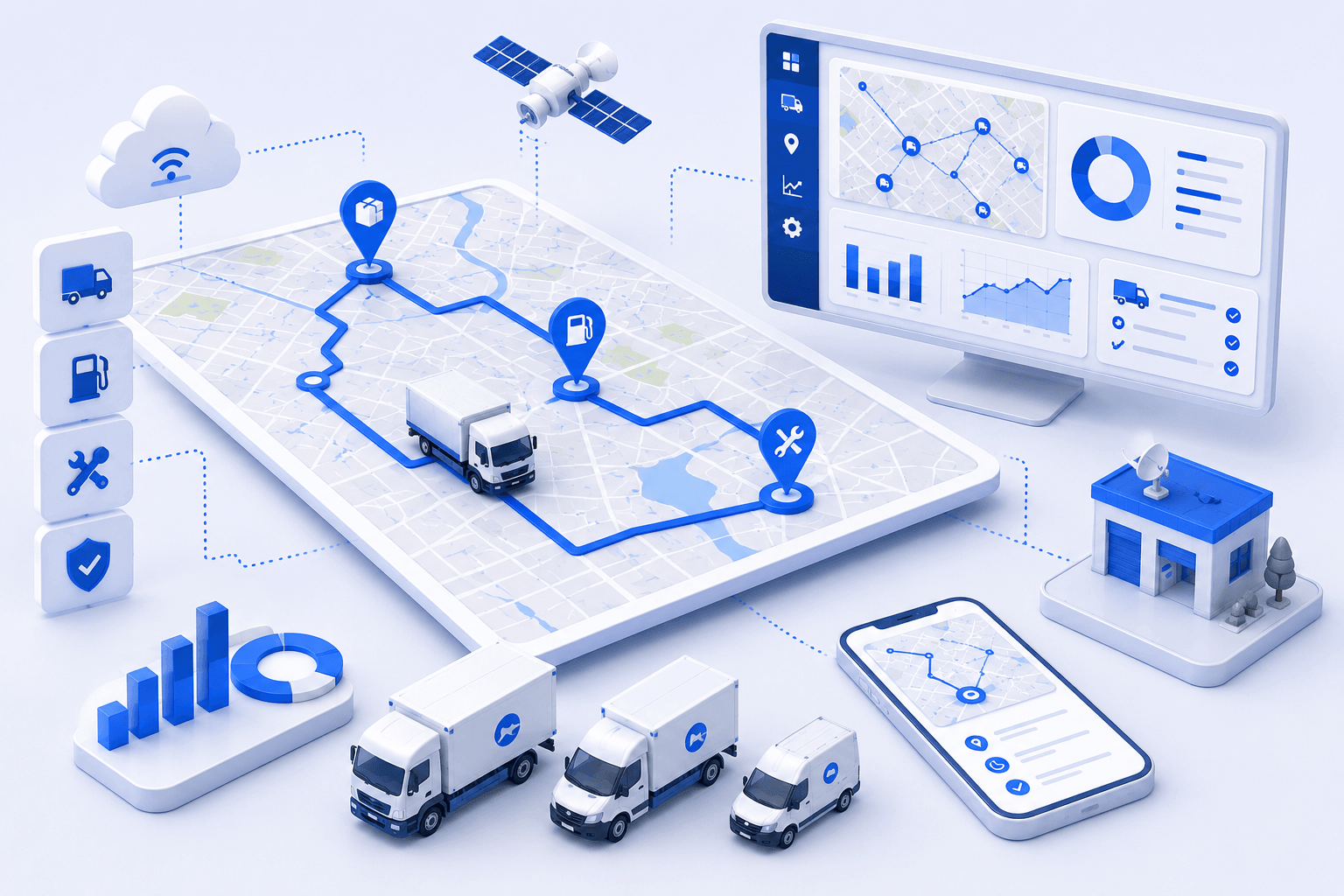
If your business runs delivery vans, service trucks, or vehicles for field visits, you are already operating a fleet, even if you have never called it that. Understanding “what is a fleet vehicle” and how fleet vehicle management works is the first step toward cutting costs, improving efficiency, and getting more value from every driver and vehicle on your team.
Fleet operations are scaling rapidly across every industry. According to Precedence Research, the global fleet management market was valued at USD 29.30 billion in 2025 and is projected to reach USD 76.33 billion by 2035, growing at a 10.05% CAGR. This growth highlights the increasing complexity and scale of modern fleet operations across delivery, field service, and transportation sectors.
Yet many operations managers still treat their vehicles as individual assets rather than a connected system. That approach leads to reactive maintenance, wasted fuel, inefficient routes, and compliance gaps that drain budgets and limit growth year after year.
In this guide, we break down the fleet vehicle meaning, explore the types of fleet vehicles used across industries, compare ownership models, cover management best practices, and address common challenges. Whether you run five vehicles or 500, you will find actionable strategies to manage your entire fleet as a coordinated, cost-efficient operation.
Table of Contents
- What Is a Fleet Vehicle? Definition, Meaning, and Key Characteristics
- 4 Types of Fleet Vehicles Every Business Should Know
- 7 Industries That Rely on Fleet Vehicles Daily
- 3 Fleet Vehicle Ownership Models: Buy, Lease, or Rent
- 6 Measurable Benefits of Managing Fleet Vehicles as a System
- How to Manage Fleet Vehicles: 6 Steps From Setup to Optimization
- 5 Common Fleet Vehicle Challenges (and How to Overcome Them)
- When to Replace a Fleet Vehicle: Key Signals and Data-Driven Timing
- How Upper Helps You Manage Fleet Vehicles
- FAQs
What Is a Fleet Vehicle? Definition, Meaning, and Key Characteristics
The fleet vehicle meaning is straightforward: a fleet vehicle is any car, van, truck, or specialty vehicle owned or leased by a business and used for commercial purposes. Unlike personal vehicles, fleet vehicles are acquired, registered, insured, and maintained under a company’s name, and they are managed as part of a group rather than individually.
There is no strict legal threshold for what qualifies as a “fleet,” but the industry standard starts at two or more vehicles used for business operations. Once you operate multiple vehicles, you qualify for fleet insurance policies, fleet maintenance contracts, and fleet management software, all of which offer cost advantages over managing vehicles one by one.
The following table breaks down the key differences between fleet vehicles and personal vehicles.
| Factor | Fleet Vehicle | Personal Vehicle |
|---|---|---|
| Ownership | Business-owned or leased under the company name | Individually owned |
| Purpose | Commercial operations (delivery, field service, transport) | Private and personal use |
| Insurance | Commercial fleet policy covering multiple vehicles | Individual auto insurance policy |
| Maintenance | Standardized schedules tracked centrally | Owner’s discretion |
| Registration | Commercial registration under a business entity | Personal registration |
| Financial treatment | Business asset on the balance sheet with tracked TCO | Personal expense |
| Data and reporting | Generates operational data (mileage, fuel, compliance) | No business reporting |
From a financial perspective, fleet vehicles are treated as business assets. They appear on balance sheets, depreciate over time, and their total cost of ownership (TCO) includes acquisition, fuel, maintenance, insurance, and eventual replacement. Tracking these costs per vehicle and per mile is what separates proactive fleet management from reactive operations.
For teams looking to centralize their fleet data, explore Upper’s fleet management software.
Now that the definition is clear, let’s look at the specific types of fleet vehicles businesses operate today.
4 Types of Fleet Vehicles Every Business Should Know
Fleet vehicles come in several categories, each suited to different operational needs. The type of fleet vehicles your business requires depends on your industry, delivery volume, cargo specifications, and service area.
1. Light Commercial Vehicles (LCVs)
Light commercial vehicles include cargo vans, pickup trucks, small box trucks, and panel vans. These are the workhorses of last-mile delivery and field service operations. LCVs represented 41.5% of the fleet management market in 2025, making them the largest vehicle segment.
Typical examples include Ford Transit vans, Ram ProMaster vans, and Toyota Tacoma pickups. LCVs are popular because they balance cargo capacity with urban maneuverability, making them ideal for operations running 50–200 stops per day across city and suburban routes.
2. Heavy Commercial Vehicles (HCVs)
Heavy commercial vehicles include box trucks, flatbed trucks, semi-trailers, tankers, and refrigerated trucks. These vehicles handle larger cargo volumes, longer haul distances, and specialized transport needs like temperature-controlled goods or bulk liquids.
HCVs require commercial driver’s licenses (CDLs), follow stricter DOT inspection schedules, and have higher maintenance and fuel costs than LCVs. Fleet managers running HCVs need robust compliance tracking for inspection certificates, emissions tests, and hours-of-service regulations.
3. Passenger Vehicles
Passenger fleet vehicles include sedans, SUVs, and minivans used by sales teams, executives, field representatives, and service coordinators. While they don’t carry cargo, passenger fleet vehicles still benefit from centralized management: fuel tracking, maintenance scheduling, route optimization for client visits, and mileage reporting.
4. Specialty and Service Vehicles
Specialty fleet vehicles are designed or modified for specific operational tasks. Examples include HVAC service trucks with mounted equipment, waste collection trucks, medical transport vehicles, mobile workshop vans, and refrigerated delivery vehicles. These vehicles often have unique maintenance requirements, capacity constraints, and route considerations that standard fleet management must accommodate.
The following table summarizes the key fleet vehicle types and their typical applications. These fleet vehicle examples cover the most common categories, though many businesses operate a mix of types depending on their service area and cargo requirements.
| Vehicle Type | Common Examples | Typical Industries | Fleet Size Range |
|---|---|---|---|
| Light commercial (LCVs) | Cargo vans, pickups, small box trucks | Last-mile delivery, courier, field service | 5–200+ vehicles |
| Heavy commercial (HCVs) | Box trucks, semi-trailers, tankers | Long-haul logistics, bulk distribution | 10–500+ vehicles |
| Passenger vehicles | Sedans, SUVs, minivans | Sales, executive transport, field reps | 5–100+ vehicles |
| Specialty vehicles | Service trucks, refrigerated vans, medical transport | HVAC, waste management, healthcare | 3–100+ vehicles |
Understanding vehicle types helps you choose the right fleet mix, but the industries using those vehicles shape how they are managed day to day.

See it in action
Upper replaces spreadsheets and phone calls with a single platform for route optimization, compliance alerts, and real-time fleet tracking.

7 Industries That Rely on Fleet Vehicles Daily
Fleet vehicles power operations across dozens of industries. The way each industry uses its fleet determines the management priorities, from route optimization and compliance tracking to proof of delivery and customer notifications.
1. Last-Mile Delivery and Courier Services
Last-mile delivery and courier services run the highest daily stop counts. A mid-size courier operation might dispatch 15 drivers with 80–150 stops each, making route optimization critical. Every extra mile driven per vehicle multiplies across the fleet, turning even small inefficiencies into significant fuel and labor costs.
2. Field Services (HVAC, Plumbing, Pest Control, Electrical)
Field service companies rely on fleet vehicles to reach customer sites throughout the day. Technicians carry specialized equipment, follow recurring service schedules, and need time-window management so customers get accurate arrival estimates. For a deeper look at how vehicle monitoring supports field operations, check out our guide on vehicle tracking system.
3. Waste Management and Recycling
Waste management and recycling fleets follow fixed collection routes but face daily variability from container placement, traffic, and customer schedule changes. These fleets benefit from territory-based routing and automated reporting to track pickup completion rates. For a closer look at how routing software supports this industry, see Upper’s waste collection route planning page.
4. Pharmaceutical and Medical Supply Delivery
Pharmaceutical and medical supply delivery fleets must meet strict compliance standards, including chain-of-custody documentation and delivery time windows for temperature-sensitive medications. Proof of delivery with photos, signatures, and GPS verification is not optional; it is a regulatory requirement.
5. Food and Grocery Delivery
Food and grocery delivery operations face tight delivery windows and perishable inventory. These fleets need real-time route adjustments when orders change, traffic delays occur, or customers reschedule.
6. Construction and Building Supply Distribution
Construction and building supply distribution fleets handle heavy, oversized loads that require vehicle capacity planning and height/weight restriction compliance for truck routing.
7. Sales and Territory Management
Sales and territory management fleets use passenger vehicles to cover client visits across defined territories. Route optimization for sales reps means maximizing face-to-face time with customers and minimizing windshield time between appointments.
Regardless of industry, the fleet vehicle ownership model you choose has a direct impact on costs, flexibility, and maintenance responsibilities.
3 Fleet Vehicle Ownership Models: Buy, Lease, or Rent
How you acquire your fleet vehicles affects your cash flow, tax position, maintenance obligations, and long-term flexibility. There are three primary ownership models, and many fleets use a mix depending on vehicle type and operational needs.
1. Company-Owned Fleets
Purchasing vehicles outright gives your business full control over the asset. You decide the make, model, and configuration. You manage maintenance on your own schedule. And you build equity in the vehicle that you can recover through resale or trade-in.
The trade-off is a high upfront capital expenditure. Company-owned vehicles also depreciate, and your team carries the full maintenance burden. This model works best for businesses with stable, long-term fleet needs and the internal capacity to manage vehicle lifecycles.
2. Leased Fleets
Leasing spreads costs into predictable monthly payments without the large upfront investment. Operating leases keep vehicles off your balance sheet, while capital leases transfer ownership at the end of the term. Many fleet operators choose leasing for vehicles that need frequent replacement, like LCVs that accumulate high mileage in delivery operations.
Leased fleets often include maintenance packages from the lessor, reducing your team’s administrative burden. However, you may face mileage caps, modification restrictions, and early termination penalties.
3. Rented or Contracted Fleets
Short-term rentals and contracted vehicles serve seasonal demand spikes, temporary projects, or trial expansions. A delivery company scaling up for holiday peak season might rent 10 additional vans for three months rather than purchasing vehicles that sit idle the rest of the year.
This model offers maximum flexibility but comes at the highest per-vehicle cost. Rentals also limit customization and branding opportunities.
The following table compares the three ownership models side by side.
| Ownership Model | Upfront Cost | Maintenance Responsibility | Flexibility | Best For |
|---|---|---|---|---|
| Company-owned | High (full purchase) | Full (in-house or contracted) | Low (long-term commitment) | Stable, long-term fleet needs |
| Leased | Low–Medium (monthly payments) | Shared (often included in lease) | Medium (term-based) | Growing fleets, predictable budgets |
| Rented/Contracted | None (pay-as-you-go) | None (rental company handles) | High (short-term) | Seasonal peaks, temporary projects |
Choosing the right ownership model is one piece of the puzzle. The bigger operational question is how you manage those vehicles day to day, and that is where fleet vehicle management comes in.
6 Measurable Benefits of Managing Fleet Vehicles as a System
The fleet vehicle benefits become clear when vehicles are managed as a coordinated system rather than individual assets. The operational and financial gains compound across every vehicle, driver, and route.
1. Lower Cost Per Delivery Through Route Optimization
AI-powered route planning reduces total miles driven by 20% per week by sequencing stops in the most efficient order, factoring in traffic, time windows, and vehicle capacity.
2. Improved Operational Visibility With Fleet GPS Tracking
Fleet managers see every vehicle on one screen, including live location, route progress, and ETAs. This eliminates blind spots and enables faster responses to delays or deviations. To see how real-time monitoring works in practice, explore Upper’s driver fleet tracking feature.
3. Better Compliance Tracking
Automated alerts notify fleet managers 30, 15, and 7 days before registration, insurance, inspections, or permits expire. No more missed deadlines or surprise fines.
4. Increased Stops Per Day
Optimized routes help teams complete 28% more stops per day compared to manual route planning. More stops per driver means higher revenue without adding vehicles or headcount.
5. Enhanced Customer Satisfaction
Automated SMS and email notifications keep customers informed with real-time ETAs and live tracking links. Operations using these capabilities report a 95% customer satisfaction score.
6. Reduced Vehicle Downtime
Proactive maintenance scheduling based on mileage thresholds and service intervals catches issues before they cause breakdowns. Less downtime means more billable hours on the road.
These benefits sound compelling, but achieving them requires a structured approach to fleet vehicle management. Here is a step-by-step process to get there.
See it in action
See These Fleet Vehicle Benefits in Action
Upper automates route planning, compliance alerts, and fleet tracking so you can focus on growing your operation.
How to Manage Fleet Vehicles: 6 Steps From Setup to Optimization
Managing fleet vehicles effectively means building systems that automate routine decisions, surface problems early, and give dispatchers and drivers the tools they need to perform at their best.
Step 1: Build a Complete Vehicle Profile
Every fleet vehicle should have a detailed profile that tracks its identity, specifications, compliance documents, and assignment history. This profile becomes the single source of truth for all decisions related to that vehicle.
- Record VIN, make, model, year, license plate, color, and fuel type for every vehicle
- Log vehicle specifications: height, width, maximum stops per route, speed limits, and cargo capacity (boxes, volume, weight)
- Upload registration, insurance, and inspection documents for centralized access
- Assign specific drivers to each vehicle and track driver-vehicle relationships over time
Step 2: Set Up Compliance and Maintenance Alerts
Compliance lapses lead to fines, liability exposure, and vehicles pulled from service at the worst possible time. Automated alerts eliminate the risk of missed deadlines.
- Configure expiry alerts for registration, insurance, inspection certificates, emissions tests, DOT inspections, permits, warranties, and lease end dates
- Set multi-stage reminders at 30, 15, and 7 days before each expiry
- Schedule service intervals based on mileage (e.g., oil change every 5,000 miles) and time (e.g., tire inspection every 90 days)
- Track odometer readings and estimated mileage to trigger condition-based maintenance
Step 3: Optimize Routes for Your Fleet
Route optimization is the single highest-impact change most fleet operations can make. It reduces miles, saves fuel, increases daily stops, and cuts planning time from hours to minutes. Upper’s route planning feature handles this in three steps: import stops, click optimize, and dispatch to driver apps.
- Import stops from Excel, CSV, or eCommerce integrations (Shopify, WooCommerce)
- Set constraints: delivery time windows, vehicle capacity, priority stops, service zones, and driver availability
- Click Optimize to generate the most efficient route sequence in seconds
- Dispatch routes to driver mobile apps with one click
Step 4: Track Vehicles and Drivers in Real Time
GPS fleet tracking gives dispatchers live visibility into every vehicle’s location, speed, route progress, and estimated time of arrival at each stop. This visibility transforms fleet operations from reactive (waiting for drivers to call in) to proactive (identifying and resolving delays as they happen).
- Monitor all drivers on a single map with live GPS updates
- View route progress and identify stops that are running behind schedule
- Respond to delays by reassigning stops or adjusting routes in real time
- Use breadcrumb trails to review driver routes after the fact for performance analysis
Step 5: Capture Proof of Delivery at Every Stop
Proof of delivery (POD) protects your business from disputes, supports insurance claims, and builds customer trust. Modern POD systems capture multiple data points in seconds. To learn more about digital delivery verification, explore Upper’s proof of delivery software.
- Collect electronic signatures from recipients directly in the driver app
- Take photos at the point of delivery (3–10 photos, depending on your plan)
- Add delivery notes for special instructions or exceptions
- Every POD record is automatically GPS-tagged and timestamped for a complete audit trail
Step 6: Monitor Performance With Fleet Reporting
Fleet reporting turns raw operational data into actionable insights. Without reporting, fleet managers rely on gut feel and anecdotal feedback to make decisions about routes, drivers, vehicles, and costs.
- Track cost per mile to identify vehicles that are becoming too expensive to operate
- Monitor on-time delivery rates to measure service quality
- Review fuel consumption by vehicle and driver to spot inefficiencies
- Compare planned versus actual route performance to identify coaching opportunities
- Use scheduled reports to share fleet KPIs with stakeholders automatically
Cloud-based fleet management solutions are forecast to grow at a 14% CAGR from 2026 to 2035, outpacing on-premise systems as fleets centralize reporting and analytics, per Precedence Research.
With the management framework in place, let’s address the challenges that derail fleet operations when they are not handled proactively.
5 Common Fleet Vehicle Challenges (and How to Overcome Them)
Every fleet operation faces recurring challenges. The difference between well-managed fleets and struggling ones is whether those challenges are addressed reactively or built into the management system from the start.
1. Rising Fuel and Maintenance Costs With No Clear Data
Fuel and maintenance are typically the two largest variable costs in any fleet operation. Without per-vehicle and per-mile tracking, fleet managers cannot identify which vehicles are draining the budget or which routes burn the most fuel.
How to Overcome
- Track fuel purchases per vehicle with receipt uploads and approval workflows to catch anomalies
- Log odometer readings at every fill-up to calculate real fuel efficiency per vehicle
- Compare fuel consumption against route distance to identify vehicles with declining efficiency
- Use maintenance cost trends to flag vehicles approaching the replacement threshold
- Consolidate all cost data in a fleet analytics platform; Upper’s route management analytics dashboard surfaces these trends automatically
2. Routes That Fall Apart When Reality Changes
Most route planners optimize routes once at the start of the day, but deliveries rarely go according to plan. Cancellations, urgent add-ons, traffic delays, and missed time windows force dispatchers to rebuild routes manually, wasting time and creating chaos.
How to Overcome
- Use a route planner with real-time adaptability (Upper’s drag-and-drop timeline lets you adjust routes in 30 seconds)
- Ensure changes sync instantly to driver apps so drivers are not working off outdated routes
- Build in buffer time for high-variance delivery zones
3. Drivers Not Following Optimized Routes
The best-planned routes mean nothing if drivers ignore them. Driver adoption depends on app simplicity, trust in the optimization, and clear communication from dispatch.
How to Overcome
- Choose a driver app that integrates with familiar navigation tools (Google Maps, Waze, Apple Maps)
- Keep the driver interface simple: stop list, turn-by-turn navigation, two-tap proof of delivery
- Share route rationale with drivers so they understand why the sequence is optimized
4. Compliance Lapses From Manual Tracking
Tracking registration, insurance, inspections, emissions tests, DOT certifications, and permits across dozens of vehicles using spreadsheets is a recipe for missed deadlines. A single lapse can pull a vehicle from service, trigger fines, or void insurance coverage.
How to Overcome
- Centralize all compliance dates in one system with automated multi-stage alerts
- Assign compliance ownership so specific team members are responsible for each renewal
- Upload and store compliance documents digitally for instant access during audits or roadside inspections
5. No Centralized Visibility of the Fleet
When dispatch relies on phone calls and text messages to know where drivers are, response time suffers. Dispatchers cannot reassign stops, communicate accurate ETAs to customers, or verify that drivers are on route.
How to Overcome
- Implement GPS fleet tracking with live map visibility for all vehicles
- Use geofence alerts to automate notifications when vehicles enter or leave designated zones
- Provide customers with live tracking links and automated status updates through notification software to reduce inbound calls
These challenges are manageable with the right systems. But there is one fleet decision that no amount of software can fully automate: knowing when to replace a vehicle.
When to Replace a Fleet Vehicle: Key Signals and Data-Driven Timing
Replacing a fleet vehicle too early wastes capital. Replacing it too late drains the budget through escalating maintenance costs, breakdowns, and downtime. The goal is to find the optimal replacement point where the total cost of ownership (TCO) is minimized.
Key signals that a fleet vehicle needs replacement:
- Recurring breakdowns: If a vehicle has had three or more unscheduled repairs in the past six months, the reliability has crossed a threshold where the cost of keeping it running exceeds the cost of replacing it
- Rising maintenance costs: Track the cumulative maintenance spend per vehicle. When annual maintenance exceeds 50% of the vehicle’s current market value, replacement is typically more cost-effective
- Declining fuel efficiency: A vehicle consuming 15–20% more fuel than its baseline indicates engine or drivetrain degradation that will only worsen
- Safety concerns: Aging vehicles may lack modern safety features, have worn suspension or braking systems, or fail to meet current emissions standards
- High mileage thresholds: Most light commercial fleet vehicles reach their optimal replacement window between 100,000 and 150,000 miles, depending on vehicle type and operating conditions
Using fleet data to time replacements:
Fleet reporting makes replacement decisions objective rather than emotional. By tracking cost per mile, downtime days, maintenance frequency, and fuel efficiency over the vehicle’s life, fleet managers can identify the inflection point where operating costs begin accelerating.
Depreciation and resale value also play a role. Vehicles lose the most value in their first three years, then depreciation flattens. Selling or trading a vehicle before it enters the high-maintenance phase preserves residual value that can fund the replacement.
For fleets that want to compare plan options and pricing for the software that supports these decisions, visit Upper pricing to see which tier matches your fleet size.
With the full picture of fleet vehicles, their types, management, benefits, challenges, and replacement timing, let’s bring it all together.
See it in action
Turn Fleet Challenges Into Operational Wins
Upper boasts automated compliance alerts, drag-and-drop route changes, and GPS tracking, which solve the problems that drain fleet budgets daily.
How Upper Helps You Manage Fleet Vehicles
Fleet vehicle management comes down to visibility, efficiency, and control over every vehicle, driver, and route in your operation. This guide covered the fleet vehicle meaning, types, and ownership models, management best practices, operational benefits, common challenges, and replacement timing.
Upper is a route optimization and fleet management platform that centralizes route planning, tracking, compliance, and reporting in one system. Here is what it brings to your fleet vehicle operations:
- AI-powered route optimization: creates the most efficient routes in seconds, cutting total miles driven by 20% per week across your fleet
- Real-time GPS fleet tracking: monitor every vehicle on one screen; respond to deviations and delays as they happen
- Compliance and maintenance alerts: automated reminders at 30, 15, and 7 days before expiry for registration, insurance, and inspections
- Proof of delivery: captures photos, e-signatures, GPS coordinates, and timestamps at every stop for dispute resolution and compliance audits
- Analytics dashboard: consolidates vehicle performance, driver metrics, and route efficiency into one view for data-driven fleet decisions
Upper users report 28% more stops per day and 20% fewer miles driven per week. For fleet vehicle operations, fewer miles means lower fuel costs, less vehicle wear, reduced maintenance spend, and longer asset lifecycles, all of which directly improve your fleet’s total cost of ownership.
Frequently Asked Questions
A fleet generally consists of two or more vehicles owned or leased by a business for commercial use.
While there is no universal legal definition, many insurance providers, fleet management software platforms, and commercial service providers consider two or more business vehicles to qualify as a fleet. Even small fleets can benefit from centralized management and commercial fleet services.
A fleet vehicle is owned or leased by a business and used primarily for commercial operations, while a personal vehicle is owned by an individual for private use.
Fleet vehicles are typically covered under commercial insurance policies, follow standardized maintenance schedules, generate operational data, and are managed collectively to improve efficiency, compliance, and cost control.
In many cases, yes. Fleet insurance policies cover multiple business vehicles under a single policy, often reducing the average insurance cost per vehicle.
Insurance providers also consider factors such as driver safety records, vehicle age, fleet size, safety programs, and telematics data when determining premiums. Businesses with strong safety performance may qualify for additional discounts.
Fleet vehicle tracking uses GPS technology to monitor vehicle locations, routes, speed, and operational status in real time.
Fleet managers can view every vehicle from a centralized dashboard, monitor route progress, respond to delays, provide accurate ETAs, and analyze historical trips. Advanced systems also include geofencing, route playback, and driver behavior monitoring.
Yes. Small businesses operating just two to five vehicles can realize significant benefits from fleet management software.
Route planning becomes faster, fuel costs decrease through optimized routing, maintenance schedules become easier to manage, compliance improves, and automated customer notifications enhance the delivery experience. Because smaller teams often have limited resources, the productivity gains and return on investment can be substantial.