

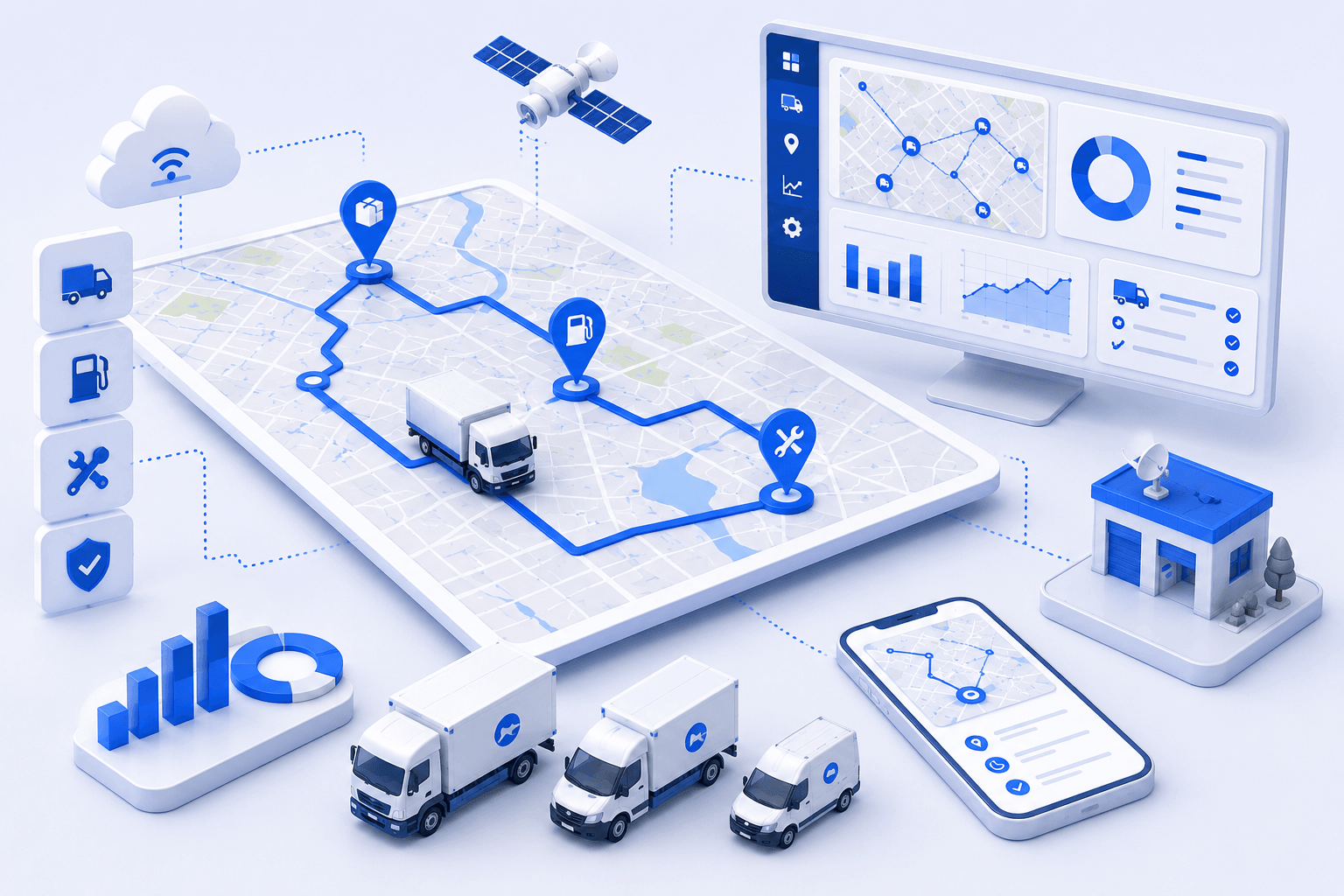
Fleet management today is no longer just about knowing where your vehicles are. It is about understanding how they are being used and how they can perform better. That is where two often confused concepts come into play: telematics and route optimization. While both aim to improve efficiency and reduce operational costs, they serve very different purposes within a fleet ecosystem.
Telematics focuses on collecting and analyzing real time data from vehicles, including location, fuel usage, driver behavior, and engine diagnostics. Route optimization, on the other hand, uses algorithms and planning tools to determine the most efficient paths for deliveries or service routes. One is centered on visibility and insights, while the other is focused on planning and execution.
Understanding the difference is not just theoretical. It can shape how you invest in technology and where you see the biggest returns. In this blog, we will break down telematics and route optimization, compare their roles, and help you decide which approach, or combination, best supports your fleet’s goals.
Table of Contents
- What Telematics Actually Does for Your Fleet
- What Route Optimization Actually Does for Your Fleet
- Telematics vs Route Optimization: Side-by-Side Comparison
- Why Fleet Managers Confuse Telematics With Route Optimization
- Decision Framework: What Does Your Fleet Need?
- Plan Smarter Routes and Track Every Driver With Upper
- Frequently Asked Questions
What Telematics Actually Does for Your Fleet
Before comparing the two technologies, it is worth establishing exactly what telematics does well. This is not an argument against telematics. It is an argument for understanding its boundaries.
Vehicle Tracking and Location History
Telematics provides real-time GPS position of every vehicle in your fleet along with historical trip logs and breadcrumb trails. You can see where a truck is right now and where it has been over the past week.
For fleets that need to verify driver locations or audit trip histories, this capability is foundational. For a deeper look at what fleet telematics explained means in practice, the technology covers vehicle monitoring comprehensively.
Driver Behavior and Safety Monitoring
Harsh braking events, rapid acceleration, and speeding alerts feed into driver scorecards and safety reporting. Telematics platforms excel at identifying risky driving patterns and helping fleet managers reduce accidents and insurance premiums. This data is valuable for coaching drivers and lowering operating costs tied to unsafe behavior.
Vehicle Diagnostics and Maintenance Alerts
Engine fault codes, battery voltage, and fuel level readings allow telematics to flag maintenance issues before they cause breakdowns. Predictive maintenance scheduling based on actual usage data keeps vehicles on the road longer and reduces unexpected downtime.
Compliance and Reporting
Hours of Service (HOS) tracking, Electronic Logging Device (ELD) compliance, and IFTA mileage reporting are core telematics functions. For regulated fleets, this capability alone justifies the hardware investment.
Telematics excels at answering “what is happening with my vehicles right now?” and “what happened yesterday?” But it does not answer “what should my drivers do tomorrow?” That is where route optimization enters.
What Route Optimization Actually Does for Your Fleet
Route optimization sits on the opposite side of the operational equation. While telematics monitors what has happened and what is happening, route optimization plans what should happen next. Here is what that covers in practice. For a comprehensive breakdown, see our full route optimization guide.
Multi-Stop Route Sequencing
Calculating the most efficient order to visit 20, 50, or 100+ stops is the core function. The algorithm accounts for time windows, service durations, and priority levels to produce sequences that minimize total drive time while meeting every constraint. Manual planning cannot match the computational output of optimization software, especially as stop counts grow.
Constraint-Based Planning
Route optimization handles vehicle capacity limits, driver hours, territory boundaries, and customer preferences simultaneously. Rather than just minimizing distance, it balances workload across drivers so no single route is overloaded while another finishes early. This is the planning layer that telematics was never designed to provide.
Dynamic Rerouting and Dispatch
Adding or removing stops mid-route without rebuilding the entire plan is a standard capability. Dispatchers push optimized routes directly to driver mobile apps, and adjustments flow through the same channel in real time. This keeps operations flexible without requiring phone calls to every driver whenever the plan changes.
Delivery Execution and Proof of Completion
Driver navigation, stop-by-stop workflow guidance, and proof of delivery capture close the loop between planning and execution. Dispatchers see real-time route progress, and customers receive automated delivery notifications. The route plan does not just exist on paper. It tracks through to completion.
Route optimization answers “what should my drivers do, in what order, and how do I know they did it?” The two technologies serve different operational questions, and the next section puts them side by side.

See it in action
See AI-Enabled Route Optimization in Action
Upper plans multi-stop routes in minutes, dispatches them to drivers, and tracks every delivery. See how it works for your fleet.
Telematics vs Route Optimization: Side-by-Side Comparison
This is the comparison that most fleet technology content avoids. Here is a direct capability breakdown showing what each technology covers and where the gaps are. Use this as a reference when evaluating your fleet’s tool stack.
| Capability | Telematics | Route Optimization |
|---|---|---|
| Real-time GPS tracking | Yes | Yes (app-based) |
| Historical trip logs | Yes | No |
| Driver behavior monitoring | Yes | No |
| Vehicle diagnostics | Yes | No |
| HOS/ELD compliance | Yes | No |
| IFTA reporting | Yes | No |
| Multi-stop route sequencing | No | Yes |
| Time window planning | No | Yes |
| Vehicle capacity constraints | No | Yes |
| Mid-route stop changes | No | Yes |
| Driver dispatch | No | Yes |
| Proof of delivery | No | Yes |
| Customer notifications | No | Yes |
| Route analytics (planned vs actual) | Partial | Yes |
Both technologies show vehicles on a map, which is exactly why the confusion exists. At first glance, they look like the same product. But the overlap is shallow. Telematics vendors increasingly add basic “routing” features like point-to-point navigation, but these are not multi-stop optimization. Similarly, route planning software like Upper Route Planner increasingly includes basic tracking, which further blurs the line.
The key distinction: telematics is retrospective and monitors in real time. Route optimization is prospective and prescriptive. One watches. The other plans.
The Integration Opportunity
The most powerful fleet setup is not choosing one over the other. It is combining both. Telematics data on driver behavior, fuel consumption, and maintenance needs feeds into smarter route planning decisions. Route optimization data showing planned versus actual routes makes telematics reporting more meaningful.
Together, a fleet can plan the optimal route, execute it through a driver app, monitor compliance with telematics, and measure the result against the plan. A 40-vehicle HVAC service fleet that had used telematics for years thought it had fleet management covered. When it added route optimization, its on-time service rate jumped from 71% to 89% in the first month. Telematics told them where trucks were. Route optimization told drivers where to be.
This is not an either/or decision. Fleets with telematics need to add route optimization, not replace their hardware. Fleets starting fresh should prioritize based on their most pressing operational pain and build from there.
With both technologies clearly defined and compared, the remaining question is why so many fleet managers conflate them in the first place.
See it in action
Fill the Route Planning Gap in Your Fleet
Upper handles every capability in the route optimization column. Add it alongside your telematics system without replacing anything.
Why Fleet Managers Confuse Telematics With Route Optimization
The confusion between these two technologies is not a knowledge gap. It is a marketing problem compounded by surface-level product similarities.
Telematics Vendors Market Broad “Fleet Management” Promises
Product pages from major telematics providers list dozens of features, positioning their platforms as complete fleet solutions. The word “route” appears frequently in telematics marketing, but it usually refers to turn-by-turn navigation or breadcrumb trails, not multi-stop optimization with constraints.
Many fleet managers discover this gap the hard way, purchasing a telematics package thinking it includes route planning, then realizing months later that seeing where trucks have been is not the same as planning where they should go.
The Map View Creates a False Equivalence
Both telematics and route optimization display vehicles on a map. That visual similarity makes them feel like the same product to someone evaluating fleet tools for the first time. Dispatchers see dots moving on a screen and assume they have route management.
What they actually have is vehicle monitoring. A fleet management platform that combines both capabilities looks different in practice because the map shows not just position but route progress, stop status, and delivery outcomes.
Small Fleets Start With Telematics and Never Evaluate Further
Telematics is often the first technology purchase for a growing fleet. By the time routes become complex enough to need optimization, the assumption that “we already have a fleet tool” is deeply embedded.
A telematics ROI analysis shows clear value from monitoring, but it does not account for the route planning gap that grows as stop counts increase.
Recognizing the distinction is the first step. The next section provides a framework for deciding which technology your fleet actually needs right now.
Decision Framework: What Does Your Fleet Need?
Rather than debating which technology is “better,” match the tool to your fleet’s current pain point. Here is a practical decision path.
You Need Telematics First If
- Your primary concern is regulatory compliance (HOS, ELD, IFTA)
- You need to monitor driver safety and reduce insurance costs
- Your vehicles require predictive maintenance tracking based on diagnostics
- You operate a small fleet with simple, repeatable routes that rarely change
For these fleets, telematics solves the most urgent problem. Route optimization can come later as stop counts and complexity grow.
You Need Route Optimization First If
- Your drivers visit 15 or more stops per day and you plan routes manually
- Missed delivery windows and late arrivals are your biggest customer complaint
- You spend hours each morning building routes in spreadsheets or Google Maps
- Your dispatchers cannot adjust routes mid-day without calling every driver individually
A 12-vehicle florist delivery operation fits this profile. With no telematics and no route software, planning 80 to 100 stops across six drivers every morning consumed hours of dispatcher time. Starting with route optimization delivered immediate time savings that justified the investment within the first week.
You Need Both When
- Your fleet has grown past 10 vehicles and routes change daily
- You need to plan efficient routes AND monitor how they are actually executed
- You want to measure planned versus actual performance and improve over time
- Compliance requirements and route planning complexity are equally important
Most delivery-focused fleets discover that route optimization solves their most pressing daily pain. Telematics adds a valuable layer of vehicle and driver monitoring on top.
See it in action
Start Optimizing Routes with AI
Upper requires no hardware and works alongside existing telematics. Build efficient routes and track deliveries from day one.
Plan Smarter Routes and Track Every Driver With Upper
Telematics and route optimization are complementary technologies, not interchangeable ones. Telematics monitors vehicles and drivers. Route optimization plans, sequences, and dispatches the work. Knowing which one you need, or whether you need both, prevents wasted spend and operational blind spots.
Upper is built for the route optimization side of the equation, and it fills the planning and execution gap that telematics hardware was never designed to cover. Multi-stop route planning with time windows and capacity constraints turns hours of manual scheduling into minutes of automated sequencing. Optimized routes dispatch directly to drivers through a mobile app, and dispatchers track route progress in real time from a fleet dashboard.
For fleets already running telematics, Upper works alongside your existing hardware. Your telematics system continues to monitor driver behavior, vehicle diagnostics, and compliance. Upper handles route planning, driver dispatch, delivery tracking, proof of delivery, and customer notifications. Together, both tools give you complete visibility from planning through execution.
Upper gives your fleet the operational layer that telematics alone cannot provide: knowing not just where your vehicles are, but where they should be and whether they got there on time. See how Upper adds route optimization and fleet tracking to your operations. Book a demo
Frequently Asked Questions
Most telematics platforms include basic turn-by-turn navigation, but this is not multi-stop route optimization. True route optimization calculates the best order to visit dozens or hundreds of stops while balancing driver workload, time windows, and vehicle capacity. These are separate computational capabilities.
No. Route optimization platforms like Upper work alongside existing telematics hardware. Your telematics system continues handling vehicle monitoring, diagnostics, and compliance while route optimization handles planning, dispatch, and delivery execution.
If your dispatchers spend more than 30 minutes per day building routes manually, if drivers visit 15 or more stops per day, or if missed delivery windows are a recurring problem, your fleet likely needs dedicated route optimization software.
Many route optimization platforms can work alongside telematics systems, either through direct API integrations or by running as a parallel tool. The key is ensuring both tools share a common view of driver assignments and route plans.