

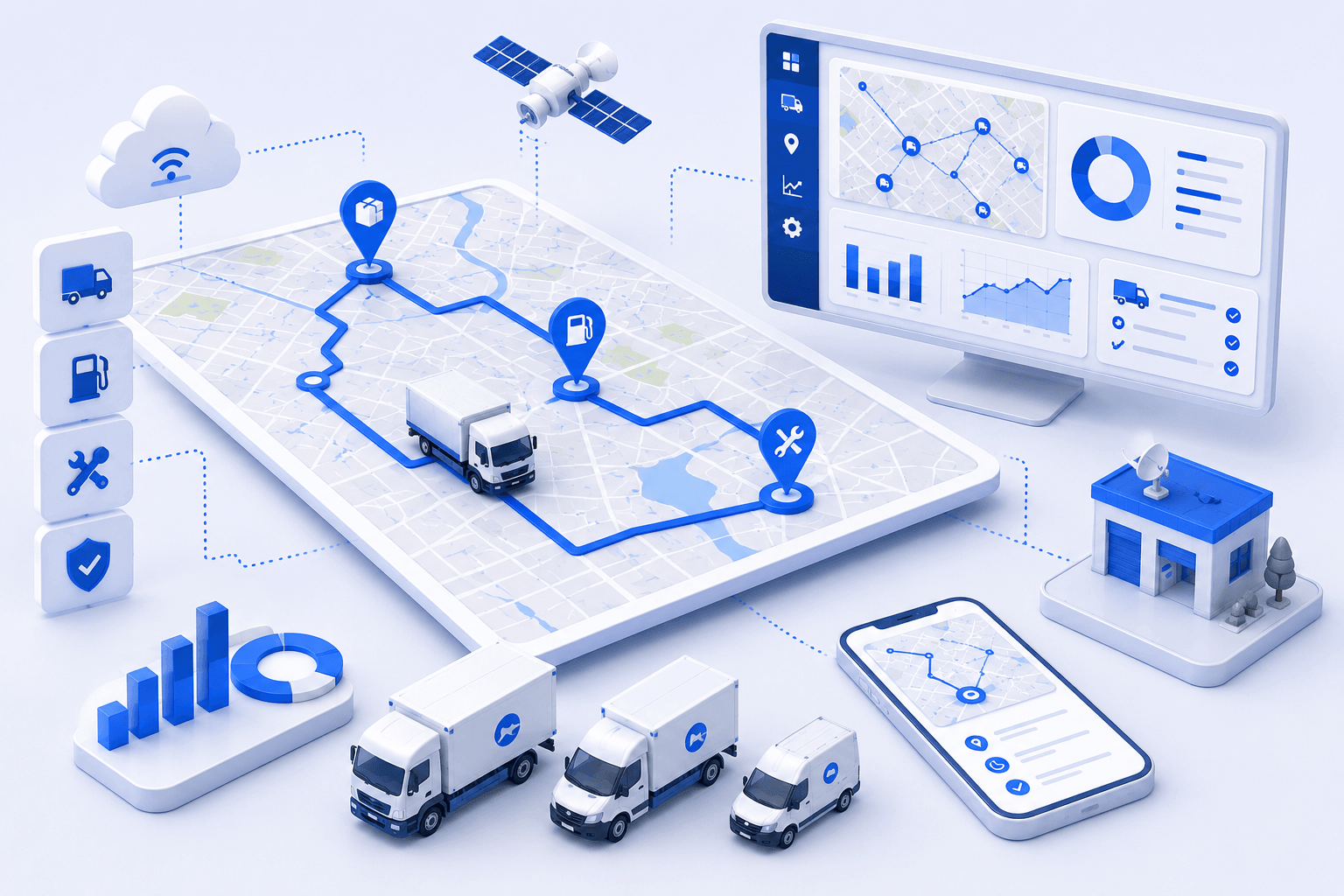
If you are comparing vehicle tracking costs right now, you have probably noticed something frustrating: almost no provider publishes a clear, all-in price. You get “starting at” numbers, asterisks next to monthly fees, and sales reps who will not quote you until you sit through a demo.
That lack of transparency is expensive. Hidden hardware markups, installation charges, and early termination penalties can inflate the real vehicle tracking cost by 40-60% beyond the advertised monthly rate.
Fleet operators are increasingly looking at the total cost of ownership in fleet management (TCO) rather than just sticker prices. The right tracking solution should pay for itself through fuel savings, reduced unauthorized use, and better driver productivity. The wrong one locks you into a multi-year contract with hardware you do not own.
This guide breaks down every cost category, compares pricing models side by side, and gives you the math to calculate your actual ROI.
In This Guide, You’ll Learn:
- What hardware, software, and hybrid tracking models actually cost per vehicle per year
- Where hidden fees show up (and how to spot them before you sign)
- How to calculate ROI using fuel, mileage, insurance, and productivity savings
- Which pricing model fits your fleet size, budget, and growth plans
- Common evaluation mistakes that lead to overspending
Table of Contents
- How Vehicle Tracking Cost Works
- Vehicle Tracking Cost Breakdown: What You Actually Pay
- Factors That Affect Vehicle Tracking Cost
- How to Calculate ROI on Vehicle Tracking
- Comparing Vehicle Tracking Cost Models: Hardware vs. Software vs. Hybrid
- Common Mistakes When Evaluating Vehicle Tracking Cost
- Track Your Fleet Without Expensive Hardware Using Upper
- Frequently Asked Questions on Fleet Tracking Costs
How Vehicle Tracking Cost Works
Vehicle tracking cost is not a single line item. It is a combination of hardware, software subscriptions, installation, and contract terms that add up differently depending on the model you choose. Understanding this structure is the first step toward comparing providers on equal footing.
Most fleet tracking solutions fall into one of three categories: hardware-based (dedicated GPS devices), software-only (smartphone-based GPS tracking), or hybrid models that combine both. Each has a different cost profile, and the cheapest monthly fee does not always mean the lowest total cost.
Hardware Costs vs. Software-Only Models
Hardware-based tracking requires a physical GPS device installed in each vehicle. These devices range from $50 to $300 per unit depending on features like real-time tracking frequency, geofencing capabilities, and OBD-II diagnostics. Some providers sell devices outright while others lease them, bundling the cost into higher monthly fees.
Software-only models skip the hardware entirely. Drivers use a smartphone app that provides GPS tracking, route data, and proof of delivery without any installed device. The tradeoff is that you rely on your drivers’ phones, but the upfront cost drops to nearly zero. Software-only tracking adoption has grown 35% year over year as more small and mid-size fleets discover this approach.
Subscription and Per-Vehicle Monthly Fees
Regardless of the tracking model, you will pay a recurring subscription. Hardware-based providers typically charge $20 to $50 per vehicle per month. Software-only platforms charge $15 to $40 per user per month. Enterprise solutions with advanced telematics can run $50 to $80 per vehicle monthly.
Watch for per-vehicle versus per-user pricing. Per-vehicle charges scale with your fleet size, while per-user pricing scales with the number of people managing or driving routes. For a fleet of 15 vehicles with 12 drivers and three dispatchers, those two models produce very different totals.
Installation and Activation Fees
Hardware devices need professional installation, which runs $50 to $150 per vehicle. Some providers include installation in the purchase price. Others charge it separately. OBD-II plug-in devices are self-installed, which eliminates this cost but offers fewer features than hardwired units.
Activation fees are another line item that providers sometimes bury in the fine print. Expect $25 to $75 per device for initial setup and network activation. Software-only platforms rarely charge activation fees since there is no hardware to configure.
Contract Terms and Commitment Periods
Most hardware-based providers require 12 to 36-month contracts. They subsidize hardware costs through longer commitments, which means your “discounted” device is not free if you are paying a higher monthly rate for three years. A survey by GPS Trackit found that 62% of small fleet operators prefer month-to-month pricing, yet the majority of hardware providers still require annual contracts.
Early termination fees range from $100 to $500 per vehicle. For a 20-vehicle fleet locked into a contract, walking away early could cost $2,000 to $10,000.
Understanding these cost components gives you a framework for comparing providers. Now, let’s put real numbers to each model.

See it in action
GPS Tracking Without the Hardware Price Tag
Upper turns your drivers' smartphones into GPS trackers. Real-time fleet visibility with zero upfront device costs.

Vehicle Tracking Cost Breakdown: What You Actually Pay
This is the section that matters most. Below, you will find actual cost ranges for each tracking model, broken into upfront costs, ongoing costs, and total first-year spend. These numbers reflect 2026 market pricing across leading providers.
The key insight: the cheapest monthly subscription often becomes the most expensive option once you factor in hardware, installation, and contract penalties. A $25/month plan with a $200 device and $100 installation costs more in year one than a $40/month software-only plan with zero upfront fees.
Hardware-Based Tracking (Full TCO)
Hardware tracking gives you dedicated GPS devices that work independently off driver smartphones. They offer consistent tracking even when phones are off or out of battery. Here is what you will actually pay.
Upfront Costs Per Vehicle
| Cost Category | Low Estimate | Mid Estimate | High Estimate |
|---|---|---|---|
| GPS device | $50 | $150 | $300 |
| Professional installation | $50 | $100 | $150 |
| Activation fee | $0 | $25 | $75 |
| Total upfront | $100 | $275 | $525 |
Ongoing Monthly Costs Per Vehicle
| Cost Category | Low Estimate | Mid Estimate | High Estimate |
|---|---|---|---|
| Software subscription | $20 | $35 | $50 |
| Cellular data fee | $0 | $5 | $10 |
| Device warranty/replacement | $0 | $3 | $8 |
| Total monthly | $20 | $43 | $68 |
Year-One TCO Per Vehicle
| Cost Category | Low Estimate | Mid Estimate | High Estimate |
|---|---|---|---|
| Upfront costs | $100 | $275 | $525 |
| Monthly costs (x12) | $240 | $516 | $816 |
| Year-one total | $340 | $791 | $1,341 |
For a 10-vehicle fleet, that means a first-year investment of $3,400 to $13,410. Marcus, an HVAC fleet manager in Denver, signed a contract at the low-end estimate. Six months in, two devices failed, and replacements cost $150 each, with $100 per reinstallation. His actual year-one spend hit $4,900 for 10 vehicles, 44% above his projected budget.
Software-Only Tracking (Smartphone-Based)
Software-only platforms turn each driver’s smartphone into a GPS tracker. No hardware purchases, no installation appointments, no device maintenance.
Upfront Costs Per Vehicle
| Cost Category | Low Estimate | Mid Estimate | High Estimate |
|---|---|---|---|
| Hardware | $0 | $0 | $0 |
| Installation | $0 | $0 | $0 |
| Activation fee | $0 | $0 | $0 |
| Total upfront | $0 | $0 | $0 |
Ongoing Monthly Costs Per User
| Cost Category | Low Estimate | Mid Estimate | High Estimate |
|---|---|---|---|
| Software subscription | $15 | $30 | $40 |
| Additional feature modules | $0 | $5 | $10 |
| Total monthly | $15 | $35 | $50 |
Year-One TCO Per User
| Cost Category | Low Estimate | Mid Estimate | High Estimate |
|---|---|---|---|
| Upfront costs | $0 | $0 | $0 |
| Monthly costs (x12) | $180 | $420 | $600 |
| Year-one total | $180 | $420 | $600 |
For the same 10-vehicle fleet, software-only tracking runs $1,800 to $6,000 in year one. That is a 47-55% savings compared to hardware-based tracking at equivalent tiers.
Hybrid and Enterprise Tracking
Hybrid models combine installed devices with a software layer for advanced analytics. Enterprise fleets (50+ vehicles) typically negotiate custom pricing that includes dedicated support, API integrations, and volume discounts.
Expect hybrid solutions to cost $40 to $80 per vehicle monthly, with hardware costs of $100 to $250 per unit. Enterprise contracts often bundle everything into a single per-vehicle rate, which simplifies budgeting but can make it harder to compare individual line items.
Priya, a logistics director managing 75 delivery vans in Atlanta, negotiated a hybrid deal at $55 per vehicle monthly, all-inclusive. Her annual spend comes to $49,500, but the contract locks her in for 36 months with a $250 per vehicle termination penalty.
Hidden Costs to Watch For
Beyond the obvious line items, several costs catch fleet managers off guard:
- Device replacement fees: GPS hardware fails. Replacement devices cost $75 to $200 each, plus reinstallation
- Overage charges: Some plans cap the number of location pings per day. Exceeding the cap triggers per-ping fees
- Report and export fees: A few providers charge extra for detailed analytics, geofence reports, or data exports
- Training and onboarding: Enterprise solutions may charge $500 to $2,000 for initial team training
- Contract auto-renewal: Many contracts auto-renew for another year if you miss the cancellation window by even a day
The full picture of vehicle tracking cost only becomes clear when you add these hidden items to your TCO calculation. Next, let’s look at what drives those costs up or down.
See it in action
Compare Upper's Software-Only Pricing
No hardware fees. No installation costs. Just transparent per-user pricing for GPS tracking, route optimization, and dispatch.
Factors That Affect Vehicle Tracking Cost
Several variables can shift your vehicle tracking system cost significantly in either direction. The same platform might cost your fleet $20 per vehicle or $60 per vehicle depending on how these factors play out.
Knowing what drives pricing gives you negotiating power and helps you avoid paying for capabilities you will never use.
Fleet Size and Volume Discounts
Most providers offer tiered pricing. A five-vehicle fleet pays the full per-unit rate. A 25-vehicle fleet might get 10-15% off. For guidance on managing smaller operations, see our guide on small fleet management. Fleets above 50 vehicles can often negotiate 20-30% discounts. Some providers also waive hardware or installation costs above a certain fleet size.
If you plan to grow, ask about pricing at your projected fleet size, not your current one. Locking in a rate for 10 vehicles when you expect to reach 30 within a year could leave you paying more than necessary. Choose fleet management software that scales pricing as you add vehicles or users.
Feature Requirements
Basic vehicle tracking (location, speed, trip history) costs less than full fleet management with route optimization, dispatch, fleet analytics, and proof of delivery. The more features you need, the higher the monthly subscription.
Be honest about what your fleet actually requires today. A 10-van courier operation probably does not need engine diagnostics or fuel card integration. Those features add $10 to $20 per vehicle monthly, and they sit unused for fleets that just need location tracking and route management.
Contract Length and Payment Terms
Longer contracts usually mean lower monthly rates. A 36-month commitment might save you 15-20% compared to month-to-month pricing. But that savings evaporates if you need to cancel early or switch providers.
Annual prepayment can also reduce costs by 5-10%. However, paying $12,000 upfront for a year of tracking ties up cash that growing fleets often need elsewhere.
Hardware Quality and Durability
Cheaper GPS devices ($50 to $100) have higher failure rates. Expect 10-15% annual replacement needs. Mid-range devices ($150 to $200) typically last three to five years with under 5% annual failure rates. Premium devices ($250+) offer ruggedized housings for harsh conditions but rarely justify the cost for standard delivery fleets.
Thomas, who runs a 20-truck plumbing fleet in Houston, initially chose $65 budget trackers. Within 18 months, he had replaced seven units at $65 each plus $100 reinstallation per truck. His “budget” hardware cost him an extra $1,155, nearly half the original hardware investment. He switched to software-only tracking and eliminated device costs entirely.
The factors above interact with each other. A large fleet with basic needs on a long contract will pay far less per vehicle than a small fleet wanting premium features month-to-month. Understanding your specific combination of these factors is the key to accurate budgeting.
How to Calculate ROI on Vehicle Tracking
Vehicle tracking is not just a cost. It is an investment that pays back through measurable savings in fuel, mileage, labor, and insurance. Most fleets recover their tracking investment within two to four months when they account for all savings categories.
The math is straightforward once you know where to look. Here are the four main areas where tracking generates returns.
Fuel Savings From Route Visibility
GPS-tracked fleets reduce unnecessary mileage by 10-20%, according to fleet management industry data. This fuel cost reduction compounds quickly across every vehicle in your fleet. For a fleet averaging 30,000 miles per vehicle annually, a 15% mileage reduction saves 4,500 miles per vehicle per year.
At $4.00 per gallon and 15 miles per gallon, that equals $1,200 in fuel savings per vehicle annually. For a 10-vehicle fleet, the annual fuel savings reach $12,000. Pair tracking with route optimization and those savings increase further by sequencing stops in the most efficient order.
Reduced Unauthorized Vehicle Use
According to fleet industry research, 15-20% of total fleet mileage in untracked fleets comes from unauthorized use: personal trips, detours, and extended breaks.
For a vehicle averaging 25,000 miles per year, eliminating 15% unauthorized use saves 3,750 miles. At $2.27 per mile in operating costs, that is $8,513 in annual savings per vehicle. Even a conservative 5% reduction returns $2,838 per vehicle.
Insurance Premium Reductions
Many commercial auto insurers offer discounts of 5-15% for fleets with active GPS tracking. The logic is simple: tracked fleets have lower accident rates, faster incident response, and better driver accountability.
For a fleet paying $3,000 per vehicle in annual commercial insurance, a 10% discount saves $300 per vehicle per year. Across a 15-vehicle fleet, that adds up to $4,500 annually in insurance savings alone.
Improved Driver Productivity
When drivers know their routes are tracked and optimized, idle time drops and stops per day increase. Fleets that implement tracking and route optimization together report 15-25% more completed stops per driver.
For a driver completing 25 stops per day at an average revenue of $15 per stop, a 20% improvement adds five stops daily. That translates to $75 per driver per day in additional revenue, or roughly $19,500 per driver per year (assuming 260 working days).
When you stack fuel savings, reduced unauthorized use, insurance discounts, and productivity gains, the ROI on vehicle tracking becomes hard to ignore. Most fleets see a payback period of two to four months. The next question is which pricing model delivers the best return for your situation.
See it in action
Start Saving on Fuel and Mileage Today
Fleets using Upper cut unnecessary miles and reduce fuel spend within the first month. See the difference for yourself.
Comparing Vehicle Tracking Cost Models: Hardware vs. Software vs. Hybrid
Choosing between hardware, software, and hybrid tracking is the biggest decision affecting your fleet tracking cost. Each model has distinct advantages depending on your fleet size, budget, and operational needs.
Here is a side-by-side comparison to help you evaluate all three. You can also review Upper’s pricing plans for a transparent look at software-only fleet tracking costs.
| Factor | Hardware-Based | Software-Only | Hybrid |
|---|---|---|---|
| Upfront cost per vehicle | $100-$525 | $0 | $100-$250 |
| Monthly cost per vehicle | $20-$68 | $15-$50 | $40-$80 |
| Year-one TCO (10 vehicles) | $3,400-$13,410 | $1,800-$6,000 | $5,200-$12,600 |
| Contract required | Usually 12-36 months | Often month-to-month | Usually 24-36 months |
| Installation needed | Yes (professional) | No | Yes (partial) |
| Tracking when phone is off | Yes | No | Yes |
| Route optimization included | Rarely | Often | Sometimes |
| Scalability cost | High (new device per vehicle) | Low (add user license) | Medium |
| Best for | Fleets needing 24/7 asset tracking | Fleets focused on driver tracking and routing | Enterprise fleets needing both |
The numbers tell a clear story. Software-only tracking wins on cost, flexibility, and scalability. Hardware tracking wins on always-on asset monitoring. Hybrid fills the gap for enterprise operations that need both but can absorb the higher price.
For most delivery and service fleets under 50 vehicles, software-only tracking delivers the best balance of GPS vehicle tracking cost and functionality. You get real-time driver locations, route optimization, and dispatch tools without the capital expenditure of hardware.
Common Mistakes When Evaluating Vehicle Tracking Cost
Fleet managers lose thousands of dollars by making avoidable errors during the evaluation process. According to FMCSA fleet safety guidelines, operational visibility is a safety requirement, not just a cost optimization tool. But choosing the wrong solution for cost reasons can undermine both your budget and your safety goals.
Here are the four most common mistakes and how to avoid them.
Comparing Monthly Fees Without Including Hardware
This is the most frequent error. Provider A charges $25/month with a $200 device. Provider B charges $35/month with no hardware cost. On a monthly fee comparison, Provider A looks cheaper. Over 12 months, Provider A costs $500 per vehicle while Provider B costs $420.
Always calculate year-one TCO per vehicle, not just the monthly rate. Include hardware, installation, activation, and any add-on fees.
Ignoring Contract Exit Costs
A 36-month contract at $30/month seems reasonable until your needs change at month 14. Early termination fees of $100 to $500 per vehicle can turn a reasonable deal into an expensive mistake.
Lisa, a regional courier dispatcher in Charlotte, signed a 36-month hardware contract for 12 vehicles. When her company merged with another courier service that used different software, she faced $3,600 in termination penalties. The “savings” from the long contract evaporated in one phone call. Before signing, calculate the worst-case exit cost and factor it into your decision.
Overbuying Features You Do Not Need
Full fleet telematics suites with engine diagnostics, fuel card integration, dashcam support, and compliance reporting can cost $60 to $80 per vehicle monthly. If your fleet of delivery vans only needs location tracking and route management, you are paying for features that sit idle.
Start with the features your operation needs today. Upgrade when the need is real, not hypothetical.
Overlooking Scalability Costs
Adding vehicles to a hardware-based system means buying new devices, scheduling installations, and potentially renegotiating contracts. Each new vehicle adds $100 to $525 in upfront costs on top of the monthly subscription.
Software-based systems let you add a new driver in minutes with no additional hardware. For growing fleets, this flexibility keeps vehicle tracking prices predictable as you scale.
Avoiding these mistakes can save your fleet thousands per year. With the right evaluation framework, you can choose a tracking solution that fits both your current operation and your growth trajectory.
Track Your Fleet Without Expensive Hardware Using Upper
Vehicle tracking cost does not have to include hardware markups, installation appointments, or multi-year contracts. The most important takeaway from this guide is simple: calculate total cost of ownership, not just the monthly fee. When you do, software-only tracking consistently delivers the best value for delivery and service fleets.
Upper Route Planner gives you real-time GPS tracking through your drivers’ smartphones. No devices to buy. No technicians to schedule. No activation fees. Every driver’s location updates on a live map, giving you full fleet visibility from the moment they start their route.
But Upper goes beyond basic tracking. You also get route optimization that reduces mileage and fuel costs, one-click dispatch management that eliminates morning chaos, and proof of delivery with photos and signatures at every stop. These are the capabilities that turn tracking from a cost center into a profit driver.
Upper’s pricing is transparent and per-user, with no long-term contracts required. Add drivers as your fleet grows without buying new hardware or renegotiating terms. For fleet managers who want GPS tracking, route optimization, and dispatch in one platform at a predictable cost, Upper is built for exactly that.
Book a demo to see how Upper can reduce your fleet tracking costs while improving driver productivity and delivery performance.
Frequently Asked Questions on Fleet Tracking Costs
Vehicle tracking cost ranges from $15 to $80 per vehicle per month depending on the model. Software-only solutions start at $15 to $40 per user monthly with no hardware fees. Hardware-based systems run $20 to $50 per vehicle monthly plus upfront device and installation costs. Enterprise hybrid solutions with advanced telematics reach $50 to $80 per vehicle.
Yes. Small fleets often see the highest relative ROI from GPS vehicle tracking. Even a five-vehicle fleet can save $6,000 or more annually through reduced fuel costs, eliminated unauthorized use, and insurance discounts. Most small fleets recover their tracking investment within two to four months.
A hardware-based vehicle tracking system cost ranges from $340 to $1,341 per vehicle in year one. This includes the GPS device ($50 to $300), professional installation ($50 to $150), activation fees ($0 to $75), and monthly subscriptions ($20 to $68). Hidden costs like device replacements and overage charges can add 10-20% more.
Yes. Software-only tracking platforms frequently offer month-to-month pricing with no long-term commitment. Hardware-based providers are more likely to require 12 to 36-month contracts because they subsidize device costs through longer commitments. If contract flexibility matters to your fleet, software-based solutions are the better option.
Software-only tracking costs 47-55% less than hardware-based tracking in year one when you compare equivalent fleet sizes. A 10-vehicle fleet pays $1,800 to $6,000 annually for software-only tracking versus $3,400 to $13,410 for hardware-based tracking. The gap widens in subsequent years as software plans have no device replacement or reinstallation costs.
Common hidden fees include device replacement costs ($75 to $200 per unit), overage charges for exceeding location ping limits, report and data export fees, training charges ($500 to $2,000), and early termination penalties ($100 to $500 per vehicle). Always request a complete fee schedule before signing any tracking contract.
Most fleets see a payback period of two to four months. Fuel savings alone (10-20% mileage reduction) can cover the monthly subscription cost for many fleets. When you add insurance discounts (5-15%), reduced unauthorized vehicle use, and improved driver productivity, the annual return typically exceeds the tracking investment by three to five times.