

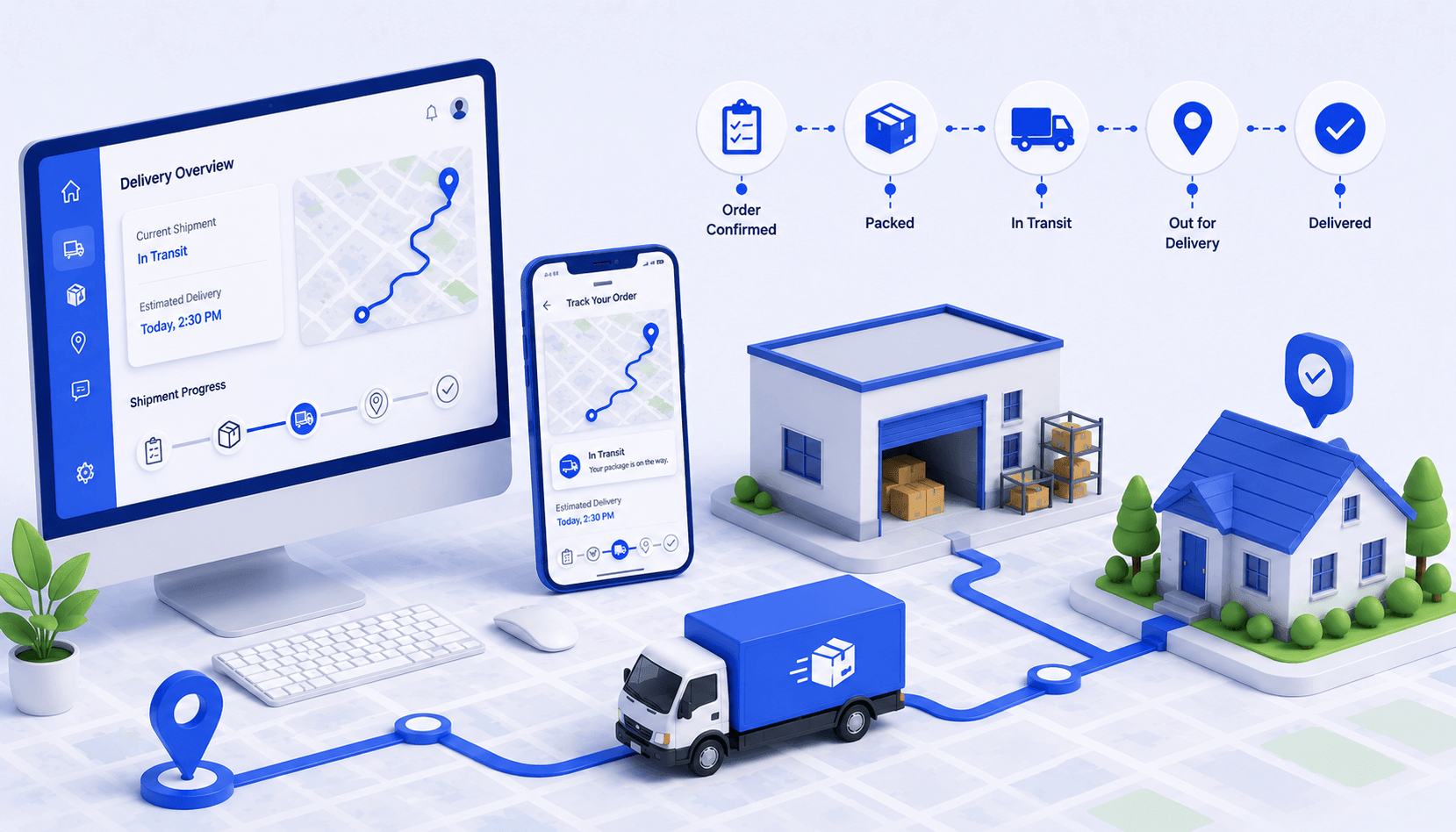
The autonomous delivery market is moving from pilot programs to commercial operations faster than most fleet managers expected. Self-driving vans, sidewalk robots, and delivery drones are completing real customer orders in cities across North America, Europe, and Asia right now.
According to Roots Analysis, the autonomous last-mile delivery market is valued at USD 28.09 billion in 2025 and is projected to reach USD 228.74 billion by 2035. That kind of growth signals a fundamental shift in how goods move from warehouses to doorsteps, driven by advances in robotics, AI navigation, and drone technology.
For fleet managers dealing with driver shortages, rising labor costs, and growing delivery volumes, autonomous delivery is no longer a distant concept. It is an operational shift that requires preparation today. Companies that wait until self-driving delivery is mainstream risk falling behind competitors who built the foundation early.
In this guide, we break down autonomous delivery for fleet operations. Learn what autonomous delivery is, the technologies powering it, proven benefits, real-world use cases, adoption barriers, and the concrete steps you can take today to prepare your fleet. Let’s get started.
Table of Contents
- What Is Autonomous Delivery?
- 4 Types of Autonomous Delivery Technologies
- How Autonomous Delivery Works
- 7 Benefits of Autonomous Delivery for Fleet Managers
- Autonomous Delivery vs Traditional Delivery
- Real-World Autonomous Delivery Use Cases
- 5 Challenges Slowing Autonomous Delivery Adoption
- 5 Steps to Prepare for Autonomous Delivery
- The Future of Autonomous Delivery
- How Upper Helps You Prepare for Autonomous Delivery
- FAQs
What Is Autonomous Delivery?
Autonomous delivery is the use of self-driving vehicles, robots, or drones to transport goods from a warehouse, store, or distribution center to the customer’s location without direct human control of the vehicle during transit. The vehicle navigates roads, sidewalks, or airspace using sensors, cameras, AI-powered decision-making, and pre-mapped routes.
The concept spans a wide range of form factors:
- Self-driving delivery vans and trucks that operate on public roads
- Sidewalk delivery robots that travel on pedestrian paths at low speeds
- Delivery drones that fly packages directly to a customer’s doorstep or designated landing zone
- Semi-autonomous vehicles, where a human driver supervises while the vehicle handles most driving tasks
It is important to distinguish autonomous delivery from delivery automation. Delivery automation refers to software-driven processes like automated route optimization, dispatch, tracking, and customer notifications. Autonomous delivery takes this further by removing or reducing the human driver from the physical transportation step.
Levels of Vehicle Autonomy
The Society of Automotive Engineers (SAE) defines six levels of driving automation, from Level 0 (no automation) to Level 5 (full autonomy with zero human intervention). Most autonomous delivery vehicles currently in operation fall between Level 3 and Level 4:
- Level 3 (Conditional automation): The vehicle handles driving in specific conditions, but a human safety operator must be ready to take over
- Level 4 (High automation): The vehicle operates independently within a defined geographic area or set of conditions (geofenced zones), with no human intervention required during operation
- Level 5 (Full automation): The vehicle can drive anywhere, in any conditions, without human input. This level is not yet commercially deployed for delivery
Scope of Autonomous Delivery
Autonomous delivery applies across three segments of the supply chain:
- Last mile: The final leg from a local hub to the customer. This is where robots, drones, and small autonomous vans are most active today
- Middle mile: Transportation between distribution centers or from a regional warehouse to a local hub. Semi-autonomous trucks and platooning technology are gaining traction here
- Long haul: Cross-country freight movement. Autonomous trucking companies are testing highway-only autonomous driving for this segment
Understanding how autonomous delivery fits into the broader logistics chain helps fleet managers identify which segment will impact their operations first, and where to focus preparation efforts.
With the fundamentals defined, let’s explore the specific technologies powering autonomous delivery today.
4 Types of Autonomous Delivery Technologies Reshaping Logistics
Autonomous delivery is not a single technology. It is a category that includes multiple vehicle types, each designed for different delivery scenarios. Here is how the four primary types compare and where each fits best.
1. Autonomous Delivery Vehicles (Self-Driving Vans and Trucks)
Best fit: Urban and suburban delivery with medium-to-large package volumes, middle-mile routes between warehouses and hubs, and high-density delivery corridors.
Self-driving delivery vehicles are full-sized vans or trucks equipped with sensor arrays, onboard computers, and AI navigation systems. According to Research and Markets, the autonomous delivery vehicles market is expected to grow from USD 1.31 billion in 2025 to USD $3.82 billion by 2030, at a CAGR of 23.8%.
Companies like Waymo, Nuro, and Gatik are operating autonomous delivery vehicles on public roads in select U.S. cities.
These vehicles handle larger payloads and longer distances than robots or drones. A single autonomous van can carry hundreds of packages per route, making them ideal for high-volume last-mile and middle-mile operations. Walmart, for example, has partnered with Gatik to run autonomous box trucks on fixed middle-mile routes between distribution centers and stores.
2. Autonomous Delivery Robots (Sidewalk Bots)
Best fit: Short-distance food delivery, grocery delivery, pharmacy delivery, and campus or neighborhood-level last-mile delivery.
Sidewalk delivery robots are small, low-speed vehicles that navigate pedestrian paths and sidewalks to deliver packages, groceries, and food orders. Companies like Starship Technologies, Serve Robotics, and Kiwibot operate fleets of these robots in college campuses, residential neighborhoods, and commercial districts.
According to Research Nester, the autonomous delivery robots market was valued at USD 738.3 million in 2025 and is projected to reach USD 7,579.4 million by 2035, at a CAGR of 27.7%.
These robots typically carry one to three packages at a time, with a payload capacity of 20–50 pounds. They travel at 4–6 mph, making them practical for short-distance deliveries within a 2–3 mile radius. Their small size and slow speed make them safer in pedestrian environments and easier to permit in many jurisdictions.
3. Autonomous Delivery Drones (Aerial Delivery)
Best fit: Lightweight packages (under 5 pounds), time-sensitive deliveries (medical supplies, food), rural or hard-to-reach areas, and scenarios where speed matters more than volume.
Delivery drones bypass road congestion entirely by flying packages directly to the customer. Amazon Prime Air, Wing (a subsidiary of Alphabet), and Zipline are among the leading companies deploying delivery drones commercially.
According to Fact.MR, the autonomous drone delivery market is projected to grow from USD 1.5 billion in 2025 to USD 15.0 billion by 2035, at a CAGR of 25.9%.
Drones excel at delivering small, lightweight packages quickly. Wing’s drones can deliver a package in as little as 10 minutes from order to doorstep within their service area. Zipline has completed over 1 million commercial deliveries globally, primarily for medical supplies and blood products in countries like Rwanda and Ghana, and has expanded into retail delivery in the U.S.
4. Platooning and Semi-Autonomous Trucking
Best fit: Long-haul freight, middle-mile transportation between distribution centers, and high-volume corridor routes where highway driving dominates.
Truck platooning uses vehicle-to-vehicle communication to link two or more trucks in a convoy. The lead truck is driven by a human, while following trucks operate semi-autonomously, maintaining a fixed following distance and mimicking the lead truck’s steering and braking.
Companies like Aurora, TuSimple, and Torc Robotics are also developing fully autonomous long-haul trucks for highway driving. These trucks operate autonomously on interstate highways and transfer to human drivers for the more complex first-mile and last-mile segments.
The following table provides a side-by-side comparison of the four autonomous delivery technologies.
| Technology | Payload | Range | Speed | Best Use Case |
|---|---|---|---|---|
| Self-driving vans/trucks | Hundreds of packages | 50–200+ miles | Road speed | High-volume last mile, middle mile |
| Sidewalk robots | 1–3 packages (20–50 lbs) | 2–3 miles | 4–6 mph | Food, grocery, and pharmacy delivery |
| Delivery drones | 1 package (under 5 lbs) | 5–15 miles | 60–80 mph | Time-sensitive, lightweight items |
| Truck platooning | Full truckload | 500+ miles | Highway speed | Long-haul freight, middle mile |
Each technology addresses different operational needs. Fleet managers should evaluate which delivery segments they operate in and which autonomous technologies align with their volume, distance, and package characteristics.
Now that we have covered what each technology does, let’s look at how autonomous delivery actually works from an operations standpoint.
How Autonomous Delivery Works: Sensors, AI, and Fleet Integration
An autonomous delivery follows a structured sequence from the moment a route is assigned to the moment a package reaches the customer. Here is how each stage works and where it connects to fleet operations you already manage today.
Step 1: Route Assignment and Optimization
Every autonomous delivery starts with a route. The fleet management software platform assigns a batch of deliveries to the vehicle, and the route optimization engine sequences stops for minimum distance and time. The same algorithms that reduce miles and maximize stops for human drivers apply directly to autonomous fleets. Constraints like delivery time windows, vehicle capacity, and geographic zones are factored in before the vehicle leaves the depot.
Step 2: Environment Sensing and Mapping
Once on the road, the vehicle’s sensor stack takes over. LiDAR creates a 3D map of the surroundings. Cameras read traffic signs and identify lane markings. Radar tracks the speed and distance of nearby objects, even in rain or fog. Ultrasonic sensors handle close-range detection for parking and docking. GPS and HD mapping provide positioning data that the vehicle cross-references with live sensor input to know exactly where it is at all times.
Step 3: AI-Powered Navigation and Decision-Making
The onboard AI processes sensor data hundreds of times per second to make real-time driving decisions. It identifies and classifies objects (cars, pedestrians, cyclists), predicts how other road users will move, calculates the safest path forward, and executes steering, acceleration, and braking commands.
The quality of the AI model, trained on millions of miles of driving data, determines how well the vehicle handles edge cases like construction zones or unexpected road closures.
Step 4: Remote Monitoring and Intervention
A remote operations center monitors the vehicle fleet in real time, similar to the driver fleet tracking that fleet managers already use for human-driven fleets. Operators view live camera feeds, intervene if a vehicle encounters a situation it cannot resolve autonomously, approve or override route changes, and communicate with customers or local authorities when needed. The operational principle is the same: real-time visibility with the ability to act.
Step 5: Delivery Execution and Proof Capture
The vehicle arrives at the customer location, and the delivery is completed through an automated process. Depending on the vehicle type, the customer retrieves the package from a secure compartment (autonomous van), receives it at the door (robot), or picks it up from a designated landing zone (drone). GPS coordinates, timestamps, and photo verification are captured automatically as digital proof of delivery.
Step 6: Performance Data and Fleet Analytics
After each route, the system logs detailed performance data: exact route traveled, speed at every point, energy consumption, delivery timestamps, stop durations, and any deviations or interventions. This data feeds into route management analytics dashboards, giving fleet managers the granularity to optimize future routes, identify inefficiencies, and track cost per delivery across their autonomous fleet.

See it in action
Track Your Entire Fleet in Real Time
Whether your drivers are human or your vehicles are autonomous, real-time visibility is non-negotiable. Upper gives you live GPS tracking, route progress monitoring, and instant alerts on one dashboard.

7 Operational Benefits of Autonomous Delivery for Fleet Managers
Autonomous delivery is not just a technology upgrade. It directly addresses the cost, capacity, and consistency challenges that fleet managers deal with every day. Here are seven benefits backed by operational logic and industry data.
1. Lower Labor and Operational Costs
Driver wages, benefits, and training represent the largest operating expense for most delivery fleets. Autonomous vehicles reduce or eliminate this expense on routes where they operate independently, shifting costs from per-driver to per-vehicle. Over time, the savings compound as fewer drivers are needed for predictable, repeatable routes.
2. Increased Delivery Capacity and Throughput
Human drivers are limited by hours-of-service regulations, fatigue, and shift lengths. Autonomous vehicles can operate extended hours without breaks, increasing the number of deliveries a single vehicle completes per day. A delivery van that runs 16 hours instead of eight effectively doubles route capacity without adding a second vehicle.
3. Reduced Fuel Consumption and Emissions
Autonomous vehicles drive more consistently than humans. They maintain optimal speeds, avoid aggressive acceleration and braking, and follow the most fuel-efficient routes. Smoother driving patterns and precise route adherence reduce fuel consumption and lower the fleet’s carbon footprint over time.
4. Improved Delivery Consistency and Reliability
Human drivers vary in speed, route adherence, and service quality. Autonomous vehicles follow optimized routes precisely every time, delivering consistent ETAs and reducing the variability that causes failed deliveries and customer complaints.
5. Extended Delivery Windows (24/7 Operations)
Autonomous delivery enables operations outside traditional driver shift hours. Late-night, early-morning, and weekend deliveries become feasible without overtime pay or scheduling complexity. For grocery, pharmacy, and eCommerce businesses, this opens delivery windows that customers increasingly expect.
6. Enhanced Safety on High-Risk Routes
Autonomous vehicles do not experience fatigue, distraction, or impaired driving. For long-haul routes and late-night operations where human fatigue is a documented risk factor, autonomous technology removes the most common cause of accidents. Without the variables of tiredness, phone use, or inattention, autonomous vehicles maintain consistent safety performance across every route.
7. Better Data Collection and Fleet Analytics
Every autonomous delivery generates detailed data: exact route traveled, speed at every point, energy consumption, delivery timestamps, and environmental conditions. This data feeds directly into fleet reporting dashboards, enabling managers to optimize operations with a level of granularity that human-driven fleets rarely achieve.
With clear benefits established, let’s see how autonomous and traditional delivery compare side by side.
Autonomous Delivery vs. Traditional Delivery: Side-By-Side Performance Comparison
The decision to adopt autonomous delivery is not binary. Most fleets will operate hybrid models for years. This comparison helps fleet managers understand where each approach excels.
The following table breaks down the key differences between traditional human-driven delivery and autonomous delivery across the operational factors that matter most.
| Factor | Traditional Delivery | Autonomous Delivery |
|---|---|---|
| Labor costs | High (driver wages, benefits, training) | Low (remote monitoring staff only) |
| Operating hours | Limited by driver shifts and hours-of-service rules | 24/7 potential with no fatigue limits |
| Route consistency | Variable (depends on individual driver) | Highly consistent (follows optimized routes precisely) |
| Scalability | Limited by driver hiring and retention | Scales with vehicle fleet size |
| Upfront vehicle cost | $30,000–$50,000 per standard van | $150,000–$300,000+ per autonomous van |
| Flexibility | High (drivers handle exceptions, customer interactions) | Limited (struggles with complex, unstructured scenarios) |
| Regulatory complexity | Established and well-understood | Evolving and varies by jurisdiction |
| Weather resilience | High (drivers adapt to conditions) | Moderate (sensors degrade in extreme weather) |
| Customer interaction | Direct (signatures, special instructions) | Indirect (app-based, automated) |
| Current readiness | Fully operational everywhere | Pilots and limited commercial deployments |
| Data quality | Dependent on driver compliance with tracking tools | Comprehensive and automatic |
The operational takeaway is clear: autonomous delivery excels in predictable, repeatable, high-volume scenarios. Traditional delivery remains essential for complex environments, customer-facing interactions, and geographies where autonomous technology is not yet permitted or practical.
The strongest near-term strategy is a hybrid approach. Use human drivers for routes that require flexibility and judgment. Deploy autonomous vehicles on fixed, high-frequency routes where consistency and cost savings compound over time. Run both on the same fleet management and route optimization platform for unified visibility and reporting.
Now let’s look at where autonomous delivery is already operating in the real world.
Real-World Use Cases: Where Autonomous Delivery Is Already Operating
Autonomous delivery is not theoretical. Multiple industries are already using it in live commercial operations. Here is where autonomous delivery is making the biggest impact today.
1. Grocery and Food Delivery
Grocery and food delivery are among the earliest adopters of autonomous delivery technology. Starship Technologies has completed over 6 million autonomous deliveries globally, primarily for food and grocery orders on college campuses and in suburban neighborhoods. Nuro’s autonomous delivery vehicles are running grocery delivery routes for Kroger and Walmart in select U.S. markets.
The combination of high delivery frequency, short distances, and time sensitivity makes grocery and food delivery a natural fit for both sidewalk robots and small autonomous vehicles.
2. Pharmacy and Medical Supply Delivery
Healthcare delivery demands speed and reliability, making it a strong fit for autonomous solutions. Zipline’s drone network has delivered over 1 million medical packages, including blood products, vaccines, and medications. In the U.S., CVS and Walgreens have piloted drone delivery for prescription medications in partnership with UPS Flight Forward and Wing.
Autonomous delivery removes the dependency on driver availability for urgent medical deliveries, ensuring that critical supplies reach patients within tight time windows. For fleet managers using pharmacy delivery software, autonomous solutions complement existing route optimization by handling urgent, single-package deliveries that are inefficient for a multi-stop route.
3. eCommerce Last Mile Delivery
eCommerce delivery volumes continue to grow, and the last mile remains the most expensive segment. Amazon has invested heavily in its Prime Air drone program and has also deployed autonomous delivery vehicles through its partnership with Rivian. FedEx tested its Roxo autonomous delivery robot for residential package delivery.
For mid-sized eCommerce fleets, autonomous delivery is not about replacing all drivers immediately. It is about supplementing human capacity during peak periods, handling overflow routes, and testing autonomous operations on high-density, repeatable delivery corridors.
4. Waste Collection and Municipal Services
Autonomous driving technology is entering municipal fleet operations. Companies are developing autonomous garbage trucks that can navigate residential streets, stop at each collection point, and operate mechanical arms to empty bins. While still in early testing, the combination of repetitive routes, consistent stop locations, and predictable environments makes waste collection an ideal candidate for automation.
5. Field Service and Parts Delivery
Field service operations often require urgent parts delivery to job sites. Autonomous delivery robots and drones can transport parts from a local warehouse to a technician’s location, reducing the time a technician spends waiting for parts. This keeps technicians productive and reduces the number of trips back to the shop.
These use cases demonstrate that autonomous delivery is not a single solution for every industry. It is a set of tools that fleet managers can deploy strategically, matching the right technology to the right delivery scenario.
Now let’s address the practical barriers that stand between today’s pilot programs and widespread adoption.
See it in action
See How Route Optimization Saves Time and Miles
Upper users complete 28% more stops per day and drive 20% fewer miles per week. The same optimization engine that powers human fleets will power your autonomous transition.
5 Challenges Slowing Autonomous Delivery Adoption (And How To Overcome Them)
Despite the progress, autonomous delivery faces significant hurdles. Fleet managers evaluating this technology need a clear picture of the obstacles and strategies to navigate them.
1. Regulatory Uncertainty and Fragmented Laws
Autonomous vehicle regulations vary by country, state, and even city. In the U.S., some states allow autonomous delivery vehicles on public roads with minimal restrictions, while others require safety drivers or have outright bans. Federal standards for autonomous delivery vehicles are still being developed, creating a patchwork of rules that complicates multi-state operations.
How to Overcome
- Monitor regulatory developments in your operating regions through industry groups like the Autonomous Vehicle Industry Association
- Start with pilot programs in jurisdictions that have clear, permissive regulations
- Build relationships with local transportation authorities early
2. Technology Limitations in Complex Environments
Autonomous vehicles perform best in controlled, predictable environments. Dense urban areas with heavy pedestrian traffic, construction zones, unmapped roads, and extreme weather conditions (heavy snow, ice, torrential rain) remain difficult for current sensor and AI systems to navigate reliably.
How to Overcome
- Identify routes in your network that are most suitable for autonomous operations: repeatable, well-mapped, and with predictable traffic patterns
- Plan for hybrid operations where autonomous vehicles handle simple routes and human drivers take complex ones
- Track technology improvements from vendors and adjust your deployment plan as capabilities expand
3. High Upfront Costs and Uncertain ROI Timelines
Autonomous delivery vehicles cost significantly more than conventional vehicles. A fully equipped autonomous delivery van can cost $150,000–$300,000 compared to $30,000–$50,000 for a standard delivery van. ROI depends on route volume, labor savings, and utilization rates, and payback periods are still being validated in commercial deployments.
How to Overcome
- Start with autonomous-as-a-service models where available (companies like Nuro and Gatik offer fleet partnerships rather than requiring vehicle purchases)
- Calculate ROI based on your specific labor costs, route density, and delivery volume
- Use your existing route planning data to model which routes would be most cost-effective for autonomous deployment
4. Public Trust and Safety Perception
Consumer comfort with autonomous delivery is growing but uneven. Some customers welcome the convenience, while others have concerns about safety, privacy, and the impersonal nature of robot deliveries. High-profile incidents involving autonomous vehicles, even in non-delivery contexts, can temporarily set back public acceptance.
How to Overcome
- Communicate clearly with customers when autonomous delivery is being used
- Provide tracking links and real-time updates to maintain transparency
- Offer the option to choose between autonomous and human delivery, where feasible
5. Integration With Existing Fleet Operations
Adding autonomous vehicles to an existing human-driven fleet creates operational complexity. Dispatch systems need to handle both vehicle types. Maintenance workflows differ. Performance metrics and reporting need to account for fundamentally different operating parameters.
How to Overcome
- Choose fleet management platforms that are built for flexibility and can adapt to new vehicle types
- Ensure your dispatch and analytics tools already support advanced features like geofence alerts, automated scheduling, and real-time tracking, since these are prerequisites for managing autonomous fleets
Understanding these challenges helps fleet managers build a realistic adoption timeline. The good news: concrete preparation steps are available right now.
5 Steps Fleet Managers Should Take Now To Prepare for Autonomous Delivery
You do not need to wait for fully autonomous vehicles to start preparing your operations. The technology, processes, and data infrastructure you build today directly transfer to autonomous fleet management. Here is what to prioritize.
1. Invest in Route Optimization Software Now
Autonomous vehicles still need optimized routes. The sequencing logic, traffic-aware planning, time window management, and multi-vehicle load balancing that route optimization software provides for human drivers is the same planning layer that autonomous vehicles require.
Building expertise with route optimization now means your team already understands the dispatch workflows that autonomous operations depend on. Teams that switch to optimized routing typically cut planning time from hours to minutes while reducing total miles driven.
2. Build a Data-Driven Operation
Autonomous fleet management is fundamentally data-driven. If your current operation lacks structured data on route performance, delivery times, fuel consumption, driver behavior, and vehicle utilization, you will not have the baseline metrics needed to evaluate autonomous ROI or identify the best routes for autonomous deployment.
Start collecting and analyzing:
- Route efficiency metrics (miles per stop, time per delivery)
- Cost per delivery by route, vehicle, and driver
- On-time delivery rates and failed delivery frequencies
- Vehicle utilization rates and idle time
- Customer satisfaction scores by delivery method
3. Adopt Flexible Dispatch and Fleet Management Platforms
Rigid, single-purpose dispatch tools will not scale to hybrid human-autonomous fleets. Choose platforms that support real-time route adjustments, multi-vehicle coordination, geofence-based alerts, automated customer notifications, and comprehensive analytics. The ability to make mid-day changes in seconds and sync them instantly to drivers is exactly the adaptability that hybrid fleets demand.
4. Train Teams on Hybrid Fleet Operations
The near-term future is not fully autonomous. It is a hybrid. Human drivers will handle complex routes while autonomous vehicles cover predictable, repeatable ones. Dispatchers, operations managers, and fleet supervisors need to understand:
- How to monitor autonomous vehicle status alongside human drivers
- When to intervene or reroute autonomous vehicles
- How to interpret autonomous vehicle performance data
- How maintenance and charging schedules differ for autonomous vehicles
5. Start With Semi-Autonomous Tools Available Today
You do not need a self-driving van to start benefiting from automation. Tools available right now include:
- AI-powered route optimization that sequences stops more efficiently than any human planner
- Automated dispatch that pushes routes to driver apps with one click
- Geofence alerts that notify you when vehicles enter or leave designated zones
- Automated customer notifications with real-time tracking links
- Performance analytics with scheduled reports delivered to your inbox
These tools deliver immediate ROI while building the exact operational infrastructure autonomous fleets require.
With the right preparation steps underway, the next question is what the autonomous delivery landscape will look like in the years ahead.
The Future of Autonomous Delivery: Key Trends and Predictions Through 2030
The autonomous delivery landscape will look very different by the end of this decade. Several converging trends are shaping what fleet managers should plan for over the next four to five years.
1. Expanding geographic coverage
Today, autonomous delivery operates in limited, geofenced zones. By 2028–2030, expect the operational areas to expand significantly as vehicles accumulate more driving data, HD maps cover more roads, and regulations mature. Suburban and semi-urban areas will see the fastest growth, while dense urban cores and rural regions will lag.
2. Hybrid fleets become the standard
The fully autonomous, driverless fleet is not the near-term reality. Instead, the standard operating model by 2028 will be a hybrid fleet: human drivers handling complex routes, autonomous vehicles running predictable routes, and a unified dispatch platform coordinating both. Fleet management software that supports this hybrid model will become essential.
3. Costs come down, ROI accelerates
As autonomous vehicle technology matures and production scales, vehicle costs will decline. The shift from custom-built prototypes to mass-produced autonomous vehicles will bring per-unit costs closer to conventional vehicles. Combined with labor savings, the ROI timeline for autonomous deployment will shorten from 3–5 years to 1–2 years for high-utilization routes.
4. Route optimization becomes even more critical
Counterintuitively, autonomous delivery makes route optimization more important, not less. When vehicles run 16–24 hours per day, every inefficiency in stop sequencing, routing, and scheduling is amplified. A 5% route efficiency improvement on a vehicle running 20 hours daily saves significantly more fuel and time than the same improvement on a vehicle running eight hours.
5. Regulatory frameworks solidify
By 2028, expect clearer federal guidelines for autonomous delivery in the U.S. and comparable regulatory frameworks in the EU, UK, and key Asian markets. This regulatory clarity will reduce adoption risk and accelerate commercial deployment.
6. New roles emerge in fleet operations
Autonomous delivery will not eliminate fleet management jobs. It will transform them. New roles will include autonomous fleet supervisors, remote vehicle operators, vehicle data analysts, and hybrid fleet coordinators. Dispatchers who understand both human and autonomous fleet operations will be highly valued.
The fleet managers who invest in operational technology and data infrastructure today will be the ones best positioned to capture the cost and capacity advantages of autonomous delivery as it scales.
See it in action
Start Optimizing Your Fleet Operations Today
Upper gives you AI-powered route optimization, real-time GPS tracking, automated dispatch, and performance analytics. The same tools your autonomous fleet will need tomorrow, delivering results for your team today. No credit card required.
How Upper Helps You Prepare for Autonomous Delivery
Whether autonomous vehicles arrive in your market next year or in five years, the fleets that perform best will be the ones already running on optimized routes, centralized data, and automated dispatch. Every section of this guide points to the same operational foundation: visibility, efficiency, and adaptability.
Upper is a route optimization platform built for delivery and field service teams that need results today while laying the groundwork for what comes next. Here’s what it brings to your operation:
- AI-powered route optimization: creates the most efficient routes in seconds, helping fleets complete 28% more stops per day and drive 20% fewer miles per week, building the route intelligence autonomous vehicles depend on
- Real-time GPS fleet tracking: monitor every vehicle on one screen; respond to deviations and delays as they happen, the same visibility model used for autonomous fleet monitoring
- One-click dispatch: push optimized routes to driver apps instantly, establishing the automated dispatch workflows that hybrid fleets require
- Analytics dashboard: consolidates route performance, driver metrics, and delivery outcomes into one view for data-driven autonomous readiness assessment
- 30-second route adjustments: drag-and-drop changes sync instantly to driver apps; the mid-day adaptability that hybrid human-autonomous operations demand
Fleets using Upper already operate on the same optimized routing, centralized tracking, and automated dispatch framework that autonomous vehicles will require. The operational habits you build now, tighter routes, cleaner data, faster replanning, become the foundation that autonomous technology plugs into when it reaches your market.
Start your 7 days free trial, no credit card required, and see how optimized routes and real-time fleet visibility prepare your operation for autonomous delivery.
Frequently Asked Questions on Autonomous Delivery
Autonomous delivery robots use technologies such as LiDAR, cameras, GPS, and ultrasonic sensors to perceive their environment.
Onboard artificial intelligence processes this sensor data in real time to detect obstacles, plan safe paths, and navigate to the delivery location.
Most systems are remotely monitored by human operators who can intervene if the robot encounters a situation it cannot resolve on its own.
Legality varies by jurisdiction. Several U.S. states, including Arizona, California, Texas, and Florida, have enacted laws allowing autonomous delivery vehicles and robots to operate on roads or sidewalks.
Other states may require permits or impose restrictions, and federal regulations are still evolving. Businesses should review local and state regulations before deploying autonomous delivery systems.
Key challenges include regulatory differences across jurisdictions, technology limitations in extreme weather or dense urban environments, and the high cost of autonomous vehicles.
Additional challenges include public safety concerns and the operational complexity of integrating autonomous vehicles with existing human-driven fleets.
Costs vary depending on the technology used. Autonomous delivery vans can cost $150,000–$300,000 or more per vehicle.
Sidewalk robots are often offered through fleet-as-a-service models that charge per delivery, while drone delivery costs in established service areas may range from $2 to $5 per delivery.
Many companies start with autonomous-as-a-service partnerships to reduce upfront investment and operational risk.
Rural environments present challenges such as unmapped roads, limited connectivity, and long distances between delivery stops.
Ground-based autonomous vehicles currently perform best in mapped suburban and urban environments, while drones are proving effective for rural deliveries where road access is limited.
As mapping data and connectivity infrastructure improve, autonomous ground delivery in rural areas will become more feasible.
Autonomous delivery vehicles are built with multiple redundant safety systems, including LiDAR, cameras, radar, and ultrasonic sensors that provide 360-degree environmental awareness.
These systems eliminate risks associated with human fatigue, distraction, and impairment. However, challenges remain in extreme weather, dense pedestrian environments, and poorly mapped areas.
Many commercial deployments include remote human operators who can intervene if the system encounters a situation it cannot handle autonomously.