

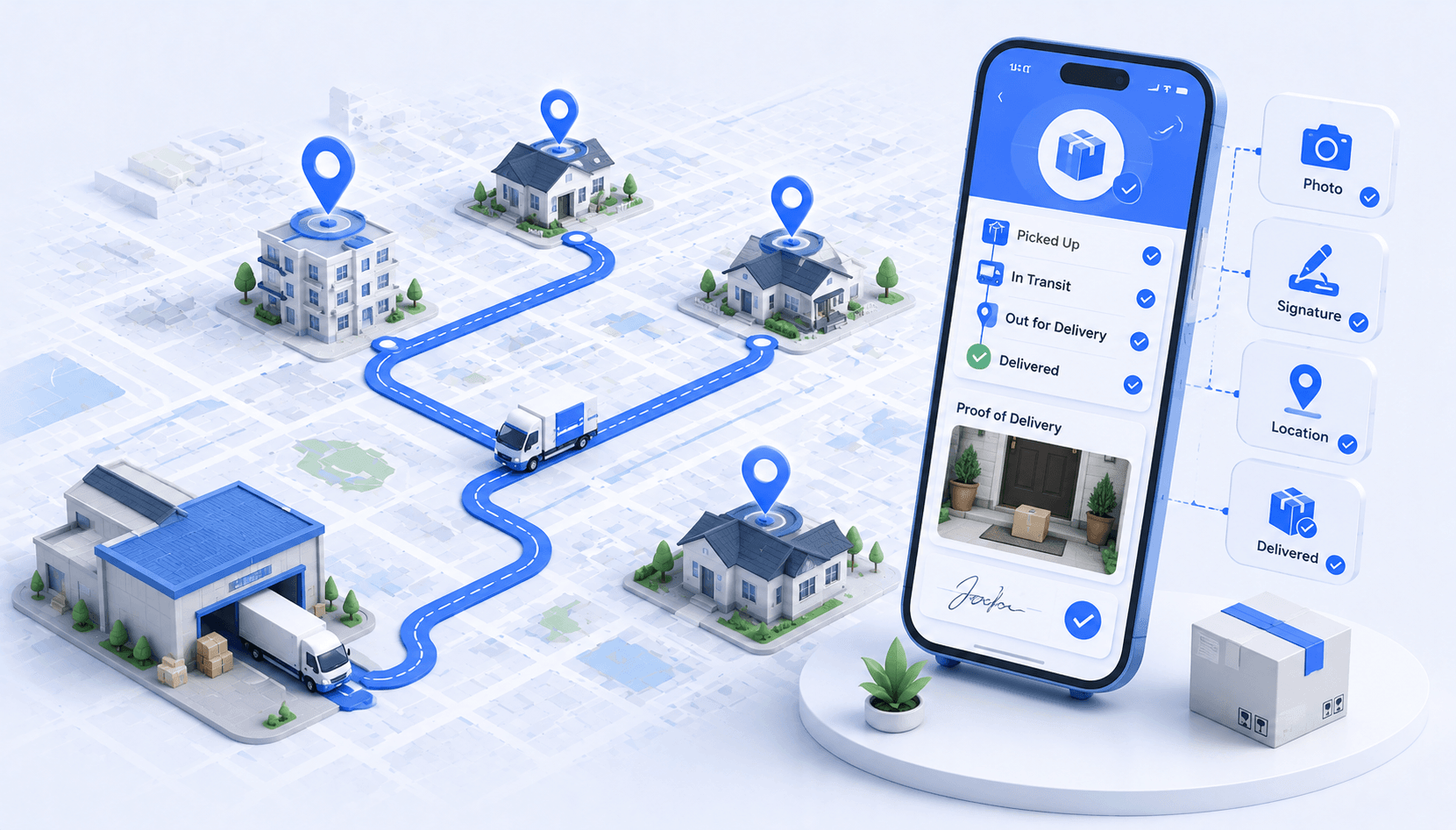
Delivering prescriptions isn’t just about speed and efficiency. It’s about protecting sensitive patient information at every step. As per Future Market Insights, the global prescription delivery service market was valued at USD 174.8 million and is expected to reach USD 304.3 million by 2035. This growth highlights how rapidly pharmacy delivery operations are expanding and becoming more complex.
With this growth comes greater responsibility. Proof of delivery in pharmacy logistics must go beyond simple confirmation and meet strict privacy requirements under HIPAA. Traditional methods like paper signatures, unsecured photos, or manual logs not only slow down operations but also increase the risk of exposing protected health information.
That’s where HIPAA-compliant proof of delivery becomes essential. By adopting secure, digital workflows, pharmacies can capture accurate delivery confirmations while safeguarding patient data.
In this blog, we’ll break down what HIPAA-compliant proof of delivery means for pharmacy deliveries, the key requirements you need to follow, and how the right system can help you stay compliant while scaling your delivery operations.
Table of Contents
- What HIPAA Requires for Pharmacy Delivery Documentation
- Why HIPAA-Compliant Proof of Delivery Matters for Pharmacies
- How to Build a HIPAA-Compliant Proof of Delivery Workflow for Pharmacy
- Common HIPAA Compliance Challenges in Pharmacy Delivery
- HIPAA-Compliant Pharmacy Delivery Best Practices
- Pharmacy Delivery Tools That Support HIPAA Compliance
- Protect Patient Data and Streamline Pharmacy Deliveries With Upper
- Frequently Asked Questions
What HIPAA Requires for Pharmacy Delivery Documentation
HIPAA does not prohibit pharmacies from documenting deliveries. It governs how that documentation handles protected health information. The overlap between the Privacy Rule, the Security Rule, and the pharmacy delivery process creates specific obligations that most standard delivery workflows fail to meet. Understanding where these rules apply to delivery documentation is the foundation of a compliant operation.
Protected Health Information in Pharmacy Deliveries
PHI in a delivery context extends beyond medical records. It includes any information that links a patient’s identity to their healthcare, and pharmacy deliveries generate this data at nearly every step.
A delivery record that connects a patient’s name to their address and medication constitutes PHI under HIPAA. Even partial identifiers create risk. A delivery photo showing a prescription label at a doorstep exposes the patient’s name, medication, and dosage to anyone with access to that image. GPS coordinates tied to patient addresses in delivery logs also fall under PHI protection when linked to delivery records.
Driver notes that reference medication types, special handling instructions for controlled substances, or health-related delivery accommodations all qualify as PHI. The practical implication is clear: nearly every proof of delivery element in a pharmacy delivery can contain or expose protected information.
The HIPAA Privacy Rule and Delivery Documentation
The Privacy Rule limits who can access PHI and under what circumstances. For pharmacy deliveries, this means every person and system that touches delivery records must operate within “minimum necessary” information standards.
Drivers should see only the data they need to complete a delivery. Dispatchers and managers should access records through role-based controls. Patient authorization or acknowledgment may be required for certain documentation methods, particularly when delivery records include medication details visible to third parties.
Documentation must also follow HIPAA record retention requirements. Delivery records containing PHI cannot be discarded casually. They require defined retention periods and secure disposal methods that meet HIPAA destruction standards.
The HIPAA Security Rule and Digital Proof of Delivery
The Security Rule requires administrative, physical, and technical safeguards for electronic PHI (ePHI). Digital signatures, delivery photos, and GPS logs stored electronically are all subject to these protections.
Encryption is mandatory for data in transit and at rest. When a driver captures a signature or photo through a delivery app, that data must be encrypted as it transmits to the cloud and remain encrypted in storage. Access controls must ensure that only authorized personnel can view delivery records containing PHI.
Every access to ePHI must be logged. Audit trails documenting who viewed delivery records, when they accessed them, and what actions they took are not optional. They are a core requirement of Security Rule compliance.
Business Associate Agreements for Delivery Technology
Any third-party software or service handling PHI on behalf of a pharmacy is a “business associate” under HIPAA. This includes delivery management platforms, cloud storage providers, and notification services.
A Business Associate Agreement (BAA) defines the vendor’s obligations for PHI protection, breach notification, and data handling. Pharmacies are liable if they use non-compliant vendors without proper BAAs in place.
The compliance chain is only as strong as its weakest vendor. Every tool in your pharmacy delivery stack that touches patient data requires a signed BAA before it accesses any delivery records.
Understanding these requirements is the first step toward building a compliant delivery operation. The next is recognizing why a purpose-built proof of delivery workflow protects both the pharmacy and its patients.

See it in action
Deliver Prescriptions With HIPAA-Compliant Proof
Use Upper to securely capture proof of delivery while protecting sensitive patient information at every step.
Why HIPAA-Compliant Proof of Delivery Matters for Pharmacies
Compliance is not a regulatory checkbox. For pharmacies expanding home delivery, a HIPAA-compliant proof of delivery system is a competitive advantage that reduces financial risk, builds patient trust, and creates operational efficiency at the same time.
Reduce HIPAA Violation Risk and Financial Penalties
HIPAA violations carry penalties ranging from $100 to $50,000 per incident, with annual maximums of $1.5 million per violation category. Delivery-related breaches, including lost devices, unsecured photos, and unencrypted records, are increasingly common enforcement targets.
A documented, compliant proof of delivery workflow demonstrates “reasonable safeguards” during Office for Civil Rights (OCR) audits. Organizations with documented, compliant delivery workflows resolve OCR audit inquiries 60% faster than those relying on manual records. Proactive compliance is significantly cheaper than reactive breach response, where the average cost of a healthcare data breach reached $10.93 million in 2023.
Build Patient Trust in Pharmacy Delivery Services
Patients trust pharmacies with sensitive health information, and delivery must maintain that trust. Research from the National Association of Boards of Pharmacy shows 89% of patients say they are concerned about the privacy of their health information during delivery.
Compliant delivery confirmation through secure signature capture, protected notifications, and controlled documentation signals professionalism. Patient confidence in delivery privacy directly impacts adoption rates for home delivery programs. Pharmacies that integrate automated customer notifications with privacy safeguards build the transparency patients expect without exposing PHI.
Create Audit-Ready Documentation for Every Delivery
HIPAA requires pharmacies to demonstrate compliance through documentation, not just policy statements. A compliant proof of delivery system creates a timestamped, access-controlled record for every delivery.
Audit trails showing who accessed delivery records, when, and why satisfy OCR investigation requirements. Digital records are faster to produce during audits than paper-based systems. Pharmacies using electronic proof of delivery report a 90%+ reduction in delivery dispute resolution time compared to paper-based methods.
Streamline Operations Without Sacrificing Compliance
Manual compliance workarounds slow delivery operations. Paper logs, verbal confirmations, and separate secure systems add friction that reduces daily stop counts and increases delivery times.
A digital proof of delivery system built around compliance requirements handles both documentation and PHI protection in one workflow. Drivers capture proof of delivery through a single app without managing separate compliance steps. Dispatchers access delivery records through role-based dashboards that enforce access controls automatically.
The benefits are clear, but the real value comes from knowing exactly how to build this workflow step by step.
How to Build a HIPAA-Compliant Proof of Delivery Workflow for Pharmacy
HIPAA-compliant proof of delivery is not about adding complexity to your delivery process. It is about designing the process correctly from the start so compliance is built in, not bolted on. This five-step framework walks pharmacy operators through building a delivery verification system that meets HIPAA requirements at every touchpoint.
Step 1: Map PHI Touchpoints in Your Delivery Process
Before configuring any tools, you need a clear picture of where PHI is created, accessed, and stored during delivery operations.
Identify Where PHI Is Created During Delivery
PHI enters the delivery process at multiple stages. During order intake, patient names, addresses, and prescription details are entered into the delivery system. Route assignment sends patient addresses and potentially medication information to drivers.
In transit, driver devices store delivery addresses, stop sequences, and customer details. At delivery completion, signature capture, photos, and delivery notes may contain or expose PHI.
Classify Each Touchpoint by Risk Level
Not all PHI touchpoints carry the same risk. High-risk touchpoints include delivery photos showing prescription labels and digital records linking patients to medications. Medium-risk touchpoints include GPS logs and route data tied to patient addresses, along with driver app data stored on personal devices.
Low-risk touchpoints include aggregated delivery metrics without patient identifiers. Use this risk map to prioritize safeguards in subsequent steps. High-risk touchpoints need immediate encryption and access controls. Medium-risk touchpoints require monitoring and policy-based protections.
Step 2: Configure Proof of Delivery for Minimum Necessary Information
The “minimum necessary” standard is a core HIPAA principle. Your delivery documentation should capture only the information required for operational and compliance purposes.
Define What Drivers Need to See (and What They Don’t)
Drivers need delivery addresses and special instructions such as “leave at back door” or “refrigerated package.” They do not need patient names displayed on screen, medication details, or prescription numbers. Configure delivery apps to show only the minimum information required for successful delivery.
Set Photo and Signature Capture Rules
Delivery photos should confirm package placement without capturing prescription labels or patient-identifiable details. Train drivers to photograph the package at the door, not the label. Digital signatures should capture confirmation of receipt without requiring patients to provide additional health information beyond acknowledgment.
Step 3: Secure the Digital Chain of Custody
Every piece of delivery data that qualifies as ePHI requires technical safeguards from creation to storage. Fleet GPS tracking creates a verifiable chain of custody, but only when that data is properly secured.
Encrypt Data in Transit and at Rest
All delivery data transmitted between the driver app and centralized dashboard must use TLS/SSL encryption. Stored delivery records, including photos, signatures, and GPS logs, must be encrypted at rest. Verify that the delivery platform’s cloud infrastructure meets HIPAA encryption standards before granting it access to any PHI.
Implement Access Controls and Audit Logging
Role-based access is non-negotiable. Drivers see only their assigned stops. Dispatchers see their team. Managers access aggregate data. Every access to delivery records containing PHI must be logged with user ID, timestamp, and action taken. Automatic session timeouts on driver devices prevent unauthorized access when phones are left unattended.
Step 4: Establish Vendor Compliance and BAA Coverage
Your delivery technology stack likely includes multiple tools that touch PHI. Each one creates a compliance obligation.
Evaluate Your Delivery Technology Stack
List every tool that touches delivery data: route planning software, driver apps, cloud storage, and notification services. Determine which tools handle PHI and require a Business Associate Agreement. Verify that each vendor’s security practices align with HIPAA Security Rule requirements.
Execute and Maintain Business Associate Agreements
Obtain signed BAAs from all vendors handling PHI before granting access to delivery data. BAAs must specify breach notification timelines, data handling obligations, and termination procedures. Review BAAs annually or whenever vendor services change to ensure ongoing compliance.
Step 5: Train Drivers and Staff on Compliant Delivery Procedures
Technology alone does not create compliance. Every person involved in the delivery workflow needs training specific to PHI protection.
Driver Training on PHI Protection
Drivers must understand what constitutes PHI in the delivery context and why it matters. Training should cover how to capture delivery photos without exposing prescription labels or patient details. Device security is critical: locking phones, never sharing login credentials, and reporting lost devices immediately.
Dispatcher and Manager Training
Dispatchers and managers need training on accessing delivery records within role-based permissions. Incident reporting procedures for potential PHI breaches during delivery must be clearly documented and practiced. Documentation requirements for compliance audits should be part of every manager’s standard operating procedures.
Even well-designed compliant workflows encounter friction points that pharmacies must anticipate. The next section covers the most common challenges and how to address them.
See it in action
Protect Patient Data During Every Delivery with Upper
Capture proof of delivery using Upper’s secure workflows designed to keep protected health information safe and compliant.
Common HIPAA Compliance Challenges in Pharmacy Delivery
Pharmacy delivery compliance is an ongoing process, not a one-time setup. The most well-intentioned workflows develop gaps over time as delivery volume scales, driver teams change, and new technology enters the stack. Anticipating these challenges prevents costly compliance failures.
Driver Devices as PHI Exposure Points
Drivers using personal smartphones for delivery apps create uncontrolled PHI access points. A lost or stolen device with an active session exposes patient addresses, delivery histories, and potentially prescription details.
The solution is requiring device-level encryption, remote wipe capability, and automatic session timeouts. Delivery apps should store minimal PHI locally and sync to secure cloud storage rather than caching data on the device.
Delivery Photos That Inadvertently Capture PHI
A delivery photo showing a prescription label, patient name on a package, or medication details visible through packaging becomes a PHI record under HIPAA. This is one of the most common unintentional violations in pharmacy delivery.
Train drivers to photograph the package at the delivery location, not the label. Use photo capture prompts within the delivery app that guide framing away from identifiable information.
Third-Party Vendors Without Proper BAA Coverage
Pharmacies often use multiple tools for routing, notifications, and delivery tracking without verifying HIPAA compliance or executing BAAs for each. Every uncovered vendor is a potential breach vector.
Audit your full technology stack annually. Platforms that consolidate delivery functions, including routing, proof of delivery, tracking, and notifications, reduce the number of vendors requiring BAA coverage.
Balancing Compliance Documentation With Delivery Speed
Adding compliance steps to the delivery workflow slows drivers down, increasing delivery times and reducing daily stop counts. This tension between compliance and efficiency is the most persistent challenge in pharmacy delivery.
Choose delivery management tools that embed compliance into existing workflows rather than adding separate steps. Compliant photo capture, secure signature collection, and encrypted data sync should happen within the normal stop-completion flow, not alongside it.
These challenges become manageable with the right operational habits and compliance-first tools. The following best practices keep pharmacies compliant as delivery operations grow.
HIPAA-Compliant Pharmacy Delivery Best Practices
Setting up a compliant workflow is one thing. Sustaining compliance as delivery volume scales, driver teams rotate, and technology evolves is another. These best practices separate pharmacies that pass a single audit from those that build delivery operations designed to stay compliant long term.
Conduct Regular PHI Risk Assessments for Delivery Operations
HIPAA requires periodic risk assessments, and delivery workflows should be included in every cycle. Review PHI touchpoints quarterly as delivery volume, technology, and driver teams change.
Only 34% of healthcare organizations conduct regular risk assessments that include their delivery and logistics operations. Document assessment findings and remediation actions for audit readiness.
Use Role-Based Access Controls Across All Delivery Systems
Drivers, dispatchers, managers, and compliance officers should each see only the data their role requires. Access controls reduce the attack surface for PHI breaches by limiting who can view sensitive delivery records.
Audit logs tied to role-based access simplify breach investigation by showing exactly who accessed what and when.
Implement Automated Retention and Disposal Policies
Define how long delivery records, including photos, signatures, and GPS logs, are retained based on state pharmacy board requirements and HIPAA minimums. Automate deletion of records past the retention window to minimize stored PHI.
Ensure disposal methods meet HIPAA’s destruction standards, meaning unrecoverable removal, not simple deletion.
Consolidate Delivery Technology to Reduce Compliance Surface Area
Every additional vendor handling PHI adds a BAA requirement and a potential breach vector. All-in-one delivery platforms that combine route optimization, proof of delivery, GPS tracking, barcode scanning for package verification, and customer notifications under one system reduce the number of compliance relationships to manage. Fewer tools means fewer integration points where PHI can leak between systems.
The right delivery technology makes following these best practices a natural part of daily operations rather than an added compliance burden.
See it in action
Stay Compliant With Every Prescription Delivered
Upper enables you to log accurate, time-stamped delivery proof while meeting HIPAA privacy and security requirements.
Pharmacy Delivery Tools That Support HIPAA Compliance
Pharmacy delivery documentation has evolved from paper logs and manual signatures to digital proof of delivery systems that capture, encrypt, and store delivery evidence automatically. That shift matters for compliance because digital systems can enforce safeguards that paper-based methods cannot: encryption, access controls, audit logging, and automated retention policies.
What to Look for in Compliant Delivery Management Software
The right delivery platform for pharmacy operations should include digital proof of delivery with secure signature capture, photo documentation, and timestamped delivery notes. End-to-end encryption for data in transit and at rest is non-negotiable. Role-based access controls with audit logging ensure that only authorized personnel view delivery records.
GPS tracking for chain-of-custody documentation with verifiable delivery coordinates provides the location evidence auditors need. Barcode scanning for package verification confirms the right prescription reaches the right patient without exposing medication details on screen. Route optimization that consolidates routing, dispatch, and proof of delivery into a single platform reduces the number of vendors requiring BAA coverage.
Standalone Pharmacy Delivery Software vs. All-in-One Delivery Platforms
Pharmacy-specific platforms offer deep regulatory features, including controlled substance tracking, state board integration, and pharmacy management system connectivity. However, they often lack the route optimization and fleet management tools pharmacies need as delivery volume grows.
General delivery management platforms provide strong operational tools: routing, dispatch, proof of delivery, and real-time tracking. Pharmacies can configure these platforms for compliance by pairing their operational capabilities with pharmacy-specific compliance policies and procedures.
The best approach for most pharmacies is an operational delivery platform with configurable proof of delivery, encryption, and access controls, paired with pharmacy-specific compliance policies. This combination gives pharmacies the documentation tools they need without sacrificing delivery efficiency.
Connecting the right tools to the compliance framework outlined in this guide creates a delivery operation that satisfies both operational goals and HIPAA audit requirements.
Protect Patient Data and Streamline Pharmacy Deliveries With Upper
HIPAA-compliant proof of delivery for pharmacy operations is not about choosing between compliance and efficiency. It is about building a delivery workflow where documentation, PHI protection, and operational speed work together from the start. The framework in this guide gives pharmacies a clear path from PHI mapping to vendor compliance to driver training.
Upper provides the delivery management foundation pharmacies need to build compliant workflows. Drivers capture digital signatures, photos, and delivery notes through the mobile app at every stop, creating a verifiable record that syncs securely to the centralized dashboard.
Upper’s proof of delivery pairs with barcode scanning for package verification, ensuring the right prescription reaches the right patient without exposing medication details on a screen. GPS tracking creates verifiable delivery coordinates for every stop. Automated customer notifications confirm delivery without transmitting PHI. Route optimization ensures drivers complete more stops per shift while the centralized dashboard gives dispatchers and managers controlled access to delivery records through role-based permissions.
See how Upper’s proof of delivery and delivery management tools fit into your pharmacy’s compliance workflow. Book a demo to walk through the platform with your team.
Frequently Asked Questions on HIPAA-Compliant Prescription POD
HIPAA requires that any delivery documentation containing protected health information is handled with appropriate administrative, physical, and technical safeguards. This includes encrypting digital delivery records, limiting access to authorized personnel, maintaining audit logs, and ensuring any third-party technology handling PHI operates under a Business Associate Agreement.
A digital signature can be HIPAA-compliant when the signature capture system encrypts data in transit and at rest, limits access through role-based controls, and maintains audit logs. The signature itself should confirm delivery receipt without requiring the patient to provide additional health information beyond acknowledgment.
Yes. A delivery photo that captures a prescription label, patient name, medication details, or any information linking a patient to their medication constitutes PHI under HIPAA. Pharmacies should train drivers to photograph package placement at the delivery location without including identifiable labels or health information in the frame.
Any workforce member who handles PHI, including delivery drivers, must receive HIPAA training. For pharmacy delivery drivers, training should cover what constitutes PHI in the delivery context, how to capture proof of delivery without exposing patient information, device security practices, and incident reporting procedures for potential breaches.
A Business Associate Agreement (BAA) is a contract between a pharmacy and any vendor that creates, receives, maintains, or transmits PHI on the pharmacy’s behalf. Delivery management software, cloud storage providers, and notification platforms that handle delivery records containing PHI require a signed BAA before the pharmacy grants access to patient data.
Pharmacies maintain chain of custody through a combination of barcode scanning at pickup, GPS tracking during transit, and proof of delivery capture at the destination. Each step creates a timestamped, verifiable record documenting who handled the package, where it was at each stage, and who received it. Digital proof of delivery with signatures and photos closes the chain at the final touchpoint.
A breach of delivery records containing PHI triggers HIPAA’s Breach Notification Rule. The pharmacy must notify affected patients within 60 days, report the breach to the HHS Office for Civil Rights, and if the breach affects 500 or more individuals, notify prominent media outlets. Penalties depend on the level of negligence, ranging from $100 to $50,000 per affected record, with annual maximums of $1.5 million per violation category.