

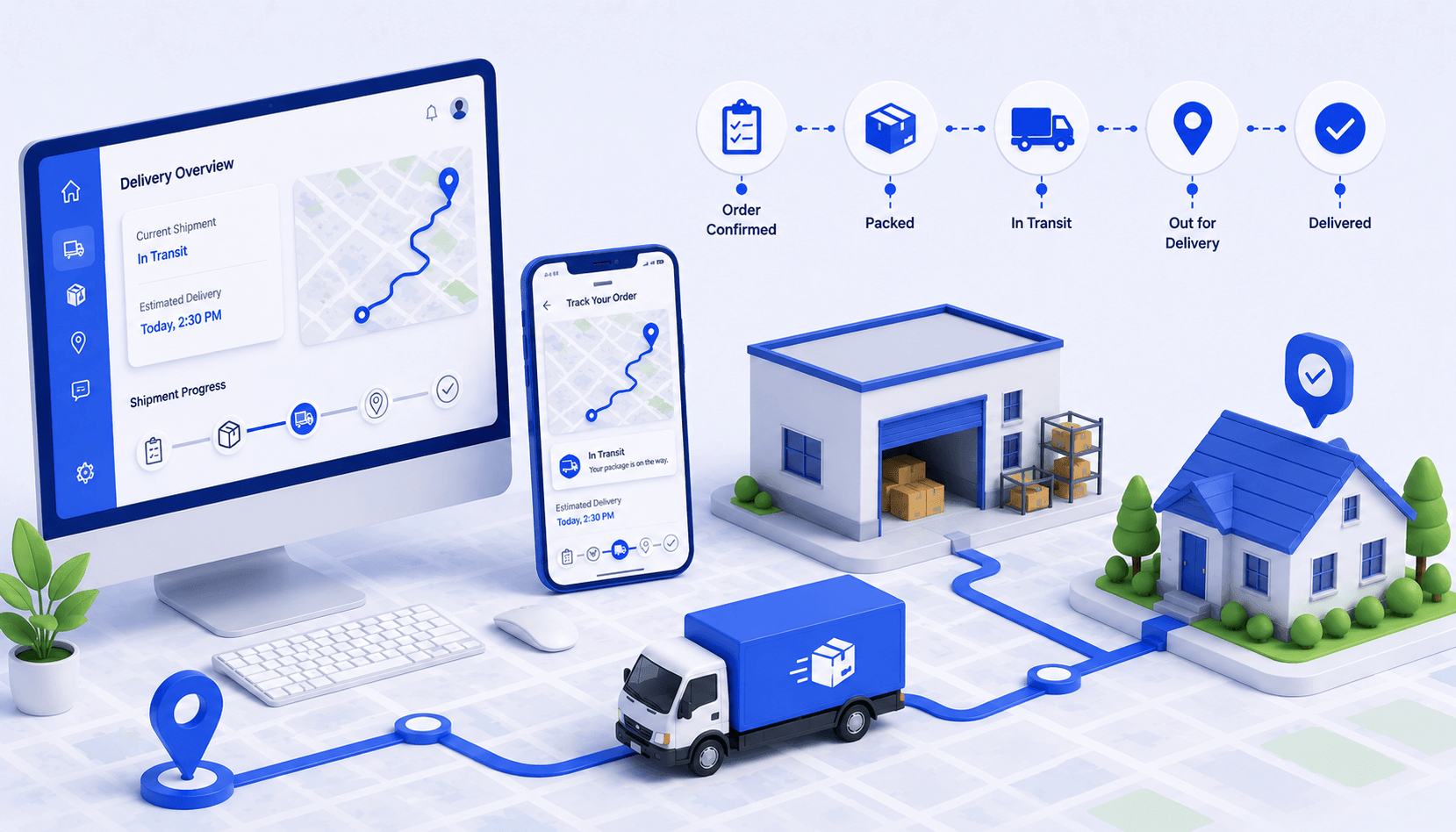
- Treat delivery management as a state-controlled order-to-close process, not a collection of loosely connected tools.
- Give every delivery one ID, one current version, one state, one owner, and one retained event history.
- Advance work only when the next gate passes; keep rejected, held, canceled, failed, and rescheduled states visible.
- Separate planned time, execution events, customer communications, and completion evidence so one timestamp does not stand in for the entire day.
- Define every metric with a numerator, denominator, scope, cutoff, exclusions, and source before setting a target or buying software.
Delivery management is not a dashboard, a route, or a string of driver messages. It is the operating system that moves each accepted physical delivery from a valid order to an evidence-backed closeout. It defines which state the work is in, what must be true before it advances, who owns the next handoff, and how an exception is resolved without losing the original commitment.
This guide is about deliveries of physical goods and field-service items. It is not about software-product delivery, agile project management, warehousing strategy, procurement, or the entire supply chain. Route planning, driver scheduling, dispatch, live tracking, customer communication, and proof of delivery are distinct decisions inside the delivery-management boundary, not interchangeable names for the whole process.
Reliable management also requires event evidence. GS1 describes EPCIS as a supply-chain visibility standard that helps represent the what, when, where, why, and how of products and other assets. Your operation does not need to implement EPCIS to use the principle: every important state change needs an identifiable object, timestamp, location or channel, business reason, actor, and source.
You will learn the delivery record, eight operating states, handoff gates, exception loop, completion packet, metric definitions, and seven-step implementation sequence needed to make the process auditable. The framework does not promise a universal performance result or replace legal, safety, employment, cargo, privacy, or records-retention decisions owned by qualified people.
I have spent years at Upper watching orders fail in the gap between two systems that each assumed the other owned the handoff. This guide closes those gaps.
What Is Delivery Management?
Delivery management is the controlled process of accepting, validating, planning, assigning, releasing, executing, confirming, and closing physical deliveries while preserving ownership, state, customer commitments, exceptions, and evidence.
It begins when an order or service request becomes eligible for delivery work. It ends when the authorized owner accepts the completion or failure record, resolves required follow-up, and closes the delivery version. The management layer links decisions without pretending they are the same decision.
| Neighboring discipline | Owns | Delivery-management interface | Does not decide |
| Order management | Commercial order and fulfillment status | Accepted delivery object and customer commitment | Route sequence or execution response |
| Warehouse or origin | Pick, pack, stage, and release readiness | Ready time, load, count, and handoff evidence | Driver eligibility or delivery completion |
| Route planning | Stop grouping, sequence, timing, and feasibility | Versioned route candidate and rejected work | Customer promise or employment policy |
| Driver scheduling | Available and eligible driver-resource assignments | Accepted assignment and operating boundary | Stop order or proof sufficiency |
| Dispatch | Release, communication, and day-of change control | Current execution version and exception owner | Commercial order cancellation policy |
| Proof and closeout | Completion evidence and disposition | Final state, evidence packet, and follow-up | Legal sufficiency without qualified review |
What Is a Delivery Management System?
A delivery management system is the people, policies, data, tools, and controls used to operate that lifecycle. Software may hold parts of the record or automate approved steps, but the system also includes source ownership, exception authority, release rules, training, access, retention, and manual fallbacks.
What Is Outside This Guide’s Definition?
This guide does not use delivery management to mean managing software releases or an agile delivery-manager role. It also does not expand delivery management to every upstream sourcing, manufacturing, inventory, and transportation decision. Those functions can supply inputs or receive events while retaining their own owners.
The first control is one delivery object that can survive every handoff.
What Record Does Delivery Management Control?
Delivery management controls a versioned delivery record that links the order, stop, recipient, service commitment, route, driver, vehicle, instructions, state, events, communications, evidence, exceptions, and closeout decision.
Do not let each team recreate the order in a private spreadsheet or chat. Establish a canonical delivery ID and a field owner for every input. A copied value can be displayed elsewhere, but the record must say which system or person owns the current truth and when that truth became effective.
| Record group | Minimum fields | Owner question |
| Identity | Delivery ID, order or job reference, service date, version | Can every system refer to the same object? |
| Recipient and stop | Validated location, contact channel, access, service instructions | Who may correct each field and until when? |
| Commitment | Required or preferred window, priority, promised service, approved fallback | Which term is externally committed? |
| Work | Items, quantity, service duration, load units, handling, proof requirement | Are units and required evidence explicit? |
| Resources | Route, driver, vehicle, equipment, crew, eligibility state | Does the complete assigned set pass? |
| Execution | Released version, planned times, actual events, route progress, changes | Which version did the driver receive? |
| Communication | Audience, trigger, channel, content version, send and delivery state | What was actually communicated? |
| Closeout | Completion or failure state, proof, exception, disposition, approver | Can an owner reconstruct and accept the result? |
GS1’s event model provides a useful visibility principle. Its EPCIS overview links interoperable events with status, location, movement, and chain of custody, while the companion Core Business Vocabulary supplies shared meanings for data values. See the GS1 EPCIS and CBV overview. Your event vocabulary should likewise define what each state and reason means before different teams exchange it.
What Makes a Delivery Event Usable?
Record the delivery ID, prior state, new state, event time, effective time if different, location or channel, actor, source, reason, affected fields, and new version. Preserve correction events instead of overwriting history. An event saying only delivered or delayed is usually too weak to support closeout or model improvement.
With the object and event contract set, the lifecycle can be expressed as explicit states.
How Does Delivery Management Work From Intake to Closeout?
Delivery management moves work through eight controlled states: accepted, validated, planned, assigned, released, in execution, completed or failed, and closed.
The exact labels may differ, but every state needs an entry condition, owner, permitted actions, failure state, and exit evidence. Do not let a dashboard color be the only definition.
| State | Required action | Exit evidence | If the gate fails |
| 1. Accepted | Create delivery ID and capture source commitment | Accepted scope and cutoff | Reject, clarify, or hold |
| 2. Validated | Verify recipient, location, work, time, load, access, and evidence needs | Valid input record | Return to field owner |
| 3. Planned | Group, sequence, time, and test route feasibility | Candidate plus rejected-work log | Correct, reschedule, split if allowed, or hold |
| 4. Assigned | Match eligible driver, vehicle, equipment, and crew | Accepted resource pair | Reassign or expose capacity gap |
| 5. Released | Approve one version and issue instructions | Release ID, timestamp, audience, and acknowledgment path | Keep in hold or resolve access |
| 6. In execution | Capture progress, changes, communications, and exceptions | Current event stream and owner | Use approved exception path |
| 7. Completed or failed | Collect result, proof, failure reason, and follow-up | Completion packet or failed-attempt packet | Investigate, retry, reschedule, return, or escalate |
| 8. Closed | Approve disposition and retain required evidence | Closeout decision and next-action state | Remain open with named owner |
Can a Delivery Move Backward?
Yes, when the state model permits it. A released route may return to planned after an approved cancellation, resource failure, or location correction. Record the transition, reason, decision owner, affected scope, and superseding version. Do not edit the released record in place.
What Happens to Rejected or Unassigned Work?
Keep it visible in a hold, rejected, rescheduled, canceled, or failed state with a reason and owner. Work does not disappear merely because it cannot fit the current route. The customer or commercial process may need a separate decision about the commitment.
State changes are reliable only when every handoff has a clear sender and receiver.
Who Owns Each Delivery Handoff?
Each delivery handoff needs one accountable sender, one accepting receiver, a shared record, an acceptance condition, a rejection path, and a time boundary.
Titles vary across operations, so define roles by decision rather than job name. One person may hold several roles, but the record should still show which authority was used.
| Handoff | Sender must provide | Receiver must confirm | Escalation owner |
| Order to delivery | Valid object, service commitment, cutoff, change policy | Deliverable scope is accepted | Commercial or order owner |
| Origin to planner | Ready state, count, load, handling, release time | Planning inputs are usable | Origin owner |
| Planner to scheduler | Feasible route blocks and resource requirements | Candidate resources can be tested | Planning owner |
| Scheduler to dispatcher | Eligible assignments and operating bounds | One release candidate is complete | Scheduling owner |
| Dispatcher to driver | Current version, sequence, instructions, proof and exception rules | Access and acknowledgment follow policy | Dispatch owner |
| Driver to closeout | Execution events, result, proof, notes, failure and return state | Packet is accepted or returned | Closeout owner |
| Closeout to upstream | Final disposition, exception, retry, return, billing or support trigger | Next owner accepts follow-up | Delivery-management owner |
What Is a Handoff Acceptance Rule?
It is a short, testable condition that the receiver can apply before accepting responsibility. For example, a dispatcher may require a released route ID, eligible driver and vehicle, approved operating boundary, complete instructions, proof requirement, and named exception owner. Missing fields create a hold instead of an implied acceptance.
The most consequential pre-execution handoff is the release of a feasible route.
What Must Pass Before a Delivery Route Is Released?
Before release, every required delivery must have a visible state, every assignment must be eligible, the timed route must pass its constraints, one version must be approved, and the driver must have the instructions and exception path needed to execute it.
A route plan is only one component of delivery management, but a bad release contaminates every later event. Audit the complete work scope, not just the stops that fit.
| Release gate | Pass condition | Evidence |
| Scope | Every accepted delivery is planned, held, rescheduled, canceled, or rejected | Coverage and work-state manifest |
| Inputs | Locations, windows, work, durations, load, access, and proof needs are current | Input version and validation record |
| Resources | Driver, vehicle, equipment, and crew pass required rules | Eligibility record and effective date |
| Feasibility | Route boundary, load transitions, service, wait, breaks, windows, and return pass | Timed route audit |
| Version | One route ID, timestamp, and approver are current | Released manifest |
| Instructions | Sequence, work, access, proof, communication, and failure rules are visible | Driver handoff record |
| Change control | Add, cancel, reassign, replan, and hold authority are named | Exception policy and contact path |
Keep customer and route timing distinct. Google’s time-window documentation separates pickup or delivery windows from vehicle start and end windows and the global model window. It also notes that a visit can begin inside its shipment window and extend beyond it only while staying within the vehicle and global operating windows. That is a useful data distinction regardless of your planning method.

See it in action
Need the detailed route-planning workflow?
Use the companion guide to collect inputs, build a timed candidate, audit feasibility, release one version, and capture execution evidence.

After release, delivery management shifts from candidate design to event-driven execution control.
How Should You Manage Live Delivery Execution and Exceptions?
Manage live execution with expected events, current route state, threshold-based exception detection, one decision owner, the smallest affected scope, a new version when instructions change, and retained communication evidence.
Tracking is not a map-watching activity. It is a comparison between expected and observed events that helps an authorized owner decide whether to monitor, contact, correct data, change instructions, reassign, reschedule, hold, return, or escalate.
| Execution signal | First check | Permitted response | Evidence to retain |
| Departure not observed | Readiness, driver access, assignment, vehicle, and event feed | Confirm, correct, hold, or release a new version | Expected and actual state plus reason |
| Travel variance | Traffic event, route change, bad location, or travel basis | Monitor, communicate, or replan affected work | Plan, actual, source, and decision |
| Service overrun | Work scope, access, wait, service input, or new request | Update expectation or adjust later stops under policy | Component reason and affected stops |
| Customer unavailable | Contact rule, access instruction, required wait, and proof policy | Retry, reschedule, return, or fail under policy | Attempts, timestamps, and disposition |
| Resource failure | Driver, vehicle, equipment, load, and safety state | Stop, substitute eligible resource, transfer if allowed, or reschedule | Failure, qualification, transfer, and new version |
| Added or canceled work | Authority, cutoff, capacity, timing, and recipient impact | Accept, hold, replan, or reject | Request, approver, before and after |
What Is the Smallest Affected Scope?
It is the minimum set of deliveries, assignments, route segments, communications, and evidence requirements changed by the event. Freeze unaffected work when policy allows. Recheck the affected set, release a new identifiable version, and communicate only what changed to the correct audience.
What Should a Customer Update Contain?
State the delivery ID or safe reference, current status, applicable time expectation, required recipient action, approved contact path, and update time. Record the audience, channel, content version, send state, and any delivery or failure state available from that channel. Do not label sent as received unless the evidence supports it.
See it in action
Review route progress without losing the release version
Evaluate GPS tracking for driver location, route progress, customer tracking links, and the operational context needed to own exceptions.
Execution is not complete until the result and required evidence pass closeout.
What Completes a Delivery Record?
A delivery record is complete only when the result state, required proof, timestamps, location context, recipient or placement information, notes, exception and disposition, source, version, and closeout owner are present and accepted.
Delivered is a state, not a complete evidence packet. The required packet varies by work, contract, customer, cargo, jurisdiction, company policy, and privacy rule. Define the evidence requirement before route release and provide a failure path when evidence cannot be collected.
| Completion field | Delivery-complete example | Failed-attempt example | Review question |
| Result | Completed under approved method | Not completed with specific reason | Is the state vocabulary defined? |
| Time | Arrival, service, completion, and departure events | Attempt and decision times | Are source and time zone clear? |
| Location | Approved completion or placement context | Attempt location and access outcome | Is precision appropriate and permitted? |
| Recipient or placement | Authorized recipient, safe placement, or service result | Unavailable, refused, inaccessible, or invalid | Does policy define the accepted state? |
| Proof | Required photo, signature, note, barcode, or other evidence | Attempt evidence and collection failure | Was the requirement set before execution? |
| Disposition | Close, notify, invoice, hand off, or retain | Retry, reschedule, return, investigate, or cancel | Has the next owner accepted? |
| Audit | Actor, source, version, correction history, and approver | Same fields plus escalation | Can the record be reconstructed? |
Is a Signature Always Required?
No. Use the evidence required by the applicable agreement, cargo, service, customer instruction, company policy, and legal or regulatory rule. A photo, signature, scan, note, recipient name, location context, or other event may be required alone or in combination. Qualified owners must define sufficiency and retention.
How Should Corrections Be Handled?
Retain the original event, add the correction, identify the actor and reason, and show which downstream records or communications are affected. Do not silently replace evidence. Restrict access and retention according to the approved privacy and records policy.
See it in action
Collect the proof your closeout rule actually requires
Evaluate electronic proof of delivery for photo capture, e-signatures, GPS verification, notes, and dashboard review within your approved evidence policy.
Once every result state is visible, the scorecard can measure process reliability without hiding unresolved work.
Which Metrics Belong in a Delivery Management Scorecard?
Use metrics that map to lifecycle states and decisions, with a written numerator, denominator, scope, cutoff, exclusions, source, and owner for every measure.
Do not import universal targets from another operation. First prove that the metric is complete, consistently defined, and actionable. Show counts beside rates and segment recurring patterns by service type, route, time band, geography, resource requirement, and exception reason when those distinctions change a decision.
| Measure | Definition | Decision supported | Required context |
| Accepted-work state | Count in planned, held, rejected, rescheduled, canceled, failed, completed, or open state | Expose capacity, data, and policy gaps | All accepted work and cutoff |
| Release completeness | Released deliveries passing every release gate / deliveries marked released | Find false-ready work | Gate version and audit source |
| On-time state | Completed inside the approved comparison window / eligible completed deliveries | Review planning and execution patterns | Window type, exclusions, and source |
| First-attempt state | Completed on first approved attempt / accepted deliveries due for an attempt | Review access, contact, and input quality | Attempt definition, due-work scope, and reschedules |
| Exception rate | Deliveries entering a defined exception state / in-scope deliveries | Prioritize recurring causes | Reason vocabulary and severity |
| Manual change | Post-release stop, resource, time, instruction, or state changes | Find weak inputs and change paths | Before, after, actor, time, and reason |
| Completion evidence | Closed packets passing evidence review / in-scope packets due for review | Test proof and closeout quality | Requirement version, due-work scope, and reviewer |
| Lifecycle time | Accepted through closed, with stage durations separated | Locate queues and ownership delays | Event completeness and clock basis |
Keep route components separate. Google’s response guide distinguishes routes, visits, transitions, skipped shipments, validation errors, per-route metrics, and aggregate metrics. It separately documents travel, wait, delay, break, visit, total duration, distance, performed work, and vehicle-use fields. It also says the corresponding request is needed to interpret a response because results reference request entities. Preserve the input and release version with your scorecard for the same reason.
How Do You Set a Target?
Establish the metric contract, audit data completeness, measure a representative baseline, identify the decision owner, and choose a target tied to an approved service or operating requirement. Record the measurement period and review rule. A target without a valid denominator can reward missing work or selective reporting.
The implementation sequence should build these records and gates before introducing broad automation.
How Do You Implement Delivery Management in Seven Steps?
Implement delivery management by defining scope and ownership, creating the delivery record and states, cleaning inputs, installing handoff and release gates, formalizing exception paths, closing evidence, and piloting the complete loop before expansion.
Start with one representative workflow and one stress case. A complete small-scope pilot is more informative than a broad rollout that leaves states or owners undefined.
| Step | Action | Required output | Gate |
| 1 | Set the physical-delivery scope, commitments, policies, and owners | Scope and responsibility map | Adjacent functions and exclusions are explicit |
| 2 | Define the delivery object, version, states, events, and reasons | Data and state dictionary | Every state has entry, exit, owner, and failure path |
| 3 | Map and clean source inputs | Field ownership and correction queue | Unknowns are held, not guessed |
| 4 | Install order, origin, planning, assignment, release, and driver handoffs | Acceptance rules and audit trail | Sender and receiver agree on one record |
| 5 | Define execution signals, thresholds, communications, and exception authority | Exception playbook | Smallest-scope response and versioning are clear |
| 6 | Define completion evidence, failed-attempt packets, disposition, and retention | Closeout contract | Every result has an owner and next state |
| 7 | Run normal and stress pilots; compare current and candidate methods | Pilot scorecard and decision | Keep, revise, reject, or expand is recorded |
What Belongs in the Stress Pilot?
Use scenarios drawn from your operation: invalid address, late origin release, missing eligible resource, tight window, customer unavailable, vehicle failure, added or canceled work, missing proof, communication failure, and correction after closeout. Include only scenarios relevant to the scope and retain the expected and actual decision path.
When Is the Process Ready to Expand?
Expand when the pilot preserves accepted work, applies gates consistently, exposes failures, keeps one current version, routes exceptions to named owners, closes evidence, and produces metrics another reviewer can reproduce. Record unresolved manual work and capacity needs instead of treating pilot completion as full readiness.
Software is useful when it strengthens this operating model, not when feature names conceal missing policy or ownership.
When Should You Use Delivery Management Software?
Test delivery management software when your current method cannot represent the required record, states, handoffs, route constraints, execution events, exception changes, completion evidence, and closeout metrics reliably within the operating deadline.
Do not decide by a fixed number of drivers, vehicles, stops, or orders. Complexity comes from interacting commitments, resources, time windows, qualifications, evidence requirements, change frequency, communication channels, and audit needs.
| Evaluation area | Test question | Evidence to retain |
| Data contract | Can required IDs, fields, units, owners, effective dates, and unknown states be represented? | Accepted, rejected, transformed, and manual fields |
| Lifecycle | Can every required state and transition be identified without overwriting history? | State diagram, events, reasons, and versions |
| Planning and release | Can routes and assignments be audited before one version reaches execution? | Inputs, rejected work, gate result, and release record |
| Execution | Can expected and actual events support owned exception decisions? | Source, threshold, decision, affected scope, and new version |
| Communication | Can audience, trigger, content, channel, send state, and failure be reviewed? | Message event and fallback path |
| Completion | Can required proof, failed attempts, corrections, disposition, and retention be controlled? | Evidence packet, review, and access rule |
| Reporting | Can counts and rates be reproduced from defined states and sources? | Metric dictionary, query, exclusions, and owner |
| Product ceiling | Which policies, legal decisions, data corrections, and approvals remain outside the tool? | Named owner and manual fallback |
How Do You Compare Manual and Software-Based Methods?
Run both methods on the same accepted work, resources, rules, cutoffs, exception cases, and closeout requirements. Include correction effort, rejected work, release time, manual changes, communication failures, missing evidence, and review effort. Do not credit software for a result created by relaxed rules or omitted work.
What Must Remain Customer-Owned?
Your owners must define commercial commitments, legal and safety rules, worker and vehicle eligibility, cargo handling, evidence sufficiency, customer-contact policy, privacy, retention, exception authority, metric targets, and final release or closeout approval. Verify which fields and controls the configured product supports.
A representative test can now determine where Upper fits within that controlled boundary.
Conclusion: How Can Upper Support Delivery Management?
Upper can be evaluated for route progress, driver location, customer tracking links, and proof-capture workflows, while your organization remains responsible for the delivery record, policies, source data, commitments, eligibility, exception authority, evidence rules, retention, and final decisions.
Bring one normal delivery day and one stress day. Include the accepted-work manifest, source fields and owners, state model, route and assignment rules, release gate, customer communication policy, exception playbook, required completion packet, closeout process, and metric dictionary.
Test whether the configured workflow keeps held and failed work visible, preserves one released version, shows route progress in context, supports the approved exception path, captures the required proof, records corrections, and produces counts that reconcile to the accepted-work denominator.
Do not treat route progress, a sent message, a photo, a signature, a lower planned duration, or a closed software status as proof of legal compliance, recipient acceptance, customer satisfaction, cost savings, complete service, or correct retention. Those conclusions require their own evidence and owners.
Use the pilot to compare your current and candidate workflows against the same states, handoffs, failures, and closeout rules. Book an Upper demo to test delivery management against the order-to-close controls your operation actually uses.
What Are the Frequently Asked Questions About Delivery Management?
No. Logistics can include warehousing, inventory, transportation, facilities, and broader material flows. Delivery management in this guide controls the accepted physical delivery from validation and route preparation through execution, completion, exceptions, and closeout.
No. Route planning groups, sequences, times, and tests stop work. Delivery management supplies commitments and resources, controls release and execution handoffs, retains exceptions and communications, and closes each delivery result.
Assign one accountable owner for the lifecycle and separate owners for source fields, planning, scheduling, release, execution exceptions, customer communication, proof review, and closeout. One person may hold multiple roles, but the decision authority should remain explicit.
A useful baseline is accepted, validated, planned, assigned, released, in execution, completed or failed, and closed. Add states only when the distinction changes ownership, permitted action, customer commitment, or evidence.
No. Tracking can provide execution events, but the system still needs valid inputs, feasible planning, eligible assignment, release control, exception authority, communication rules, completion evidence, disposition, and closeout.
Collect the evidence required for the work under the applicable contract, customer instruction, cargo rule, company policy, and legal or regulatory requirement. Define the acceptable methods, failure path, access, correction, and retention rules before release.
Map measures to lifecycle states and decisions. Define the numerator, denominator, scope, cutoff, exclusions, source, and owner; show counts beside rates; and keep held, canceled, failed, and open work visible.
Test the product with your delivery object, states, handoffs, constraints, exception cases, communications, proof rules, and closeout metrics. Require rejected inputs and unsupported decisions to remain visible, and document the manual fallback and product ceiling.