

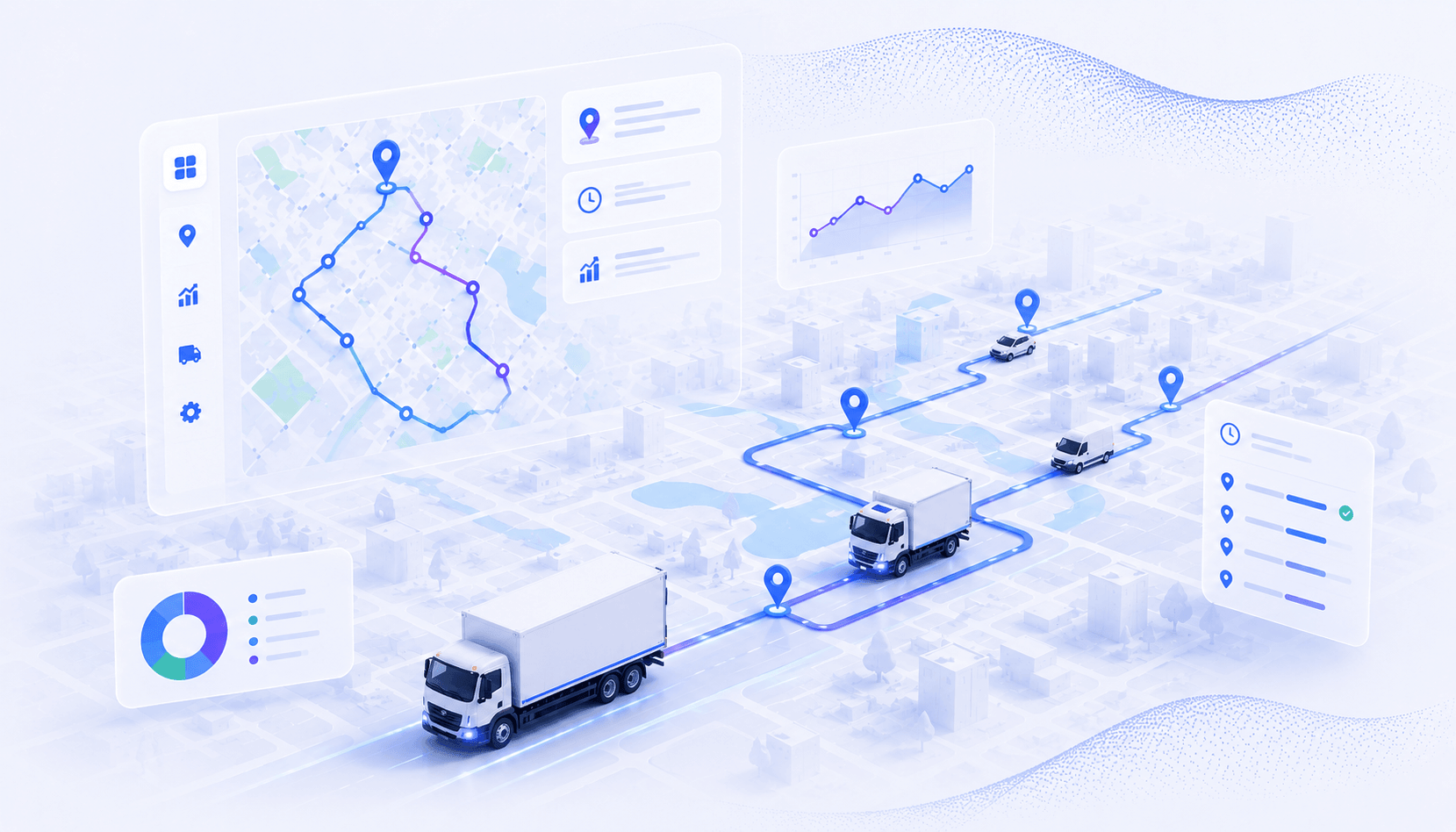
Route optimization can reduce wasted miles, planning time, overtime risk, missed stops, and the cost of serving each location. It can also help a team complete more work with the drivers and vehicles it already has. Those gains do not come from choosing the shortest route alone. Effective route optimization software assigns and sequences stops around capacity, time windows, service times, driver schedules, and other operating constraints. If you are still separating the terms, see route planning vs. route optimization.
In our conversations with delivery and field-service operators at Upper, the same problem comes up repeatedly: the routes are not the only work. Someone must clean the orders, assign them to drivers, respect real-world rules, respond to changes, and then determine whether the new plan actually improved the operation. That is why the most useful route optimization benefits are measurable business outcomes, not a claim that an algorithm found a shorter line on a map.
What is Route Optimization?
Route optimization is the process of assigning and sequencing stops to create a feasible plan under real operating constraints. Those constraints may include vehicle capacity, driver availability, service time at each stop, time windows, start and end locations, stop priorities, skills, and roads a vehicle should avoid.
A route with the fewest miles is not always the best route. A slightly longer route may be better if it prevents overtime, keeps a high-priority appointment, balances work across drivers, or avoids a sequence that cannot be completed. The goal is to improve the whole operating plan, not one distance number.
Top 10 Benefits of Route Optimization
The value of optimization usually appears in four places: cost, capacity, service reliability, and operational control. The ten benefits below explain the mechanism behind each outcome and the metric that can confirm whether it happened.
Cost benefits
1. Fewer route miles and lower fuel use
A better stop sequence can remove backtracking, duplicated travel, and unnecessary crossings between service areas. Assigning stops to the right driver or vehicle can reduce deadhead miles before the first stop and after the last one. When the work can be completed with fewer miles, fuel use should fall with it.
The result depends on the starting point. A dense, well-planned route may have less room to improve than a route built manually from a spreadsheet. Compare total route miles and fuel consumed against completed stops, not against the number of stops originally scheduled. That distinction prevents failed or skipped stops from making an inefficient day look better than it was.
2. Less vehicle wear and more predictable maintenance
Unnecessary mileage adds tire wear, service intervals, and depreciation without adding a completed job. Routes that reduce repeated cross-town travel, long idle periods, or avoidable congestion can lower the amount of vehicle use required for the same work.
Maintenance savings appear more slowly than fuel savings, so use a longer review window. Track mileage per completed stop, maintenance cost per mile, unplanned downtime, and replacement timing. Treat those trends as operating evidence, not as a guaranteed short-term reduction.
3. Lower planning effort and overtime risk
Manual routing often requires a dispatcher to filter orders, group stops, check constraints, and rebuild the plan when one input changes. Optimization software can evaluate assignments and sequences consistently, which reduces the repetitive work needed to produce a usable first plan.
A feasible plan can also make overtime easier to control because the expected workload is visible before dispatch. Measure planning hours separately from driver overtime hours. A route can save dispatcher time without changing driver hours, or reduce overtime even when total mileage changes very little.
Capacity and productivity benefits
4. More completed stops with existing drivers and vehicles
When routes contain less backtracking and idle travel, more of the workday is available for service. That may let a delivery or field-service team complete more stops without immediately adding another driver or vehicle. It can also create room for urgent work that arrives after the plan is built.
The meaningful measure is completed stops per paid hour, not stops assigned. Pair that number with on-time performance and failed-stop rate. Higher stop volume is not an improvement if the team misses promised windows or leaves work unfinished.
5. Better workload balance across drivers and vehicles
A map can make routes look balanced while one driver has long service times, a capacity-heavy load, or several strict appointments. Optimization can distribute work using more than stop count, helping planners see whether each route is realistic before it is sent to the field.
Review planned route duration, workload by driver, vehicle capacity used, overtime, and the difference between planned and actual completion time. Balanced work does not mean every route must have the same number of stops; it means each assignment is feasible for the resources and rules involved.
Service reliability benefits
6. More feasible arrival windows
Route optimization can place time-sensitive stops in a sequence that accounts for travel and service time. This gives dispatchers a stronger basis for setting expectations than a manually ordered address list. It also exposes conflicts early, such as two appointments that cannot both be reached within their promised windows.
Track the percentage of completed stops served within the promised window and the average difference between planned and actual arrival. Avoid treating an estimated arrival time as a guarantee. Traffic, parking, site access, customer readiness, and service duration can still change the day.
7. Fewer missed and failed stops
A feasible route reduces the risk that a driver reaches the end of a shift with several stops still open. Better sequencing can also place high-priority or time-constrained visits where they have a realistic chance of success. Accurate instructions and current stop information help the driver complete the work once they arrive.
Measure first-attempt completion, failed-stop reasons, rescheduled stops, and repeat travel. Routing cannot fix a wrong address, a closed site, or a customer who is unavailable, but the data can reveal which failures come from planning and which require a different operational fix.
Operational control benefits
8. Faster planning and day-of recovery
The largest time saving may happen before drivers leave. A routing system can turn a cleaned set of stops and constraints into a workable draft more quickly than manual sorting. If the operation supports re-optimization, planners can also evaluate a late order, absent driver, or delayed route without rebuilding every assignment from the beginning.
Measure time from order readiness to approved route, the number of manual edits before dispatch, and recovery time after a disruption. Fast planning only helps when the result is usable. If dispatchers must repair most routes by hand, the inputs or constraints need attention.
9. Lower fuel-related emissions
Completing the same work with fewer vehicle miles and less fuel can reduce fuel-related emissions. This is a direct operational benefit when the route change removes unnecessary travel, not simply when a route looks shorter on screen.
Use actual fuel consumption when available. Route miles can serve as a practical proxy, but they do not capture vehicle type, load, idling, driving behavior, or energy source. Organizations that report emissions should apply their approved calculation method rather than relying on a universal percentage.
10. Clearer operating data and better investment decisions
Optimization creates a plan that can be compared with what actually happened. The gap between planned and actual miles, time, stops, and failures helps a team find weak assumptions, inaccurate service times, training needs, or territories that should be redesigned.
That evidence also supports better investment decisions. Instead of asking whether route optimization ‘works,’ an operator can ask where it changed cost per completed stop, planning hours, overtime, stop capacity, and service reliability – and whether those changes justify the software and process cost.
How to Measure Route Optimization Benefits
Start with a baseline before changing the workflow. Use comparable days, territories, stop types, and staffing levels where possible. A two-week baseline is often more useful than one unusually good or bad day. Then compare the same metrics after the team has had enough time to use the new process consistently.
| Metric | Calculation | What it shows | Watch for |
|---|---|---|---|
| Miles per completed stop | Total route miles / completed stops | Travel required to finish one stop | Territory and stop-density changes |
| Planning hours | Time from ready orders to approved routes | Dispatcher effort | Time spent cleaning bad inputs |
| Overtime share | Overtime driver hours / total driver hours | Labor pressure beyond scheduled shifts | Seasonality and staffing changes |
| Stops per paid hour | Completed stops / paid driver hours | Field productivity | Do not use assigned stops |
| First-attempt completion | First-attempt completions / scheduled stops | Avoided repeat work | Address, access, or customer issues |
| On-time window rate | Stops inside promised window / completed stops | Service reliability | Window definition and clock source |
| Cost per completed stop | Driver + vehicle + fuel + routing + admin cost / completed stops | Combined operating result | Use the same cost categories before and after |
A real example: WinWaste
WinWaste plans 200-300 stops a day across five field crew. In Upper’s WinWaste customer story, the team reports that route planning moved from 45-60 minutes to under 10 minutes. Completed stops per crew per day moved from 40-50 to 55-65.
Those before-and-after figures show two separate benefits: less office time spent building routes and more field capacity after dispatch. They are more useful than a universal savings promise because another operation can compare the same baseline measures in its own environment.
When route optimization benefits may not materialize
- Optimization is only as useful as the operating model around it. Results may be limited when:
- Addresses, service times, time windows, capacities, or driver schedules are missing or inaccurate.
- The constraints make the route impossible, but the team treats the output as a promise instead of resolving the conflict.
- Drivers ignore the plan and the operation does not capture why they changed it.
- The software creates extra cleanup or manual repair work that offsets planning time saved.
- The baseline routes were already efficient, leaving little avoidable travel to remove.
- The team measures assigned stops or planned miles but does not verify completed work and actual travel.
A pilot should test both the route result and the workflow required to produce it. If the plan improves but the process becomes harder to run, the implementation still needs work.
How to Tell Whether Route Optimization Will Pay Off
Route optimization is a stronger fit when an operation manages many multi-stop routes, spends meaningful time building or repairing plans, has constraints that dispatchers must remember manually, or sees repeated mileage, overtime, missed stops, and workload imbalance. The opportunity is easier to validate when the team already has a baseline for completed stops, route miles, paid hours, planning time, and failures.
If you want to test the workflow, Upper Route Planner lets teams import stops, set practical route constraints, create and dispatch routes, track progress, and review outcomes in one place. Use a representative set of routes, keep the input rules visible, and compare the pilot with the baseline metrics above.
The right decision is not based on the longest feature list. It is based on whether the system produces usable routes, reduces planning work, fits the driver’s day, and improves a metric the business already cares about.
Frequently Asked Questions
Route optimization is important because multi-stop work involves competing constraints. The shortest-looking route may exceed capacity, miss an appointment, overload a driver, or create overtime. Route optimization helps turn these constraints into a feasible plan and provides a consistent way to evaluate cost, capacity, and service outcomes.
Operational benefits can include fewer miles, lower fuel consumption, reduced planning time, better workload balance, more completed stops per paid hour, lower overtime risk, fewer missed stops, and faster recovery when delivery plans change. The actual results depend on the starting point, data accuracy, and how closely drivers follow the optimized routes.
Technical benefits include evaluating many possible driver assignments and stop sequences consistently, applying rules for vehicle capacity and delivery time windows, and rapidly recalculating routes when inputs change if the software supports dynamic optimization.
The practical value comes from converting these calculations into routes that dispatchers and drivers can understand and execute.
Route optimization can reduce backtracking and unnecessary travel, arrange stops in a more efficient sequence, and distribute work across available drivers and vehicles. This gives drivers more time to complete deliveries and can improve overall route productivity.
Businesses can measure the impact using metrics such as miles per completed stop, stops per paid hour, first-attempt completion rate, and on-time delivery rate.
Measure route optimization ROI by comparing the verified financial benefits of the new workflow with its total cost. Include fuel, driver time, overtime, vehicle operating costs, dispatcher time, software, implementation, and training expenses.
Use completed stops and actual route data when comparing performance before and after implementation. Keep the same cost categories across both periods and avoid applying a generic savings percentage without validating it against your operation.
Conclusion
The main benefit of route optimization is a more feasible operating plan. That plan can reduce avoidable travel and planning effort, protect service commitments, create capacity, and give the business better evidence for future decisions. The outcome is credible only when the team measures what changed, accounts for real constraints, and checks the route against what happened in the field.